

Majority Russian-speaking city in Ukraine considers language ban in the arts
Ukraine's third-biggest city Odesa decides this week whether to ban Russian-language content in music and literature in public.
Majority Russian-speaking city in Ukraine weighs arts language ban
Ukraine’s third-largest city, Odesa, is set to decide this week whether to support a contentious proposal to ban the Russian language in the arts.
Councillors in Odesa, on the Black Sea coast, are considering a measure that would add to the existing restrictions on Russian language use imposed by national law.
The plan is especially notable because Odesa is overwhelmingly Russian-speaking, though the ban would apply only in public spaces and would not affect everyday use of Russian.
For millions of Ukrainians, Russian is their first language, including many of the soldiers defending the country in its war with Russia. But Ukrainian is the sole state language and is spoken by the majority, and some view Russian as a vehicle of Russian influence.
The Odesa proposal, in a city hit daily by Russian drone and missile attacks, calls for a total stop to Russian-language content in music and literature, on streets, in parks, in public institutions and in state-run arts and entertainment venues. It would also advise a ban in privately owned spaces.
In a city renowned for Russian-language writers and musicians, the idea has stirred intense emotions.
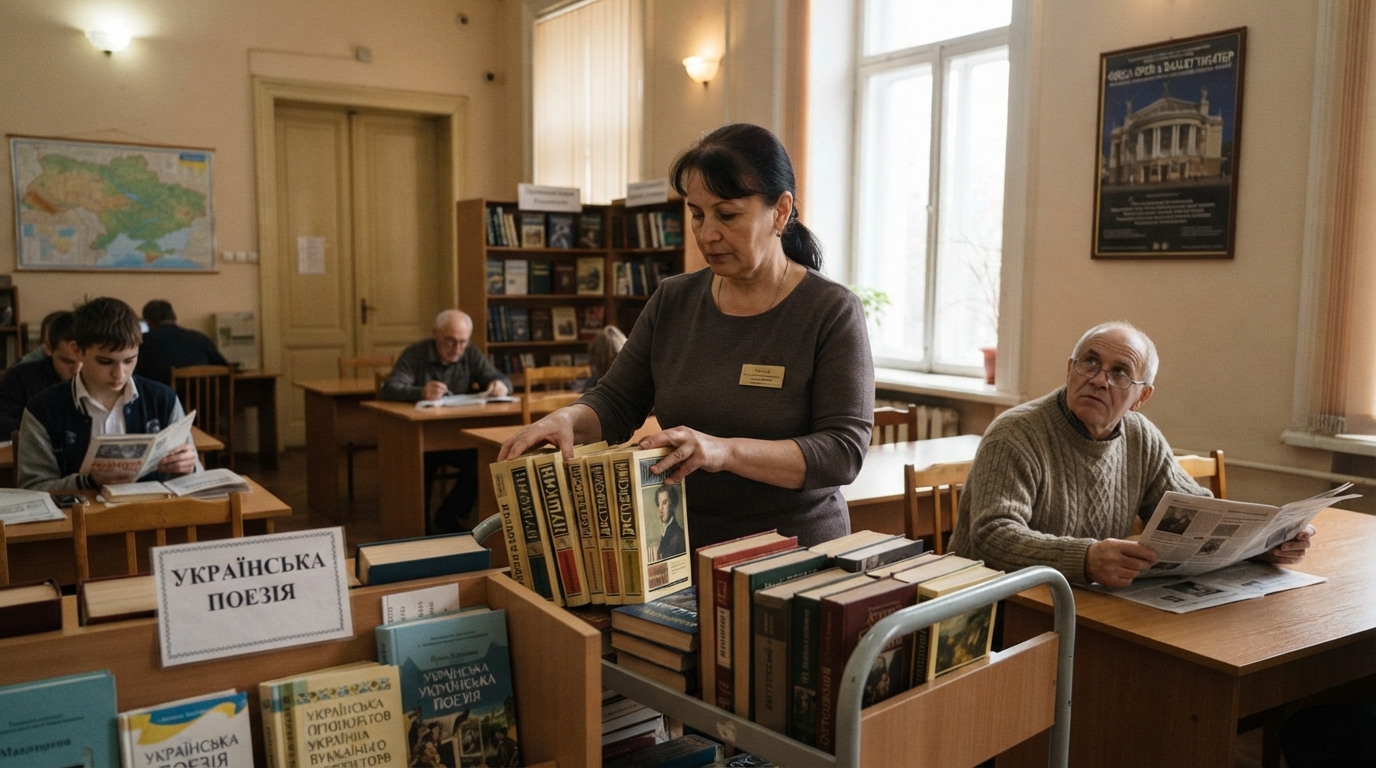
The ban would also cover public performances of old Odesa songs that are almost universally known across the former Soviet Union. All Russian-language books would be taken off display in public libraries. At present, they may be displayed, but not prominently.
"The Russian language is a weapon of Russia, and we need to try to fix that," says Odesa lawyer Artem Kartashov, who has advised local authorities on an official programme to "decolonise" the city of its historic Russian legacy.
"With Russian-speaking music and other things, Russians try to deconstruct Ukrainian identity and influence especially young people, because they grow up in a Russian-speaking environment."
But comic actor Borys Barsky, one of Odesa’s best-known performers, says: "Russian isn't [only] the language of Putin, it's the language of [writers like] Dostoyevsky and Bulgakov.
"Who benefits from setting people against other people who love Ukraine just as deeply, only love it in a different language? Only Putin benefits from this."
Russian President Vladimir Putin has repeatedly cited what he falsely claims is repression of the Russian-speaking minority in Ukraine as one of his reasons for launching the invasion.
Russian and Ukrainian are closely related, but differ in many ways. Many people in Ukraine speak a blend of the two, known as surzhyk.
Russian is the native language of President Volodymyr Zelensky, who often used it during his election campaign but has since spoken only Ukrainian in public.
However, a 2019 law requires Ukrainian to be used in many public and professional settings, including education, public services and customer service.
Workers who face the public — including waiters, shop assistants and doctors — must first address customers or patients in Ukrainian, though they may later switch to Russian if the client wants that.
Barsky’s Mask Theatre in Odesa has been fined for breaches of the law, including the use of Russian in promotional materials. A later inspection found more violations, such as a cafe sign using the Russian word for coffee.
"This isn't even like Orwell or Kafka, it's just madness," he says.
Barsky has been able to keep performing in Russian because it is a private theatre.
The new language proposal — similar to one already in place in the capital Kyiv and some other cities — would encourage, but not require, private venues including shops and cafes to adopt the ban.
Odesa’s state-appointed language ombudswoman, Anna Nerush, who inspects premises for alleged violations of the rules, believes that if it passes it will pressure them to comply.
"All businesses interact in one way or another with local government," she told the BBC. "They rent premises, they need advertising permits, and so on. So for many entities it's important to comply with a council decision, even if doesn't provide for sanctions for non-compliance.
Public performance of songs by Russian citizens is already banned across Ukraine, with exceptions for some artists who have publicly condemned the war, but Russian-language songs written or performed by Ukrainians are still permitted.
Under the proposal, those would also be prohibited in public places.
Anna Nerush said it would not stop someone celebrating a birthday in Russian in a private room in a restaurant, since it could not be heard outside.
"But on the streets, [hearing] the Russian language can be a real trigger, for example to [former] prisoners of war and people who've come from occupied territories," she said.
Many native Russian-speakers in Ukraine have shifted to Ukrainian in recent years, especially since Russia’s full-scale invasion in 2022.
Photographer Natalia Mykhailenko made the switch even earlier. She has led tours of Odesa that highlight non-Russian parts of its history.
These include landmarks such as a Cossack cemetery dating to before 1794. That is the year Russian empress Catherine the Great is said to have founded the city, though this has been widely questioned in recent years.
A statue of Catherine was removed from a central Odesa square after a council vote in 2022, and streets have been renamed to honour Ukrainian writers and activists.
"We must understand we were a colony," said Mykhailenko. "And these [language] laws are very important. I understand it's maybe sometimes not democratic. But without it, there will be no normal Ukraine in the future."
Anthropologist Anastasia Piliavsky, part of a group called Ukrainian Cosmopolis that seeks to defend freedom of thought and speech, argues that Russian-speakers are being pushed to feel like second-class citizens stripped of their heritage.
"In Ukraine, the vast majority of people understand both Russian and Ukrainian. So the question is not really one of language, it's one of liberty," she said.
"Ukraine has been fighting for freedom. The point of this war is not to be under authoritarian rule. That's what Russia has to offer. So when fines, or the threat of being fired [for breaking language laws] arrives, then people start wondering: what are we fighting for?"
It is not clear how much backing the new language proposal has. It is opposed by an influential bloc of councillors linked to former mayor Hennadiy Trukhanov.
Outside Odesa, a national poll found 80% support for Ukrainian dominating "all spheres of communication" in 2022. But a more recent survey of students in Kyiv found that 82% chose to speak Russian during breaks, even though Ukrainian is enforced in classrooms.
One well-known Odesan who became a focal point in the language dispute is Pavlo Viktor, a physics teacher whose online lessons have been watched by millions worldwide.
Ukrainian language activists criticised him for posting the videos in Russian, his first language, though he later translated them into Ukrainian. He was later criticised for saying he would speak to frightened children in Russian during missile attacks if that was the language they preferred.
Viktor wants to calm the debate, saying that at present about 10% of Odesa residents spoke Ukrainian in the street: "But if we wait 50 years, maybe 90% will speak Ukrainian."
"Ukrainianisation must be polite and soft… not to persuade children to move from Russian to Ukrainian, but to make an atmosphere when they want to do this. It's the best way. And I hope that gradually we'll move in that direction."