

"Let My Girls Be Kimmat." An exhibition by ceramic artist Rimma Gazalieva is taking place in Tashkent.
The Zanmakon cultural space is hosting an exhibition by ceramic artist Rimma Gazalieva, "Qimmat." The title refers to Qimmat, the wayward heroine of an old Uzbek fairy tale, traditionally considered a villain. The artist suggests viewing her differently—as a woman who knows her worth.
"Let My Girls Be Qimmat." An exhibition by ceramic artist Rimma Gazalieva has opened in Tashkent.
Zanmakon cultural space is hosting a solo exhibition by ceramic artist Rimma Gazalieva titled "Qimmat." She is the perfect heroine for this space dedicated to women, their experiences, creativity, and role in society.
"Rimma Gazalieva's work is a kind of essay on a new female archetype. She herself has undergone a process of rethinking her own life: for many years, she devoted herself to others, and at some point, she chose herself and began doing what she loved. And today, she creates images of heroines who love themselves, know their worth, and are not afraid to choose themselves. I think this is an inspiring example for many women," notes Zanmakon co-founder Elnora Ibragimova-Rizayeva.
Rimma Gazalieva has been working with ceramics and porcelain for several decades. She graduated from the P. Benkov Republican Art School and then from the ceramics department of the A. Ostrovsky Tashkent Theatre and Art Institute. After graduating, she interned at the Kuvasay Porcelain Factory in the Fergana Valley, where she remained and later became the lead artist. According to Gazalieva, it was the factory that gave her the opportunity to experiment extensively and develop her own approach to working with materials.
"I have many different approaches. Sometimes experts look at my work and are surprised that it's all done by one person. This comes with years and experience. A good eye is crucial: when I travel to another country, the first thing I do is go to a museum. Everything I see there gradually shapes my taste, influences what I like, and helps me find new ideas," the artist explains.
For almost her entire life, Gazalieva combined creative work with caring for her family and raising her children. She says this significantly impacted the amount of time she could devote to her artistic practice.
"I raised three children, and, of course, the entire burden of everyday life fell on me. I pursued creative work as a last resort, putting plans aside for later—I simply didn't have enough time for myself," Gazalieva shares.
After her children grew up, she was able to focus more on her own projects and work in her Tashkent studio.
Personal experience influenced the artist's reflection on the position of women. In her work, it's important for her to move away from the traditional image of women solely as mothers, wives, and homemakers and to show them as independent individuals—with their own desires, interests, and the right to choose their own path. Thus, Gazalieva's work developed a series of female portraits, featuring modern girls—different in character and mood, but equally free in expressing themselves.
"When people saw the subjects of my works, they often said, 'They seem so arrogant.' And I always wondered: why arrogant? To me, they are confident, self-sufficient, and thoughtful. One day, someone said, "So this is Kimmat!" And I thought, "Yes, let my girls be Kimmat," the artist recalls.
Kimmat is one of the main characters in the Uzbek folk tale "Zumrad and Kimmat." Unlike Zumrad, who is traditionally perceived as a modest, obedient, and docile sister, Kimmat turns out to be her complete opposite. The exhibition's title alludes to this image.
Gazalieva offers a different perspective on the wayward Kimmat: behind what is usually perceived as pride and arrogance, she sees independence and a woman's ability to determine her own personality, without striving to please everyone.
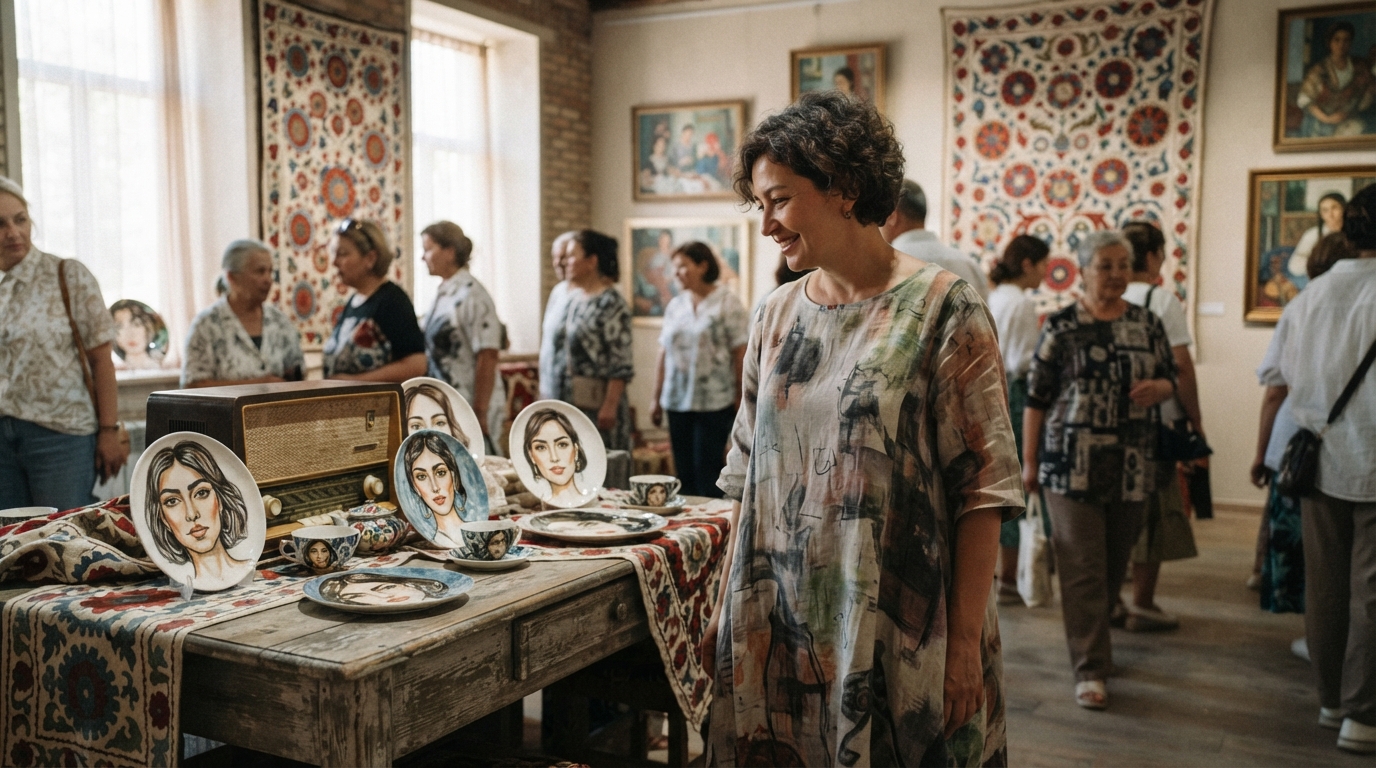
A characteristic feature of Gazalieva's female characters is the absence of a specific prototype. The artist invents her characters as she works. Each has her own features, hairstyle, facial expression, and gaze. She does not accessorize her images with jewelry or other details that might reveal their social status or wealth.
"I deliberately created a pure image—without earrings, necklaces, or other jewelry. I wanted the woman to be self-sufficient, without needing anything extra. The face, the gaze, the posture are important. This is how I see a modern young woman," explains Rimma Gazalieva.
Notably, the artist's works are not separated from the permanent exhibition but integrated into the museum's interior. Painted plates with women's faces hang next to suzani and paintings, while brightly colored teapots, cups, and saucers rest on old wooden furniture and a Soviet radiogram. This allows the porcelain to be perceived as both a work of art and a familiar household object.
The "Qimmat" exhibition will run until August 25th. It can be visited daily from 10:00 AM to 7:00 PM. Admission is free.