

Last call for the mall? How shopping centres are reinventing themselves
In the internet age, medium-sized retail hubs are looking for new ways to survive and thrive.
Last call for the mall? How shopping centres are reinventing themselves
Keith Ely recalls the Brunel Centre’s peak years, but he is focused on what comes next.
The Brunel Centre was once a busy retail draw, pulling in shoppers from near and far.
"It was incredible," says town councillor Keith Ely, who remembers its opening in Bletchley, Buckinghamshire, in 1973.
At that time, centre:MK, a major destination shopping centre four miles away in Milton Keynes, had not yet been built, and the Brunel was a major attraction.
Today, like many other medium-sized shopping centres, it is in difficulty.
Empty units and shutters covered in graffiti now dominate, and only one shop remains.
That last store, a Boots Opticians, is due to shut later this month before the centre is demolished next year.
But Ely, 87, is not saddened to see the Brunel replaced by flats and a health centre, with only some retail space retained.
"It is a sad old building, isn't it?" he says. "There is no nostalgia from me."
The Debenhams store in the Grafton Centre in Cambridge closed in 2021
The Grafton Centre in Cambridge tells a similar story, with boarded-up units, a large vacant former Debenhams department store and a cinema that has closed for good.
There are long-term plans to redevelop the site with retail as well as a life science centre.
That may suit Cambridge, a world leader in life sciences, but it is not a realistic option in much of the UK.
So, in the era of online shopping, what is the future for these medium-sized malls?
"There are too many in the UK and many don't have a future," says Subjit Jassy, a director at Pioneer Group, which owns the centre.
"The old model of retailers expanding to improve turnover has now disappeared because of the internet."
Before the Brunel Shopping Centre was built in the 1970s, people in Bletchley would travel to Aylesbury or Bedford to shop
The centre originally had very little natural light, before the roof was replaced with glass
In 2021 Milton Keynes City Council received £22.7m from the government's Town Deal Fund to redevelop the site
Boots Opticians, the centre’s last remaining store, is already shut on Wednesdays
, external found that the vacancy rate across UK shopping centres in the second quarter of this year was 16%, but it was "significantly lower" at major centres.
Meanwhile, research by estate agents Savills found that between April and June 2026 almost 73% of consumer spending in shopping centres took place in the biggest sites, with less than 18% in secondary, or medium-sized centres.
Dr Kardi Somerfield says centres with leisure businesses can "extend the day" and draw customers in during the evening
"It is not just that shopping centres have one destiny; they really don't," says Dr Kardi Somerfield, a lecturer in marketing at the University of Northampton.
Some destination shopping centres are operating at "almost 100% occupancy", she adds.
Back at the Brunel, Labour's Ed Hume, who is responsible for housing at Milton Keynes City Council, says: "We do need shops.
"The change here is about making sure we have a town centre that is much more open."
The aim is for more homes in the town centre to increase the number of people using local businesses.
Similar plans in Norwich would see the Anglia Square development largely replaced by housing.
Characters from TV show The Flintstones were at the opening of the Weston Favell Shopping Centre in 1974
But there are alternatives to simply demolishing a centre.
Market Walk in Northampton is to become a leisure and entertainment space
.
"Other shopping centres have a really important purpose as a community hub," says Somerfield, describing another possible use.
That is what managers are trying to achieve at another site that opened in the 1970s: Weston Favell, on the eastern edge of Northampton.
Footfall – the number of customers entering the building – has risen every year since the pandemic, says centre manager Kevin Legg.
"We are still relevant today," he says.
"Other shopping centres are trying to emulate and create what we've got."
What they have is a combination of a large supermarket, several major national brands and smaller independent businesses, along with other community facilities.
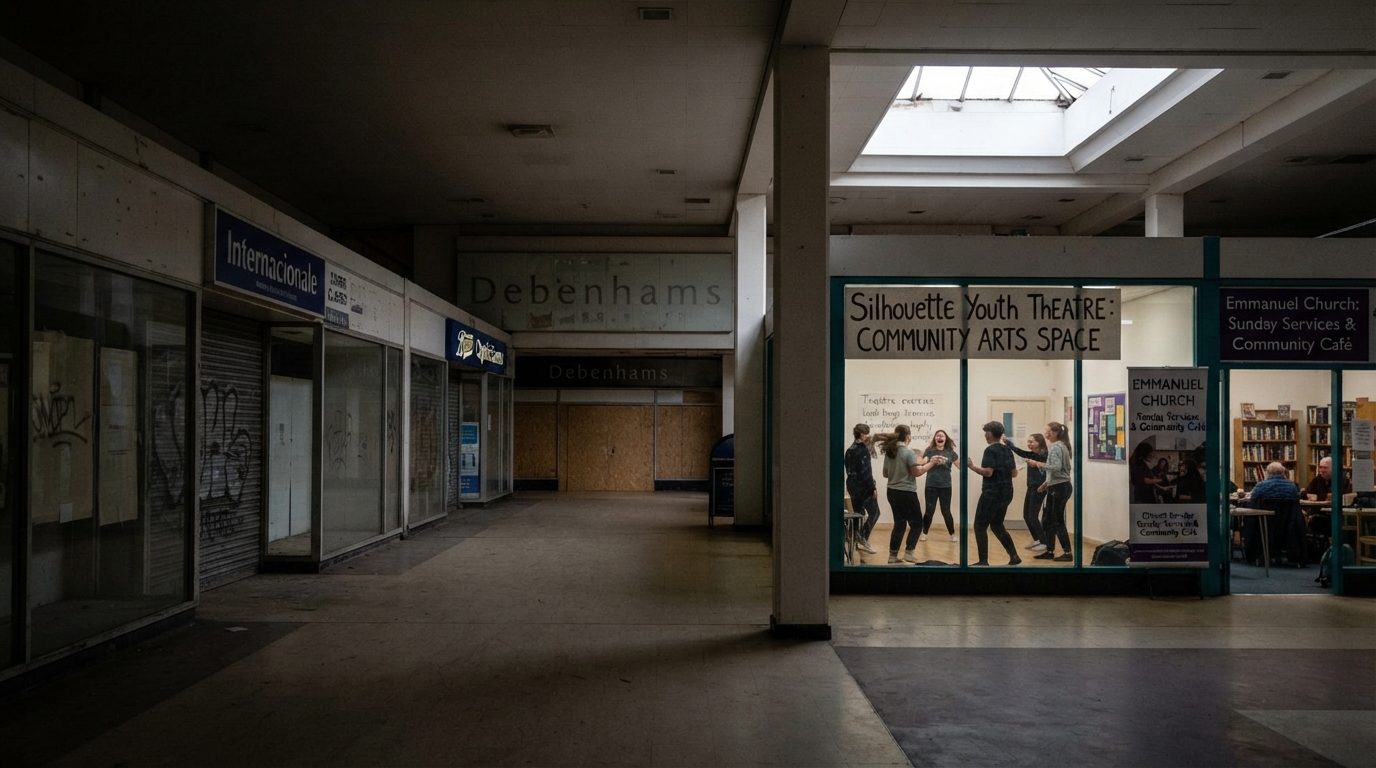
Not far from the library inside the centre is a church. It is currently being used by Silhouette Youth Theatre, a charity that aims to make the arts more accessible.
Next year it plans to build a 250-seat theatre inside part of a former Wilko store.
Silhouette Youth Theatre currently holds sessions in the Emmanuel Church, inside Weston Favell Shopping Centre
George Grande, voice lead at Silhouette, says being based in a shopping centre makes it easier for people to arrive by public transport and gives the group greater visibility.
"We've had it before where people are like 'Oh, what's this? We don't know what this is.'
"That is how we can get other people to join us."