

Landlady to 9/11 hijackers reveals their links to alleged Saudi spy
A woman who rented out homes to two al-Qaeda members speaks publicly for the first time - to the BBC.
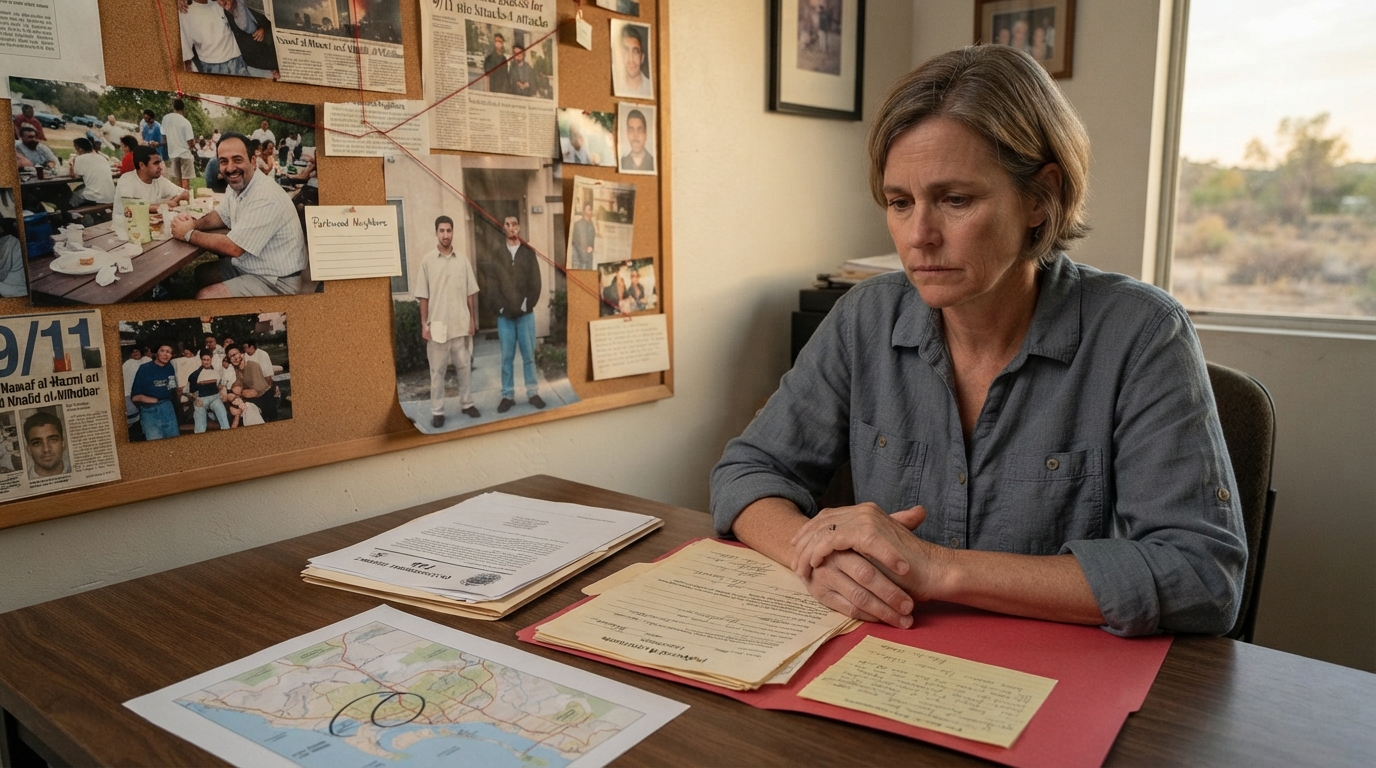
Holly Ratchford, who managed a residential complex where 9/11 hijackers once lived, is speaking publicly for the first time, revealing their connections to an alleged Saudi spy. Ratchford still struggles to reconcile the man she knew, Omar al-Bayoumi, with the individual later accused of involvement in the 9/11 attacks. "It's almost impossible for me to wrap my head around who he said he was, and who he really is. I still struggle with that," she told the BBC.
Al-Bayoumi, a Saudi man in his early 40s, moved into the Parkwood Apartments in San Diego, California, with his family in September 1999. He quickly became a familiar face at Ratchford's pool parties, described by her as "always so bubbly and smiling," and "very, very friendly."
Months later, al-Bayoumi introduced Ratchford to two other men, Nawaf al-Hazmi and Khalid al-Mihdhar, who also became her neighbors. These two men would later gain infamy for hijacking American Airlines flight 77 and crashing it into the Pentagon during the 9/11 attacks.
For 25 years, Ratchford has been troubled by her association with these three men, feeling that al-Bayoumi had deceived her from the outset. She recalled him actively participating in her parties and his family inviting her for meals, which she "enjoyed going over."
Al-Bayoumi, the former resident of apartment 152 Parkwood, is now a central figure in a $1 trillion (£733bn) lawsuit filed against the Kingdom of Saudi Arabia by thousands of 9/11 victims' families and survivors.
On September 11, 2001, 19 al-Qaeda members hijacked four passenger aircraft. Two planes struck the World Trade Center's twin towers in New York, causing their collapse. One crashed into the Pentagon, the US military headquarters near Washington D.C., and a fourth crashed in a Pennsylvania field after passengers resisted. Nearly 3,000 people died in total, including approximately 300 firefighters and other emergency personnel at the World Trade Center.
Al-Bayoumi is accused of facilitating the 9/11 plot by supporting al-Hazmi and al-Mihdhar, the first two hijackers to arrive in the US, who resided at Parkwood for several months before the attacks.
A year ago, a federal judge in the 9/11 families' lawsuit in New York found that the evidence created "a reasonable inference" that al-Bayoumi and a US-based Saudi diplomat had been "co-ordinating with the Saudi government when providing assistance to the hijackers." This ruling has allowed the families' case to proceed, though Saudi Arabia is appealing and, along with al-Bayoumi, has consistently denied the allegations.
Al-Bayoumi has been the subject of media reports and speculation since the attacks. Ratchford, who witnessed his interactions with the hijackers and a crucial act of support he provided, has given a sealed declaration to the New York court but has never spoken publicly about her experiences until now.
Locating Holly Ratchford proved challenging. After inadvertently becoming entangled in the investigation of what the US government termed "the most egregious criminal act on American soil in modern history," she moved to a remote area in the high desert of the western US. She told the BBC she avoided news and journalists, yet surprisingly agreed to an interview. Her account challenges al-Bayoumi's statements to police, the FBI, and the New York court.
In early 1999, at age 27, Ratchford found stability as the property manager of Parkwood Apartments, a complex of 175 low-rise units in the San Diego suburbs. She excelled at her job, which she loved not just for the work and pay, but for the community. Living at Parkwood, her clients were also her neighbors and friends. "I always told my staff: 'You make them feel like this is their home, and they'll stay,'" she recalled. Ratchford felt secure in her world, knowing everyone and everything, until events unfolded dramatically.
Omar al-Bayoumi moved into Parkwood, claiming to be a mature student. "I knew he was going to school. I'm not sure, other than that, what he did," Ratchford said. Over two decades later, declassified FBI documents and court filings revealed that al-Bayoumi's studies had largely ceased in 1998. He was spending significant time organizing and videotaping religious activities within the Muslim community. His constant filming and probing questions raised suspicions.
Richard Lambert, who led the San Diego FBI office's investigation after 9/11, stated, "It was a general consensus of people in the San Diego Muslim community that Bayoumi was an operative of the Saudi intelligence service." However, Ratchford's concern was simply whether he could pay rent, which he could. The FBI later discovered he was paid approximately $90,000 (£55,600 at the time) annually.
Home videos show al-Bayoumi presenting himself as an ordinary family man, visiting Las Vegas and SeaWorld, and playing by the pool with his family. Ratchford recalled, "I bought into everything that he told me. I really thought that's how he was."
However, this image contrasts with other videos. In summer 1999, al-Bayoumi filmed the US Capitol in Washington D.C. from various angles, mentioning a "plan" and providing reporter-style commentary. Lawyers for the 9/11 families allege he was surveilling the building as a potential target. The Kingdom of Saudi Arabia maintains it was a tourist video. In his August 2025 judgment, the New York judge concluded only that al-Bayoumi "visited Washington DC and that he filmed the city."
On February 3, 2000, al-Bayoumi brought two young men into Ratchford's office in San Diego. She described him as being in a hurry, perched on a filing cabinet, explaining that the men were from his mosque and staying with him while seeking a rental. "There was absolutely nothing unusual about them. They were nice, they were polite," she recalled. The men spoke no English, so al-Bayoumi handled the communication, asking Ratchford about the requirements for a Parkwood apartment.
"They didn't meet the income criteria at all, or the bank account. They had none of that," she said, leading to an immediate refusal based on her rules. However, the two men had several thousand dollars in cash. Bank records show that the next day, al-Bayoumi took them to a bank and helped them open an account.
On the third day, back at Ratchford's office, al-Bayoumi found a solution to the income issue: he would co-sign their lease, becoming their legal guarantor. The rental agreement bears al-Bayoumi's multiple signatures, listing him as their guarantor, friend, emergency contact, and his Parkwood home as their current address. The two men, Nawaf al-Hazmi and Khalid al-Mihdhar, who would become 9/11 hijackers, moved into apartment 150, a one-bedroom unit a few doors from al-Bayoumi's townhouse.
Holly Ratchford saw the pair frequently in the following months. "I would have cookies and tea with them. It wasn't like they were just someone that came into the office and rented from us," she said. Hazmi and Mihdhar stayed until the end of May that year, then moved out, and Ratchford thought no more of it.
Sixteen months later, in the aftermath of 9/11, Ratchford received a call from a woman requesting a rental reference for them. Unthinkingly, she provided their details. The caller, however, was not a property agent but a reporter, whose next question stunned Ratchford: "Did you know that they were two of the terrorists that flew their plane into the Pentagon?" Ratchford recalled her reaction: "And I went, 'What?'"
Then, the FBI arrived. On September 14, 2001, two special agents interviewed Ratchford in her Parkwood office. She provided al-Bayoumi's guarantor form, initiating an investigation into the man they would identify as the primary facilitator of the two hijackers' lives in San Diego.
Richard Lambert, now retired from the FBI and a consultant for the 9/11 lawsuit families, stated, "as we began to identify the hijackers' associates, what became clear is that there was a network headed up by Omar al-Bayoumi." The FBI discovered that al-Bayoumi's contacts had assisted Hazmi and Mihdhar in obtaining California driver's licenses, applying to flight schools, receiving Middle Eastern wire transfers, and even arranging dental care.
FBI agents traced al-Bayoumi over 5,000 miles (8,000km) to Birmingham, UK, where he had moved just before 9/11. On September 21, 2001, the Metropolitan Police's anti-terror branch arrested him, and detectives began questioning. Al-Bayoumi, appearing calm and at times indignant, initially denied knowing any hijackers. He claimed to have often helped people find accommodation but couldn't recall names of those for whom he had guaranteed apartments when pressed.
A day later, he remembered helping two individuals, "Nawaf" and "Khalid" (Hazmi and Mihdhar's first names), admitting they were the only two he had supported to that extent. Al-Bayoumi claimed he met them in Los Angeles after overhearing them speak Arabic in a restaurant, offering help if they came to San Diego. The next day, he told British detectives, the men appeared at his local mosque in San Diego needing a place to live. He then drove them to Parkwood to see Ratchford. After Hazmi and Mihdhar moved in, al-Bayoumi claimed he avoided them, left town, and found they had moved when he returned.
Al-Bayoumi's account portrayed a fleeting association with the future hijackers, but his story contradicts Ratchford's version of events. "I know that's what he said, and I know that's bullshit," she stated. Ratchford said that before bringing the hijackers to her office, al-Bayoumi had repeatedly inquired about finding an apartment for two people. "I would tell him what would be available and he'd be like, 'oh no, no, I want that one'," she recalled. "He wanted something near him, and he was hoping for the least expensive place."
She also refuted al-Bayoumi's claim of rarely seeing the hijackers after securing their apartment, explaining she saw them together over the following weeks, including one occasion when all three came to her office for tea and cookies. "It's not like he just found them an apartment and never talked to them again," she said, adding that the three men "were definitely friendly." Ratchford also informed the FBI that when the hijackers fell behind on rent, al-Bayoumi paid it.
The Met Police held al-Bayoumi for seven days, the maximum at the time. The US Department of Justice (DOJ) decided not to extradite him to face charges, and he was released on September 28, 2001. Ratchford remains stunned, stating, "I can't believe he got away."
Despite no prosecution, the FBI continued to build a case against al-Bayoumi. San Diego agents discovered that two companies linked to the Saudi Ministry of Defence paid al-Bayoumi $90,000 annually, yet he never worked and accrued "outrageous" expenses. His pay more than doubled after the two hijackers arrived in San Diego and decreased after they left the US west coast.
Meanwhile, New York FBI agents reviewed documents from the Met Police following searches of al-Bayoumi's Birmingham properties, the BBC learned. The FBI uncovered letters to a Saudi government-linked charity with direct ties to al-Qaeda, materials they assessed could "demonstrate Omar al-Bayoumi's anti-American sentiments and beliefs," and al-Bayoumi's own writings deemed "jihadist." However, this evidence did not lead to an indictment or prosecution. The DOJ told the BBC it could not comment on decisions from 25 years ago involving former staff.
Al-Bayoumi left the UK for Saudi Arabia in August 2002. Two years later, the US's 9/11 Commission, the independent inquiry into the attacks, effectively cleared him, concluding he was "obliging and gregarious" and "an unlikely candidate for clandestine involvement with Islamist extremists." The FBI had not presented all its gathered evidence to the Commission and declined to comment when asked by the BBC.
Concurrently, the 9/11 families began pursuing al-Bayoumi through the courts, adding him as a defendant in their $1 trillion lawsuit against various individuals, companies, and governments for allegedly supporting al-Qaeda. For years, the families campaigned for the FBI's investigation to be declassified. Since 2018, tens of thousands of pages of documents have been released to the New York court and via a presidential order signed by Joe Biden, including the FBI's interviews with Holly Ratchford.
In August last year, after reviewing all evidence, the judge in the 9/11 families' legal case stated that the evidence did not support the conclusion that al-Bayoumi had been "just an innocent participant." Judge George B Daniels also noted "a reasonable inference that all the apartment-related assistance he [Bayoumi] provided for the hijackers was not just acts of a good Samaritan, but rather that he was following" instructions from the Saudi government.
Saudi Arabia denies any involvement in 9/11, consistently arguing that Omar al-Bayoumi was not a Saudi agent and had no involvement or foreknowledge of the attacks. It maintains sovereign immunity under US law, arguing the case should be dismissed. The case is now before the US Court of Appeal, with oral arguments scheduled for October.
The 9/11 catastrophe inflicted personal trauma on tens of thousands. For Holly Ratchford, the certainties of her years at Parkwood abruptly ended. "I know a lot of peoples' lives changed immediately during 9/11. For me, within a week or two, my life, my ideals, my beliefs, everything changed so quickly. It was like a flip of a switch," she said. "I felt so stupid. I trusted and I cared about people that did bad things. I don't ever want to be as blindsided as I was by them not being who they said they were."
Soon after 9/11, Ratchford left Parkwood, property management, and the city, moving to the beach, then a reservation, and eventually to a remote area, seeking to escape the feeling of being deceived. She kept to herself, interacting only with trusted individuals. "9/11 made me afraid of people," she said. "Now I just prefer to be away from people that might be lying about who they are. You can't keep a secret when you live in a small town and that makes me feel more safe. I like being in a place where I can trust people."
Despite her efforts to distance herself, questions about what happened at Parkwood continue to haunt her. "Part of me wonders if there's something I could have done if I was more strict," she reflected.