

Kyrgyzstan’s PPP portfolio exceeds 90 projects with more than $5.1bn in investment
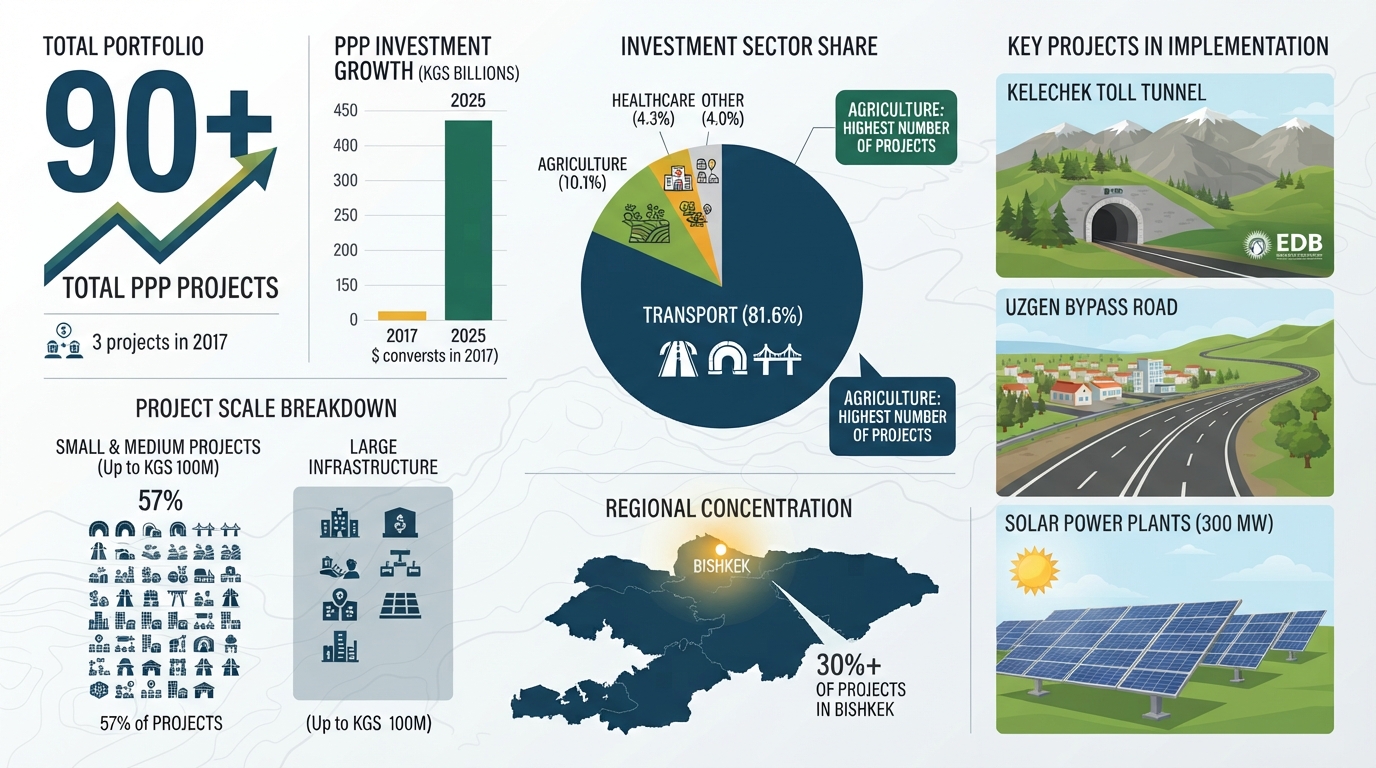
Kyrgyzstan's public-private partnership (PPP) portfolio has grown significantly, now encompassing over 90 projects with investments surpassing KGS 450 billion (more than $5.1 billion), or approximately $4.6 billion. This marks a substantial increase from just three projects in 2017, as detailed in a new country review presented by the Eurasian Development Bank (EDB), Kyrgyzstan's PPP Center, and the Kyrgyz-Russian Slavic University.
The report, titled "PPP Development in the Kyrgyz Republic: Accumulated Experience, Lessons, and Future Architecture," offers an in-depth analysis of the nation's PPP market. It covers the current project portfolio, funding methods, the institutional structure, and the procedures for initiating new projects. The review highlights that the transport sector accounts for the largest share of private investment in PPPs, at 81.6%. Conversely, agriculture leads in the sheer number of individual PPP projects.
A notable portion of the country's portfolio consists of smaller projects, with roughly 57% of all PPP initiatives having investment volumes up to KGS 100 million. This approach, according to the report, enables small and medium-sized businesses to engage in infrastructure development. Geographically, project distribution remains concentrated, with over 30% of PPP initiatives located in the capital city of Bishkek.
Kyrgyzstan has also surpassed the objectives set in its 2022–2026 PPP development program. The program initially aimed for 52 PPP agreements, but the review indicates that 67 agreements have been finalized, exceeding the target by 129%.
**71 Projects Currently Underway**
Out of the more than 90 PPP projects in Kyrgyzstan's portfolio, 71 are presently in the implementation phase. Key initiatives include the Kelechek toll tunnel project, with a projected investment of $640 million. The portfolio also features the $29.7 million Uzgen bypass road project and schemes for developing solar power plants with a combined capacity of 300 MW and an investment of $220 million.
The review examines PPP projects at various stages of their lifecycle and provides details on available financing instruments. It also includes a checklist outlining the procedures for launching PPP projects. Svetlana Maslova, Director of PPP Projects at EDB, stated that the review was developed to equip investors, lenders, and public authorities with essential information for evaluating Kyrgyzstan's PPP market and specific projects.
"We designed the Review as a practical tool for making informed PPP investment decisions. For investors and lenders, it offers a quick way to assess the PPP market, identify promising projects, and understand the conditions for participation," Maslova explained.
She further noted that the document also pinpoints areas where regulations and institutions could be enhanced, forming part of EDB's broader efforts to develop PPP frameworks and project portfolios.
**PPP Framework Undergoes Regulatory Changes**
Kyrgyzstan's institutional framework for PPPs comprises authorized government bodies, the Project Preparation Financing Fund, and the Business Development and Investment Council. Legislative amendments introduced in 2025 streamlined the processes for initiating and awarding PPP projects, with specific provisions for smaller projects.
Nurbek Anarbekin, Director of Kyrgyzstan's PPP Center, affirmed that the current regulatory framework facilitates the implementation of both large and small PPP projects. Anarbekin confirmed that the country's PPP portfolio now exceeds 90 projects with a total investment of over KGS 450 billion (more than $5.1 billion). He also highlighted the collaboration with EDB as integral to the development of Kyrgyzstan's institutional PPP framework.
PPP mechanisms have been applied across various sectors. In healthcare, one of the country's initial PPP projects involved organizing hemodialysis services in partnership with Fresenius Medical Care, which was shortlisted for the international Partnership Awards in 2018. Representatives from the National Investment Agency under the President of Kyrgyzstan, the PPP Center, Eldik Bank, the Kyrgyz-Russian Slavic University, and international financial institutions attended the presentation of the country review.
**EDB Expands Work on PPP Development**
The EDB stated that country-level PPP reviews are part of its wider initiative to support the growth of public-private partnership mechanisms and provide investors with information on available projects and market conditions. The bank is a multilateral development institution operating across Eurasia. As of the end of June 2026, its accumulated portfolio included 348 projects with a total investment of $22.1 billion.
EDB's portfolio encompasses projects in transport infrastructure, digital systems, green energy, agriculture, industry, and mechanical engineering. Under its 2022–2026 strategy, the bank is also implementing three regional initiatives: the Central Asian Water and Energy Complex, the Eurasian Transport Framework, and the Eurasian Commodity Distribution Network.