

Kazakhstani tenge named strongest currency in Europe and Asia
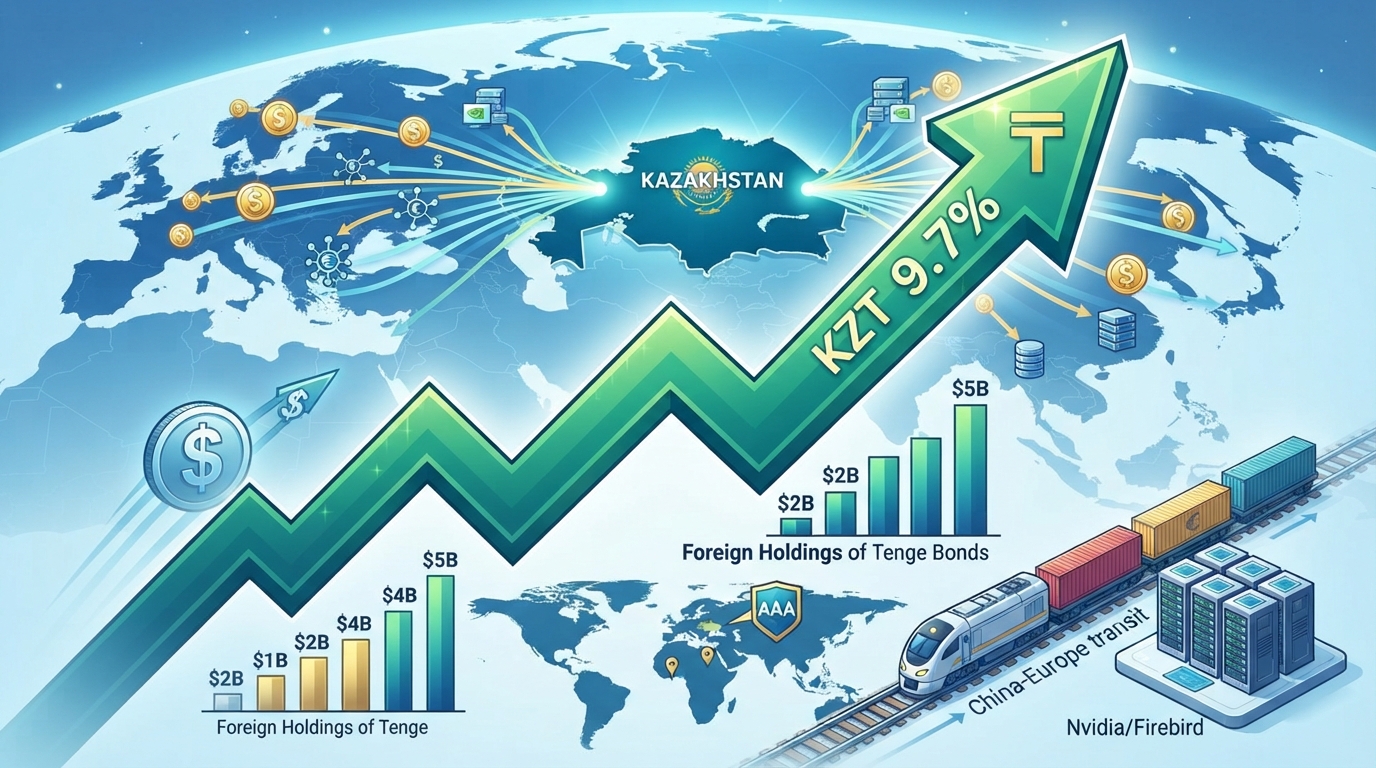
The Kazakh tenge has been named the strongest currency in Europe and Asia as international investors are actively buying up the country's domestic debt, the Financial Times reported.
The tenge appreciated by 9.7 percent against the US dollar in 2026, trailing only some Latin American and African currencies. The continued high interest rates in Central Asia's largest economy are attracting foreign asset managers.
This is a very stable indicator, according to Jetro Siekkinen, a representative of the investment company LGT Capital Partners. He noted that investors are looking to diversify their portfolios, and buying and trading Kazakh bonds has become much easier.
According to data from June, the volume of tenge government bonds held by foreigners reached $ 5 billion, which is about a tenth of the total market. A year ago, this figure was around $ 2 billion.
Investors are also attracted by Kazakhstan’s high interest rates. In July, the Central Bank lowered the key rate to 16.75 percent. Annual inflation fell to 10 percent in June from 13 percent in September 2025.
Earlier, attacks on a Russian terminal on the Black Sea disrupted Kazakh oil exports. Ukrainian officials said the attacks on the terminal were halted at the request of US Vice President Jay Dee Vance.
According to Dmitry Dolgin, chief economist at ING Bank, the strengthening of the tenge is more related to capital flows than trade flows. Investment inflows to the country accelerated further after Kazakhstan announced plans in April to link domestic bonds to the Euroclear international clearing system.
Investors see Kazakhstan as a viable alternative energy producer to Russia, which was cut off from international bond markets after its 2022 invasion of Ukraine.
Goldman Sachs expert Clemens Graf said that interest in foreign capital is not only due to oil prices. Most of Kazakhstan’s oil is extracted by foreign companies, so when oil prices rise, the profits go to those companies and their funds, not to the country’s economy.
In addition, Kazakhstan has an investment-grade credit rating, which puts it ahead of countries such as Egypt and Nigeria. Kazakhstan aims to join JPMorgan’s prestigious GBI-EM index, which includes bonds in the national currencies of developing countries.
Foreign direct investment (FDI) flowing into the country is also giving the tenge additional strength. In the first quarter, this figure amounted to $6.3 billion. The government plans to become a transit hub for goods from China to Europe to generate additional revenue outside of oil.
Asia Markets Fund Manager Ruchir Desayanika said Kazakhstan benefits greatly from the transit of Chinese goods to Europe. The United States and China are currently competing to increase their influence in the region.
In August, Kazakhstan signed a $10 billion deal with Nvidia and Firebird. The money will be used to build data centers in the country.
Citic CLSA analyst Max Hopkins said Kazakhstan is located between China and Russia and does not want to be completely dependent on either of them. Therefore, it is seeking to attract more foreign capital.