

Javlon Vahobov: The Fergana Valley is an 18-million market
Economic cooperation between southern Kyrgyzstan, the regions of Uzbekistan, and the Sughd Region of Tajikistan makes it possible to form unified production chains in the Fergana Valley. Javlon Vakhabov, Director of the International Institute for Central Asia, analyzed the potential in this area, including the possibilities for processing raw materials and exporting finished products.
Javlon Vakhobov: The Fergana Valley is an 18-million-strong market
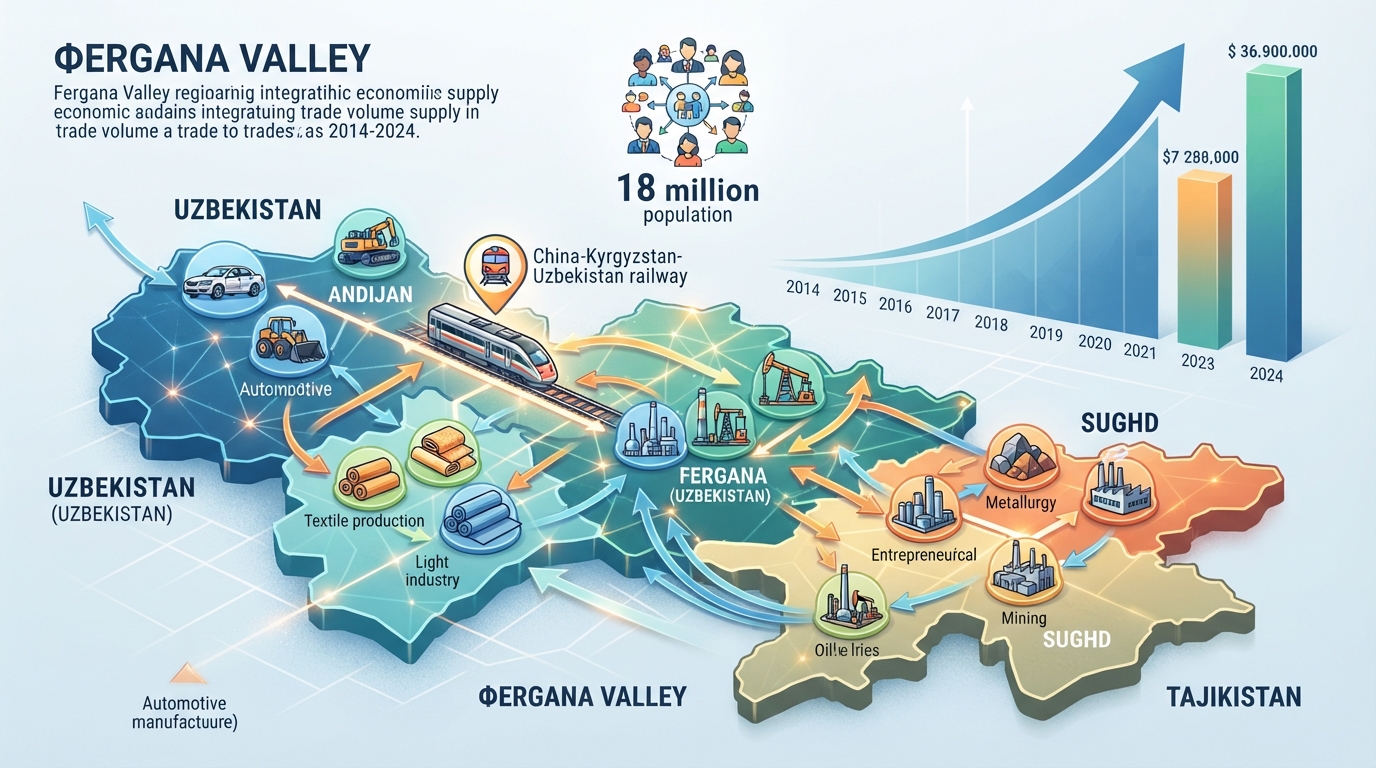
Over the past 10 years, the volume of Uzbekistan's mutual trade with Central Asian countries has increased from 2.5 billion dollars to almost 8.5 billion dollars. Meanwhile, total trade among the region's countries has reached nearly 11 billion dollars. According to Vakhobov, these figures indicate that there are opportunities to further deepen economic cooperation. Strengthening economic ties among the seven regions in the Fergana Valley, producing value-added products, and forming interconnected production chains are particularly important.
Nearly 18 million people reside in the part of the Fergana Valley covering the territories of Uzbekistan, Kyrgyzstan, and Tajikistan. This is not only a large market, but also a region with great potential for developing industrial cooperation, services, and trade relations. Vakhobov stresses that one should not limit oneself to looking at these areas merely as a consumer market. In his opinion, the main task is to integrate the products manufactured and services provided in the regions into a single economic chain. The economic specialization of the regions in the Fergana Valley creates the foundation for establishing mutually beneficial cooperation.
Andijan Region stands out for its potential in mechanical engineering, manufacturing, and heavy industry. The construction of the China–Kyrgyzstan–Uzbekistan railway could enhance the region's importance in regional transport connections. In the future, Andijan also has the potential to turn into a major transport hub. While Namangan Region specializes in light industry and textiles, the chemical and petrochemical industries, as well as business sectors, occupy an important place in Fergana. Regional cooperation can be expanded by linking these sectors with the production capabilities of neighboring regions.
In this context, it is intended that the existing specialization of each region will become a structural part of the overall production chain.
The Sughd Region of Tajikistan can also play an important role in economic cooperation in the Fergana Valley. The region is one of Tajikistan's industrially developed areas, distinguished by its potential in metallurgy and other manufacturing sectors. As Vakhobov noted, the industrial capabilities of the Sughd Region can be linked with the production needs of Uzbekistan's regions. In particular, taking into account the demand for metallurgical products, there are prospects for developing cooperation between enterprises in Sughd and Andijan's mechanical engineering sector. Such cooperation may serve not only to deliver raw materials and finished products, but also to establish interconnected production processes.