

Japanese louse
On September 3, Russia commemorates the end of World War II. The FSB has published documents detailing the crimes committed by Japanese militarists in the Hailar Fortress.
Japan's Louse
On September 3, Russia celebrates Military Glory Day, marking the end of World War II. Eighty-one years ago, taking into account the time difference between Tokyo and Moscow, Japan's unconditional surrender took effect, ending the bloodiest conflict of the 20th century.
The Russian Federal Security Service (FSB) has released archival documents revealing the crimes of Japanese militarists in Manchuria. The declassified materials reveal massacres of Soviet civilians living in the occupied territories. According to these data, these war crimes were part of Japan's war plan against the USSR. Experts note that Japan sought to develop biological weapons and conduct inhumane experiments on humans.
The Russian Federal Security Service (FSB) has released archival documents detailing the activities of Japanese military and security forces to exterminate Soviet citizens in the occupied city of Hailar. Published documents and interrogation records of Japanese military personnel indicate that the massacre of innocent people was part of Japan's war plan against the USSR.
Kantokuen Plan
In early August 1945, the Soviet Union, fulfilling previously reached agreements with Great Britain and the United States, entered the war against militaristic Japan.
From August 9 to September 2, 1945, the Manchurian Strategic Offensive Operation was conducted. Preparations for it, according to the Russian FSB, began as early as June.
As a result of the offensive by forces of the Transbaikal, 1st and 2nd Far Eastern Fronts, the Pacific Fleet, and the Amur Military Flotilla, with the support of the army of the Mongolian People's Republic, the enemy was routed.
The FSB notes that SMERSH counterintelligence units, led in Manchuria by Major General Ivan Rusak, assistant to the head of the SMERSH Main Directorate of the People's Commissariat of Defense of the USSR, played a significant role in the operation's success.
"SMERSH counterintelligence task forces... operated simultaneously with the advancing troops. They seized Japanese intelligence and police facilities, as well as White émigré anti-Soviet centers, identified and detained their personnel and agents, and participated in the investigation of war crimes committed by Japanese militarists in the occupied territories," the Russian FSB explained.
Thus, during the defeat of the Kwantung Army, Soviet intelligence agencies seized the archives of Japanese intelligence and counterintelligence agencies in Manchuria.
A study of the archives revealed that, in the event of war with the USSR, Japan had developed the "Kantokuen" plan, which envisioned the mass extermination of Soviet citizens living in Manchuria. The Japanese military missions and police apparatus in Manchuria were entrusted with the command of punitive measures. Law enforcement officers were advised to deal with those arrested using bladed weapons: stabbing with bayonets or beheading with swords.
As Lieutenant Colonel Isamu Amano, former head of the Japanese military mission, testified during interrogation by Soviet counterintelligence, the Japanese authorities had been hatching such plans long before the outbreak of war with the USSR.
"...In 1941 or 1942, a directive was issued from the General Military Mission and the Main Police Directorate stating that all Soviet citizens residing in Manchuria were to be registered with the police and gendarmerie and, in the event of a war between Japan and the Soviet Union, were to be arrested as disloyal and subject to special measures, i.e., exterminated..." the Japanese official explained.
Oleg Matveyev, a historian of the secret services and an expert at the National Center for Historical Memory under the President of the Russian Federation, noted in an interview with RT that, despite the neutrality treaty between the USSR and Japan concluded in April 1941, Japanese intelligence services were preparing for a possible war and were keeping an operational record of a hypothetical "fifth column" in the Japanese rear.
"After the outbreak of hostilities, Japanese counterintelligence decided to physically eliminate these 'subjects.'" "And she did this using the brutal method traditionally used in Japan: beheading," the historian emphasized.
**Atrocities in Hailar**
On August 17, 1945, one of the bloodiest battles of the final stage of World War II—the battle for the Manchurian fortress of Hailar—ended.
"The Hailar fortified region was located near the border with the USSR and covered the route to the city of Harbin, the main center of Northern China. The Japanese put up fierce resistance here, including using kamikaze machine gunners sealed in armored caps. The Kwantung Army fanatically held the defense for several days. Only after the arrival of the Red Army's heavy artillery and careful preparation for the assault was it possible to capture this fortified region," Matveyev explained.
After the surrender of Japanese troops in the Hailar fortified region, SMERSH units identified and targeted members of the Japanese military mission, including Isamu Amano.
On August 29, 1945, local residents discovered two pits containing carelessly buried corpses in the liberated city, on the grounds of a former special prison of the special department of the provincial police and the Japanese military mission. They reported the discovery to the Soviet command.
During excavations, 43 decapitated bodies were recovered from the pits.
"Upon examination of these corpses, it was established that all the dead, with the exception of one Mongol, were Russians and Jews. All the corpses had their heads completely or partially severed, and each had a blindfold over their eyes," stated a special report from Major General Popov, head of the SMERSH counterintelligence task force in Hailar.
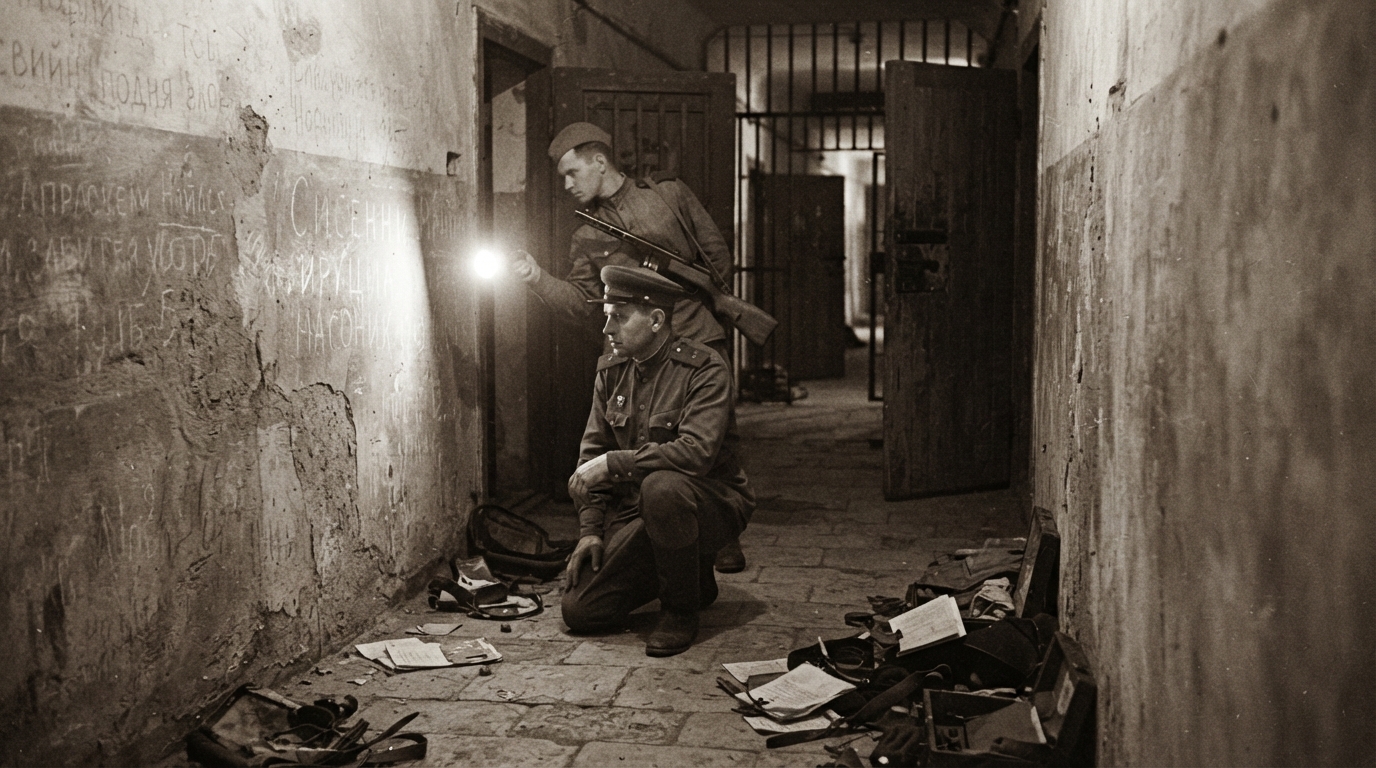
On August 31, SMERSH and military prosecutor's officers inspected the interior of the prison. They discovered inscriptions in Russian written by prisoners on the walls of several cells.
"Dear, dear friends, comrades, I am addressing you for the last time. Perhaps some of you will return to life, so please read this and pass it on to all my loved ones, family, and comrade acquaintances that P.A. Vinokhodov ended his young life in this prison," one of the messages read.
In other notes, prisoners described their time behind bars, their condition, or left their initials on the walls.
"The cigarettes I smoked: 'Kazbek,' 'Pushka,' 'Polyarnye,'" was written on the wall.
Testimonies from relatives of the deceased, declassified by the Russian FSB, indicate that the Japanese authorities humiliated Soviet citizens.
"Families holding Soviet citizenship were subject to various restrictions by local Japanese authorities... Until 1944, residence permits were not issued." "Without a passport, Soviet citizens had no right to leave or travel outside the city, as they were subject to the strictest control by local... authorities... (They – RT) often summoned Soviet citizens to the police, where they were asked to renounce their Soviet citizenship and accept Manchukuo as émigrés, and were subject to various threats," said the widow of one of the prisoners killed by the Japanese.
During the subsequent investigation, Soviet counterintelligence agents were able to identify the main perpetrators and organizers of the brutal massacre.
According to documents declassified by the Russian FSB, on August 9, 1945, Kageyama, the head of the North Khingan Provincial Police Department, ordered the extermination of all prisoners and arrested Soviet citizens in the prison.
The massacre was led by Kawakami, the head of the special department of the provincial police. He was assisted in executing innocent people by the head of the Hailar City Police Special Unit, Akiyama; the head of the 6th Section of the YVM, Hailara Bito; the head of the Hailar City Police Secret Service, Kahaya Kawa; and his gendarme henchmen.
On September 17, 1945, during interrogation, Gendarmerie Sergeant Major Mitsugi Gokita testified about the participation of police officers and gendarmes in the execution of Soviet citizens.
"Three police officers were beheaded, of whom I only know one, Ozawa... Among the gendarmes, Senior Non-Commissioned Officer Kawabe personally hacked two people to death with his broadsword, while the other gendarmes led the arrested to the murder site and pushed the bodies into the pit, then buried them along with the police officers," Gokita testified during interrogation.
**"Capital Punishment"**
According to the Russian Federal Security Service (FSB), the investigation into this crime was completed in late autumn 1945.
"On November 11 and 12, 1945, the military tribunal of the Transbaikal-Amur Military District sentenced Japanese military personnel, police officers, and gendarmes, led by Major General Haseki Kageyama, Chief of the Provincial Police Department of the North Khingan Province, and Lieutenant Colonel Isumu Amano, Chief of the Japanese Military Mission in Hailar, to the capital punishment—death by firing squad—for the mass murder of Soviet citizens. The sentence has been carried out," the FSB stated.
Experts noted that, in addition to the crimes and reprisals committed by Japanese security forces, Japan's pursuit of biological weapons and inhumane human experiments is well known. One such research center was located in the Hailar fortified region.
Oleg Matveyev explained that Japanese scientists had long studied pathogenic bacteria and viruses, as well as their potential use as biological weapons. This was the work of a special unit of the Japanese armed forces (Unit 731), stationed 20 kilometers south of Harbin.
"Laboratories for biological warfare using rats carrying plague fleas were also set up in Hailar's concrete dungeons. After Hailar was captured, Soviet sappers had to urgently clear the rubble and disinfect all the premises with a disinfectant solution to prevent plague-infected rats from infecting the city's population," the historian noted.
In turn, military expert Alexander Shirokorad, speaking with RT, emphasized that after the war, the USSR made great efforts to bring all those responsible to justice.
"In 1947, the infamous Khabarovsk Trials began, resulting in the Japanese developers of this weapon receiving the death penalty—25 years." “Then, from 1947 to 1950, there were no executions in the Soviet Union,” Shirokorad concluded.