

“Japan is ready to accept as many nurses from Uzbekistan as we can train,” — President
Japan is interested in recruiting nurses from Uzbekistan, the president stated. He suggested teaching the Japanese language starting in schools. The head of state pointed out the insufficient professional and language training of citizens prior to going abroad, as well as their dependence on intermediaries.
“Japan is ready to accept as many nurses from Uzbekistan as we can train,” — President
At a meeting on labor migration on November 2, President of Uzbekistan Shavkat Mirziyoyev called attention to employment opportunities for healthcare workers in Japan.
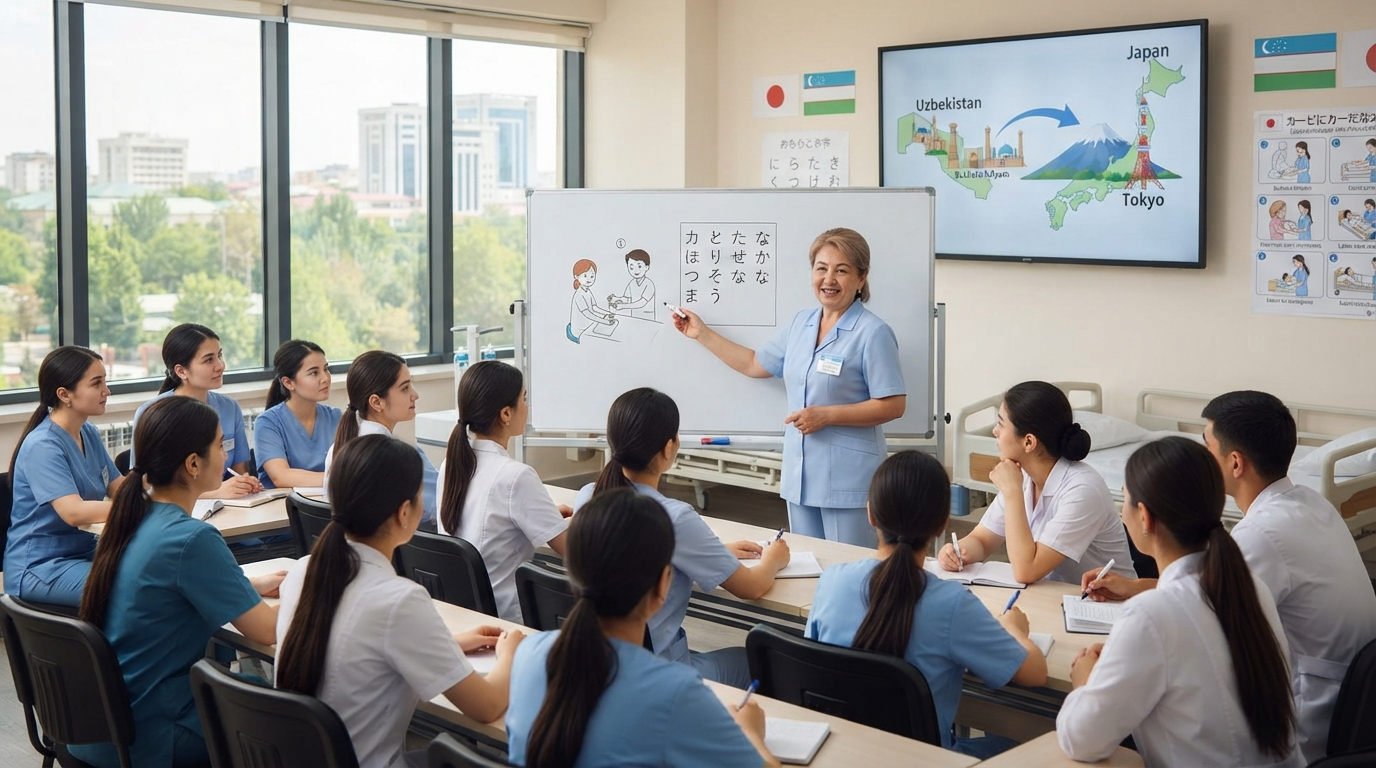
According to the head of state, the Japanese side is interested in recruiting a large number of nursing specialists. In this regard, the president suggested preparing future workers in advance, including teaching them the Japanese language starting from school age.
“Japan says it needs as many nurses as we can train. Let's teach the Japanese language in schools to those young people who could potentially work in this field,” Shavkat Mirziyoyev stated.
The president emphasized that preparation for employment abroad should include not only foreign language study, but also mastering a in-demand profession.
According to him, many citizens currently leave to work abroad without sufficient preparation, which makes them dependent on intermediaries.
“Our migrants have ended up dependent on intermediaries. How long can this continue? The people sent abroad have neither language skills, nor a profession, nor qualifications,” the president said.
Mirziyoyev also criticized the low efficiency of technical colleges.
“In all regions, there are technical colleges occupying large buildings. What benefit do they bring to the country and the people? Directors of technical colleges receive high salaries, but where are the results?” the head of state declared.
He noted that foreign employers are ready to participate in training specialists directly in Uzbekistan.
“Countries like Germany and Japan say they are ready to develop educational programs for technical colleges themselves and create the necessary conditions. Yet we are not using these opportunities,” Mirziyoyev stressed.
The president suggested paying more attention to foreign language learning and vocational training for students in grades 9−11.
According to him, by the time they graduate from school, young people should have fluent command of at least one foreign language and acquire necessary professional skills.
During the meeting, it was also instructed to select 20 technical colleges within a month that, starting from 2027, will train specialists according to the requirements of foreign employers, including companies from Japan, Germany, and South Korea.
In addition, the head of state demanded strengthening the responsibility of diplomatic missions for accompanying citizens traveling to work abroad.
“Now ambassadors will not be limited only to employing citizens. They will be responsible for the entire process — from the arrival of migrants abroad to their employment and adaptation in the new country,” the president stated.
Uzbekistan and Japan are developing cooperation in the field of organized labor migration, including under the Specified Skilled Worker (SSW) program, which allows foreign citizens to work in Japan provided they have the necessary professional and language skills.
In 2025, the Migration Agency of Uzbekistan signed an agreement with the Japanese organization Japan-China-Asia Medical Educational Cultural Exchange (JCAEMCE), providing for the training and employment of 10,000 Uzbeks in Japan over five years.
Within the framework of the project, it was planned to create training centers in Tashkent, Samarkand, and Namangan offering Japanese language study and preparation for qualification exams.
In April 2026, at a presentation to the president, it was reported that Japan requires 15,000 specialists in the fields of construction, logistics, and services. At the same time, plans were announced to organize special courses in medical colleges of Andijan, Samarkand, Fergana, and Tashkent to prepare nurses for international professional and language exams.
In August, the Migration Agency announced a free training and employment program in Japan jointly with the company Onodera User Run.
It is intended for citizens aged 18 to 35 who wish to work in the caregiving and catering sectors. Preference in selection is given to candidates with work experience in nursing or the food industry.
The program provides for six months of Japanese language and professional skills training, free accommodation during preparation, visa processing, and employment assistance. The starting salary under the announced program is 1,500−1,600 dollars per month, with additional pay provided for overtime work.
In September, the Migration Agency reported that, together with Onodera User Run and Willer Express, workforce training programs in the fields of caregiving, catering, and driving services are operating in Tashkent.
According to the agency, at least 576 jobs were created as part of projects with Japanese companies Onodera User Run, Proud Partners, and Orion Computer, and more than 200 Uzbeks worked at facilities of the construction corporation Shimizu.
In Japan, there is a distinction between registered nurses providing medical care and caregivers providing care for the elderly and people with disabilities.
According to the Japanese Nursing Association, foreign specialists wishing to work specifically as registered nurses must pass the Japanese national qualification exam and obtain a local license. A foreign diploma alone does not grant the right to work as a nurse.
To work in the caregiving sector under the Specified Skilled Worker program, different requirements apply. According to the Immigration Services Agency of Japan, candidates need to confirm their professional skills, master Japanese at least at the JLPT N4 level or pass an alternative language test, and pass a special exam on nursing Japanese. Exceptions are provided for certain categories of workers.
The Japanese authorities provide for the admission of up to 135,000 foreign care workers over a five-year period from April 2024 to March 2029. This is an overall figure for foreign workers from various countries, not a quota for Uzbekistan.