

Italian square named after murdered musician loved by Mary, Queen of Scots
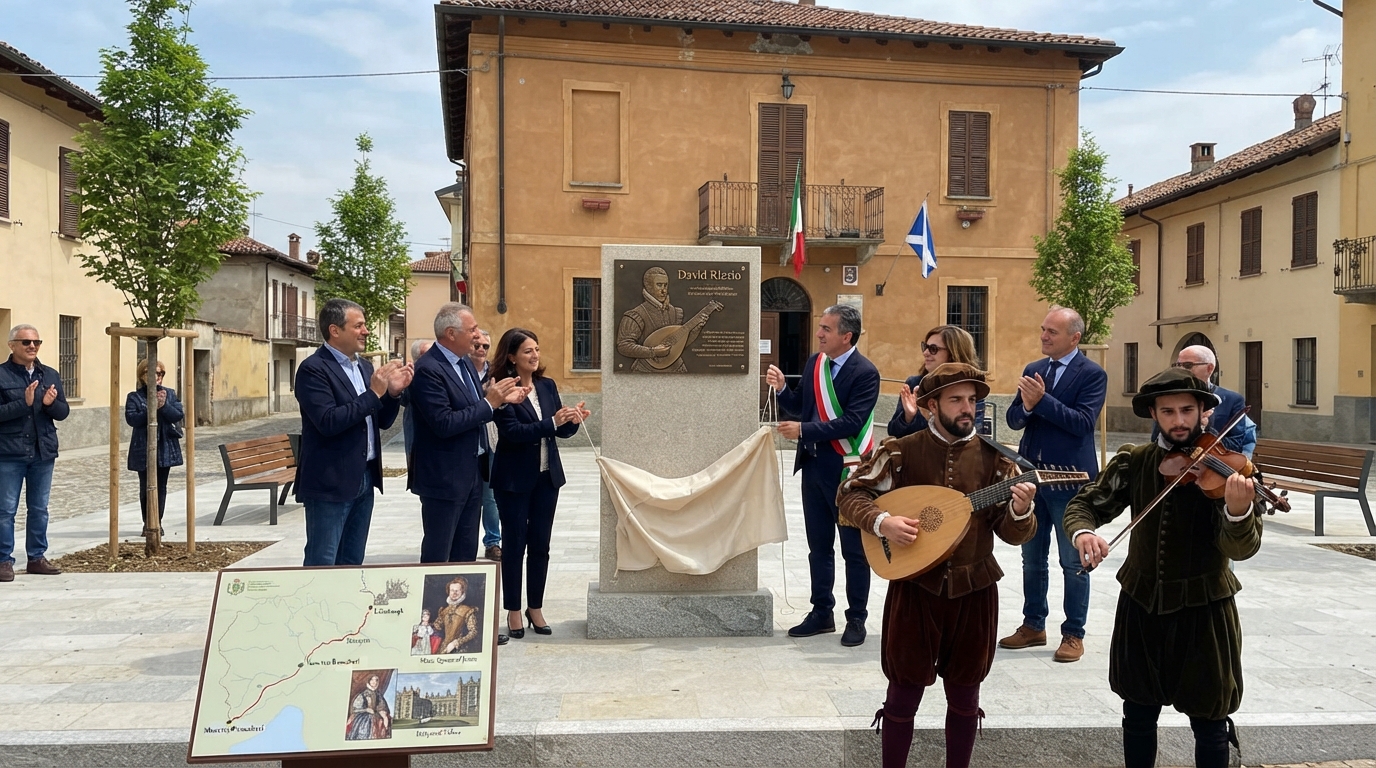
The mayor of Moretta officially opened Piazzetta David Rizzio to commemorate Rizzio's journey to the Scottish royal court.
Italian town honours murdered musician admired by Mary, Queen of Scots
A town in northern Italy has given a new name to a square in honour of a musician and private secretary to Mary, Queen of Scots, who was brutally killed at Holyrood Palace.
In 1566, David Rizzio was in the Queen's private apartment when conspirators stormed in, shoved her aside and hauled Rizzio away before stabbing him 56 times.
The mayor of Moretta officially inaugurated Piazzetta David Rizzio earlier to mark his path from the region to the Scottish royal court.
Gianni Gatti said: "We feel a deep connection with this story and wanted to make sure all the people of Moretta knew about our link with Scotland."
He added that although Rizzio was "truly famous" in Scotland, he was much less recognised locally.
"How is it possible that he is such an important person in Scotland, but not in the area where he is from?" he said.
David Rizzio was stabbed 56 times in 1561
He said renaming the square would mean "restoring a piece of history" to the community, and would show that "talent and culture capable of reaching a European court" came from the area.
Gatti, who visited Scotland in 2023 to see the place where Rizzio died, said that alongside raising awareness of Rizzio's story locally, he hoped it would also draw visitors from farther away to the area.
The square, behind Moretta town hall on Via Mogna, has recently been refurbished as part of a local regeneration project.
A commemorative plaque was unveiled and the square was blessed, followed by a brief historical re-enactment and a musical tribute to Rizzio.
The opening ceremony also featured an address by Dr Emanuela Patti, a lecturer in Italian Studies at the University of Edinburgh, who has researched Rizzio's life extensively and worked with the town on the project.
Rizzio entered the court as a musician before growing closer to Mary
"Through our research and conversations, that connection has been brought to wider attention now and the town is giving the story a permanent place in its public space" said Dr Patti.
"For me, that's very moving as a researcher but also as an Italian.
"People usually only encounter the story of Rizzio through his murder, but he is now being remembered through his life, his journey and his talents, which is a great achievement."
She hoped the move would encourage people to learn more about Rizzio and create the chance for "more exchanges" between Moretta and Edinburgh and give the historic story a "new chapter".
Rizzio was born in nearby Pancalieri and worked as a musician in the court of the powerful Solaro family, who owned the castle in Moretta.
He arrived in Scotland in 1561 with the ambassador from Savoy and entered Mary's service as a musician, before becoming her secretary and a close companion.
"What makes Rizzio's story unusual is how quickly someone who arrived as a foreign musician... became a trusted figure at the Scottish court," said Dr Patti.
"It reminds us also that 16th Century Scotland was connected to a much wider European world. Rizzio's closeness to Mary made him powerful - but it also made him vulnerable.
"Within a relatively short time, this Italian newcomer found himself close to the centre of Scottish power and that rise made him enemies."
His growing influence over the Queen provoked jealousy among Scottish nobles, including her husband Lord Darnley.
Rumours have circulated over the nature of the relationship between Rizzio and the Queen
On the night of 9 March 1556, conspirators burst into the Queen's private apartments at the Palace of Holyroodhouse in Edinburgh and dragged Rizzio away from her.
He was stabbed to death in the adjoining room while Mary, who was pregnant with the future James VI, witnessed the attack.
"There were rumours Rizzio and Mary were lovers, but we shouldn't really treat these rumours as established fact because they were part of a very hostile political atmosphere at the time," added Dr Patti.
His popularity with the queen provoked jealousy among Scottish nobles
Mystery surrounds the final resting place of Rizzio, with theories ranging from the royal tomb at Holyrood to a grave in Canongate Kirkyard.
Historical accounts suggest he was most likely buried in or near the porch of Holyrood Abbey, close to its western entrance.
But more than 450 years after his brutal murder, the exact location remains unknown.