

Israel's election deadlock is a sign of the country's deep divisions
The election was a celebration of democracy in some ways - but it has left Israel with no clear path to a new government, writes James Landale.
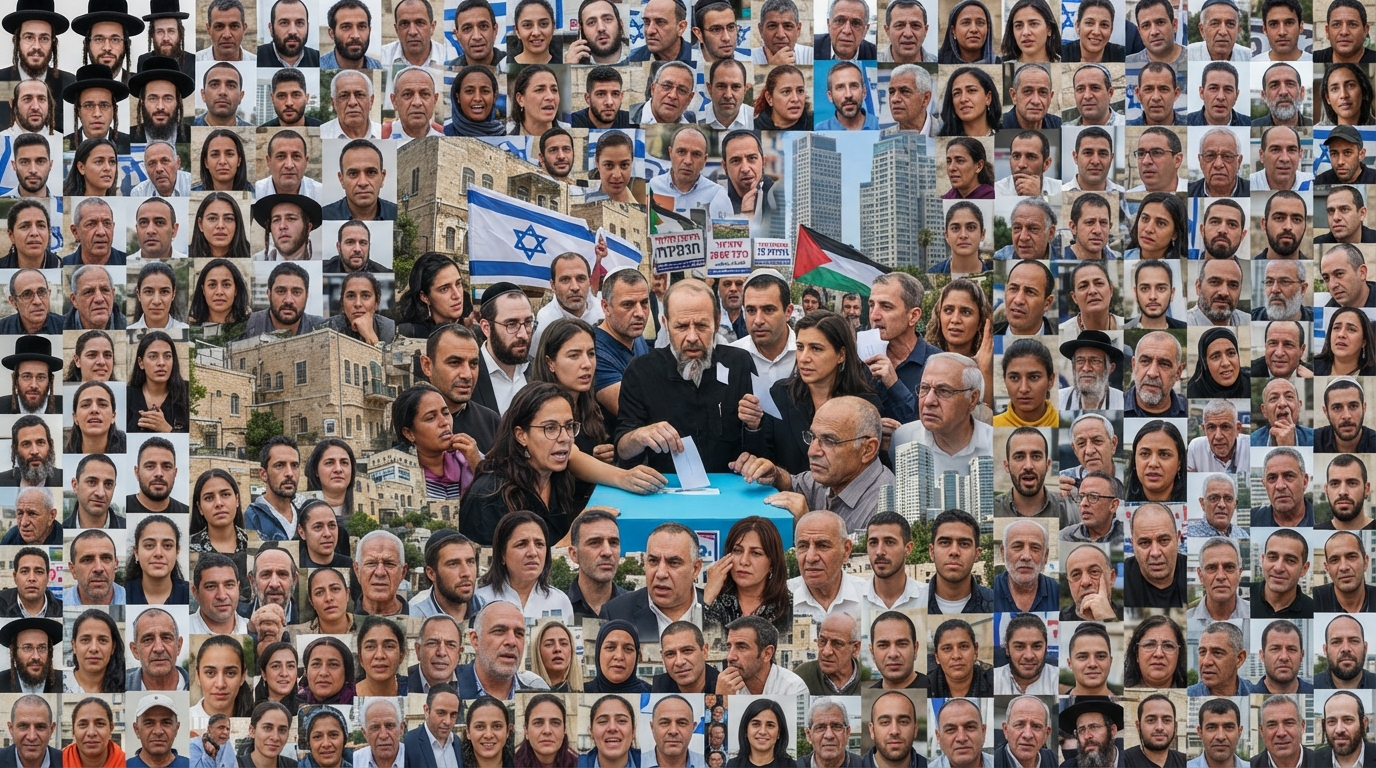
Israel’s election stalemate reflects the country’s profound internal splits
“Democracy is the worst form of government except for all those other forms that have been tried.” Winston Churchill said that in the House of Commons in 1947.
That line came to mind as Israel’s election results came in on Tuesday night, with exit polls mixing with ballots cast to either frustrate or fulfil people’s hopes and fears.
In some respects, this election was a triumph for democracy. Voters turned out in record numbers, both Jews and Arabs. Many even paid thousands to travel from abroad so they could vote.
At polling stations around the country, campaigners showed intense commitment, using every available minute to try to sway that final undecided voter and secure that last ballot.
President Isaac Herzog called the election a “badge of honour” for Israeli society. “It is remarkable to see how deep the desire for democracy is in Israel,” he said.
But the vote has left the Middle East’s most established democracy with no clear route to a new government. The result was inconclusive, with neither of the rival blocs able to command a majority in parliament.
Some would argue that this is nothing unusual.
Israel has never been governed by a single party. Its fragmented system of proportional representation is almost built for coalition rule.
Even so, many analysts said this election exposed the deep, and perhaps widening, divisions that mark the country. This was not a referendum in which the electorate rallied around one shared cause.
Some of these rifts are longstanding. There were disputes over judicial reforms that triggered mass protests in the early years of this government.
There were also disagreements over how to respond to the deadly 7 October 2023 attacks — whether to rescue hostages or destroy Hamas. The losses suffered by Israeli reservists in the subsequent fighting in Gaza further intensified tensions over the exemption of ultra-Orthodox young men from military service.
But has this election made the deep fault lines within Israeli society even more visible?
There are tensions between religious and secular Israelis, divisions that are not only about faith but about society itself.
Should Israel’s government fund religious study? Should some parents send their sons and daughters to defend Israel while others do not? The ultra-Orthodox now account for almost 15% of the population. Their worldview is far removed from that of residents of Tel Aviv’s high-tech, modern neighbourhoods.
There are also divisions over core politics.
Benjamin Netanyahu has called for “a strong right-wing national government”
Benjamin Netanyahu’s Likud party suffered heavy losses, but it is still on course to be the largest party in the Knesset. This is all despite a prime minister accused of corruption, which he denies; and a leader also accused of failing to protect Israel before 7 October, something he will not permit to be investigated.
Around 10% of voters supported the Jewish supremacist far right: politicians such as Finance Minister Bezalel Smotrich, who, even as the results were being announced, was promising to establish Jewish settlements in Gaza.
The Arab parties, which represent about one-fifth of Israeli citizens, made major gains, taking about 15% of the vote and potentially winning seats in the high teens.
Then there was the opposition bloc, a blend of centre, left and right led by Gadi Eisenkot, which fell short of delivering the change it sought — change many saw as existential for the country’s future.
Gadi Eisenkot said the public had “spoken in favour of change”
How these sharply different views can be brought together into any kind of government is now the daunting challenge facing Israel’s political system. The choices and compromises required could involve fundamental decisions about the country’s future.
Would Netanyahu be willing to abandon his religious allies and build a coalition with right-wing figures from the opposition bloc? Would they be prepared to overcome their hostility to the prime minister and join his government?
Is the opposition bloc ready to give up much of its campaign platform and work with Arab parties to push Netanyahu from office? Are the Arab parties ready to take the risk of joining a government that could collapse within months?
Yair Golan, the left-wing Democrat leader, called on the opposition bloc to partner with Arab parties. “We must no longer accept Netanyahu’s racist division between Jewish votes and Arab votes,” he said.
But is Israeli society ready for that?
Amit Segal, an Israeli commentator sympathetic to Netanyahu, said the strong turnout among Arab Israeli voters “reminded Jews on both sides that, after years of division, they may have to learn to sit together after all”.
The danger is that this election, rather than setting Israel on a new course, has instead deepened doubts about what binds its citizens together. What shared factors hold this complex and diverse collection of people together as one polity?
Autocratic governments, which are increasing in number, have long criticised democracies for producing weak, short-lived governments — often fragile coalitions that struggle to stay intact, let alone deliver what voters wanted.
Israel may now spend months trying to form a government. It could even fail and be forced into another election.
President Herzog confronted that risk directly as he prepared to begin coalition talks: “We must do everything we can, certainly after yesterday, to avoid another round of elections.”
For years, Israel has concentrated on defending itself from external enemies. But must it now also be ready to defend itself from dangers within, if the divisions laid bare by this election become unmanageable?
In another speech, Churchill said democracy was not only “insurance against dangers from abroad”. It was also, he added, “insurance against dangers scarcely less grave and much more near and constant which threaten us here at home”.
Can Israel’s democracy rise to that challenge?