

Islamic banking in Uzbekistan: which architecture to choose and how to prepare the IT infrastructure?
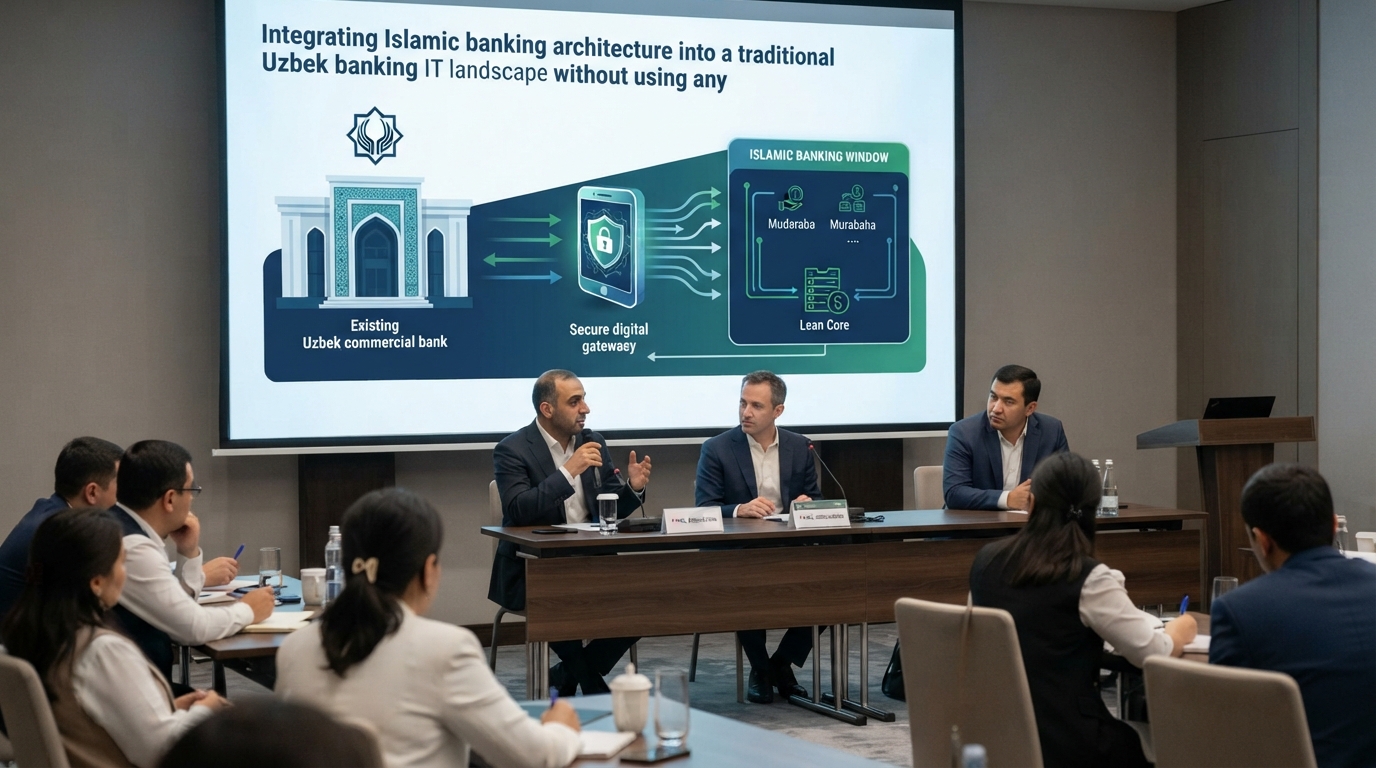
Representatives of Green Light, Profinch, and Oracle discussed IT architecture, accounting, and information security issues for implementing Islamic banking in Uzbek banks at a closed meeting in Tashkent. During the event, product launch models for Islamic windows and international experience were reviewed.
Islamic banking in Uzbekistan: which architecture to choose and how to prepare the IT infrastructure?
A demand for Islamic finance has emerged in Uzbekistan: the law has been adopted, and according to the Central Bank, more than ten commercial banks are preparing to introduce new instruments. The speed of launching an Islamic window depends on the decisions made beforehand. "What products should be offered to customers?" "How to set up accounting and control?" "How to integrate the new direction into the existing infrastructure?" Mistakes at this stage lead to additional costs, and whoever's architecture and IT foundation is first ready to safely integrate the Islamic window will win.
Uzbekistan's banks can traverse this path faster by relying on a reliable IT base and international experience. Such an opportunity is provided by the partnership of the system integrator Green Light, the international company Profinch, and the vendor Oracle. Together, they held a closed meeting "Islamic Banking in Uzbekistan — High-Level Dialogue". On September 17, an event was held in Tashkent for heads of banks and departments responsible for implementing Islamic banking. The main topic of the event was the preparation of the IT landscape and practical issues of product logic.
The central part of the event was a panel discussion with representatives of foreign Islamic banks. Muhammad Adil Siddiqui (Bank Nizwa, Oman), Faizan Ahmed (Trustbank Amanah, Suriname), and Khalid Al-Kayumi (Alizz Islamic Bank, Oman) analyzed the launch of Islamic banking using real examples — discussing how processes were set up, how teams were trained, how product economics were evaluated, and how Sharia governance was organized. The meeting participants discussed with their foreign colleagues the tasks of implementing and developing Islamic business in Uzbekistan. Special attention was paid to practical difficulties and ways to overcome them.
Islamic banking is capable of expanding access to financial services for citizens and entrepreneurs. For customers for whom the compliance of products with Islamic principles is important, it opens up additional opportunities, while allowing banks to expand their product range and attract new customers. At the same time, the main question for chairmen and shareholders is "how to build a sustainable direction with economics and growth potential?".
Implementation teams, on the other hand, are interested in ensuring the launch within the set deadlines and avoiding changes.
"An Islamic window is a large-scale infrastructure project, where the launch of new products affects the bank's IT landscape in four directions simultaneously," said Artyom Sklyarov, Sales Director of Green Light in Uzbekistan.
Banks need to create isolated segments of corporate networks, allocate new server capacities for a parallel accounting circuit, provide customer service channels (call centers), and, most importantly, establish strict information security mechanisms for data separation and access control.
Hardware and network readiness must be complemented by a well-thought-out architecture at the software level. Kirill Alyakin, Regional Director for Central Asia and the Caucasus at Profinch, demonstrated the company's approach to launching Islamic banking and presented successful examples of its implementation in Middle Eastern and African countries. Using the example of completed projects, he showed how the accumulated experience helps to choose the right launch model, avoid typical mistakes, and shorten the time-to-market for Islamic products.
An incorrect accounting model, excessive system customization, or late-detected data issues can inflate the budget and delay the launch. The experience of similar projects helps to identify these risks in advance. The bank gains practical knowledge: it learns what processes to prepare before the first transaction, what to implement step-by-step, and which solutions will allow expanding the product line.
At the same time, international practice requires adaptation to local requirements, payment infrastructure, and banking processes.
Green Light and Profinch have experience in localizing and implementing banking IT solutions in Uzbekistan, which allows linking the product model with technical implementation in local conditions.
A successful implementation begins with abandoning the typical approach of "automating everything as it is." This is the opinion of Bakhtovar Yusufi, a member of the supervisory board of Openbank and an experienced specialist in implementing Islamic banking. If one tries to place CRM, ERP, conveyor, and reporting in the CBS, the system becomes a "monolith". It becomes difficult to update, and technical debt and risks increase.
The solution is Lean Core, i.e., a lightweight core. It retains only the general ledger, balances, and bulk transaction processing. KYC, business process management, fixed assets, and business expense accounting are moved outside of it. At the same time, it is safer to launch Islamic products according to the Sidecar principle: specialized modules run in parallel with the existing system. The bank enters the market quickly and tests integrations without putting the main CBS at risk.
During the event, other conditions for a successful start were also discussed: a real set of first-stage products, separate accounting of Islamic transactions, distribution of authority, and control. Data and staff preparation should be carried out simultaneously with platform configuration: balance reconciliation, test migration, and training directly affect the bank's readiness to launch.
"The technological foundation of this approach is Oracle FLEXCUBE for Islamic Banking. FLEXCUBE supports AAOIFI standards and operates in more than 100 Islamic banks worldwide," Oracle representatives noted.
The platform is used in Islamic banks around the world, including major players in the Middle East.
Combined with Green Light's infrastructure base and Profinch's expertise, this creates a reliable foundation for Uzbekistan's banks to develop a new direction.
By combining global experience with IT implementation practice in Uzbekistan, Green Light and Profinch help banks make informed decisions and move faster from strategy to effective products. The goal of this work is to develop the market for quality banking services, expand opportunities for customers, and contribute to the prosperity of Uzbekistan.
Over 13 years in the Central Asian market, the integrator Green Light has implemented more than 300 projects, including projects for Uzbekistan's Aloqabank, HamkorBank, InfinBANK, Octobank, and other financial institutions. Drawing on this experience, Green Light, in partnership with the international company Profinch, helps banks go all the way from studying and designing the architecture to integration and further support of the Islamic window.