

Is tracking your food purchases good for your health?
Food tracking apps are popular, but are they a good way to make us eat a healthier diet?
Is monitoring your food purchases beneficial for your health?
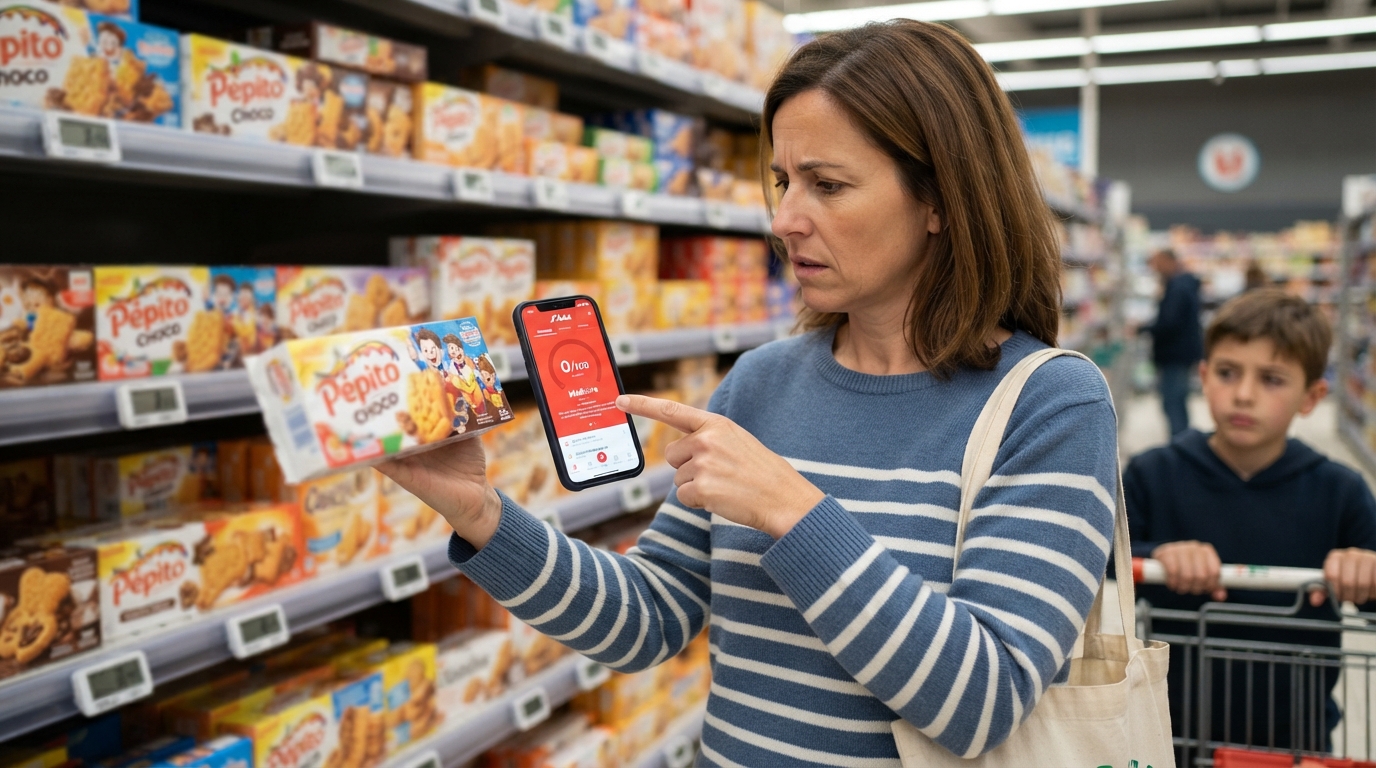
Nathalie utilizing the Yuka app
While holding a packet of biscuits in one hand and her smartphone in the other in the sweet biscuits aisle of her local Hyper U supermarket west of Paris, Nathalie is alarmed.
"Look at this!" she exclaims, showing her phone, which displays a score of 0/100 in red.
"This is one of Malo's [her 12-year-old son] favorites, but it’s loaded with sugar and saturated fats, plus it contains four additives, one of which poses a health risk," she explains.
Nathalie taps on the concerning additive: E450. "A mineral that, when consumed in excess, can cause issues with bone marrow and kidneys," she reads aloud.
"Honestly, it drives me crazy that they can include such ingredients in food targeted at children!" she adds.
We then scan an Italian alternative, whose packaging suggests it was crafted by peasant women in traditional black shawls.
The score isn’t much better: "Malo hates shopping with me now," Nathalie admits. "It takes forever to scan everything, and he can never get what he wants."
After triggering a red alert, the app recommends a healthier option. It’s organic and includes whole wheat, fruit, and fiber.
"You end up buying a lot more organic products, so it’s pricier," she notes.
Nathalie is among a rising number of users of Yuka, an app created in France, aimed at promoting healthier shopping habits—not just for food but also for cosmetics and toiletries.
By downloading the app, users can scan the barcodes of any of the six million products in the Yuka database (with about 1,200 new items added daily) and receive immediate feedback—green for good, red for bad, yellow for could be better. For those seeking more information, the app offers extensive details.
Launched in 2015, Yuka now boasts 85 million users across 12 countries, including several in Europe, as well as the US, Canada, and Australia.
The UK ranks as the third-largest user base with around five million, France follows with six million, but the US leads significantly with 28 million users.
Yuka has garnered notable supporters in the US, including Robert F. Kennedy Jr., who served as Donald Trump’s Secretary of Health and Human Services, and claims it is his favorite app.
Yuka employs a traffic light system along with additional nutritional information.
Although Yuka was founded in France, where its headquarters remain, co-founder and CEO Julie Chapon relocated to the US three years ago due to the app's success there.
She believes the app thrives in the US because the demand is greater. "I’m excited to be in a country where there is still so much progress to be made," she diplomatically states.
In France, Yuka is part of a broader trend in food tracking.
In 2012, French programmer Stéphane Gigandet launched Open Food Facts, a free, online, crowdsourced food product database during Food Revolution Day, an initiative by British chef Jamie Oliver.
This community-driven non-profit now provides information on over four million food products globally.
Additionally, just two months after Yuka's debut, the French government introduced the Nutri-Score labeling system, created by food researcher Serge Hercberg from Paris' Sorbonne University.
"I was particularly inspired by the UK's Traffic Light system, which uses green, amber, or red indicators for sugar, fat, salt, and calories, but I wanted something simpler. The Nutri-Score offers an overall score, allowing you to quickly assess whether a product is healthy or not," he explains.
After some negotiation with the food industry, Nutri-Score became a voluntary front-of-pack label for pre-packaged foods. Many major food companies, including Danone and Nestlé, have widely adopted it, although some brands—especially those that would score poorly—choose to opt out.
"Apps like Yuka and Open Food Facts help bridge that gap," Hercberg states.
They also provide more detailed information than Nutri-Score, such as data on additives (chemicals added for preservation or coloring, often labeled as e-numbers), which are strong indicators of ultra-processed foods.
France's government food labeling initiative is Nutri-Score.
However, there are limitations to Yuka, according to Christian Reynolds, Reader in Food Policy at City St George's University, London, who notes that technology is just one part of a broader solution, and research indicates its limitations.
"I contributed to a [British government] review on how people engage with labels and information, and the conclusion was that few individuals have the time, capacity, or desire to engage with shopping and food choices beyond their usual routines."
Hercberg acknowledges the limitations of food tracking systems as well: "Unfortunately, they primarily reach the more privileged segments of