

Is Russia proving better at protecting friends than fighting enemies in West Africa?
Russian forces were brought in to help defeat jihadists but they also defend the military leadership in Niger.
Is Russia proving more effective at shielding allies than defeating foes in West Africa?
Niger’s embrace of Russia, along with that of other Sahel states, has been interpreted as a rebuff to post-colonial Western powers.
When mutinous soldiers took over a key military base in Niger’s capital last Saturday, the ruling junta in the country turned to a foreign partner it has depended on more and more since taking power: Russia.
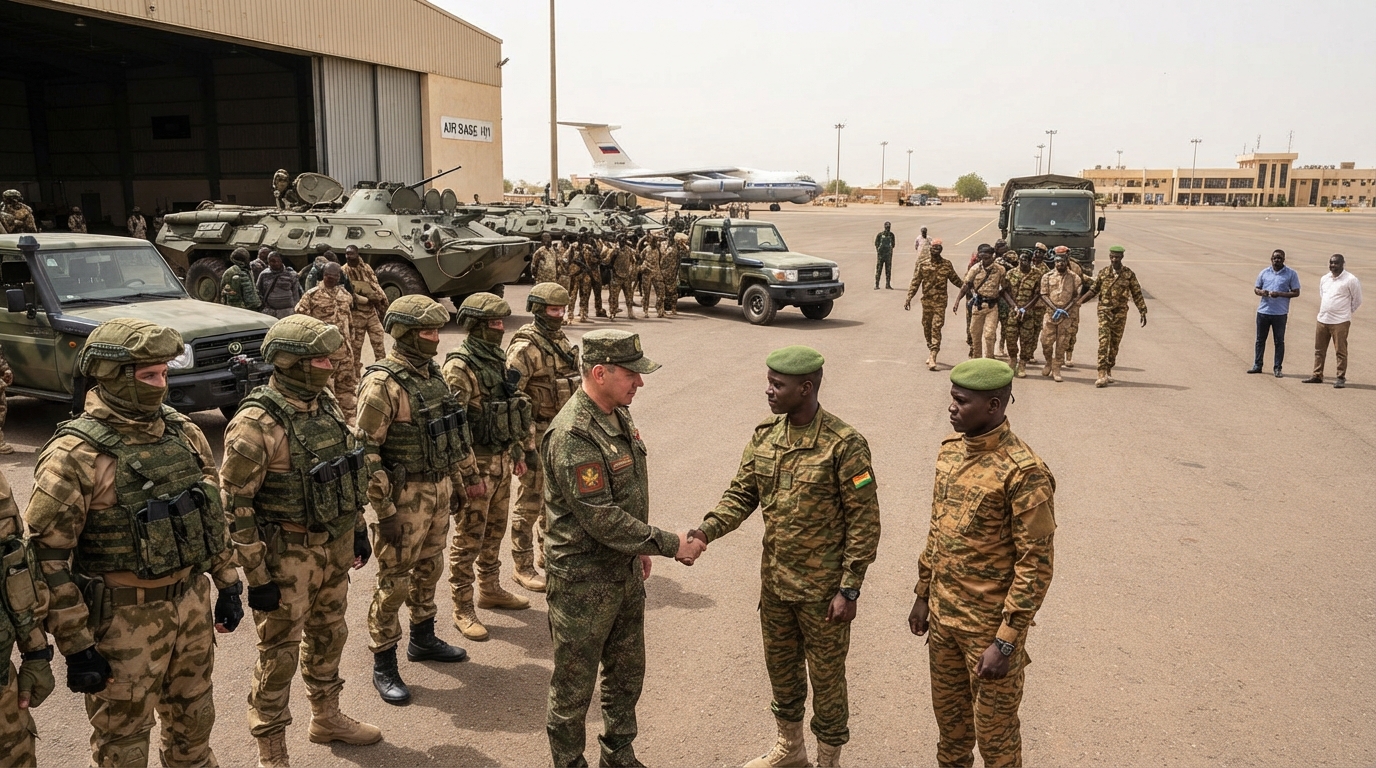
After a night of heavy fighting in Niamey, Russia’s Africa Corps helped Nigerien loyalist forces retake Air Base 101 at Diori Hamani International Airport.
Africa Corps, unlike the Wagner Group that came before it, is directly controlled by Moscow’s defence ministry. It offers combat support and military training and is believed to have about 200 to 300 personnel in Niger.
Russia’s ambassador to Niger, Viktor Voropaev, openly confirmed the weekend intervention, saying his country’s forces had helped “repress a mutiny”.
“This is seen as a symbolic victory,” said Beverly Ochieng, senior analyst at Control Risks. “[One] that will continue to put them at the centre of not just the counter-insurgency campaign, but even in the protection and prolongation of military rule.”
The attempted coup may be the clearest sign yet that Africa Corps’ work in three Sahel countries goes beyond its declared aim of helping governments fight jihadist insurgencies.
Russia is increasingly showing that it can offer something perhaps even more valuable to the military rulers of Niger, Mali and Burkina Faso: protection for the governments themselves.
After the mutiny was crushed, state television aired images of some of the soldiers being arrested.
“It was not sufficient to bring stability,” Ochieng said, “but it’s enough to allow these military governments to have a political lifeline.”
The failed mutiny also exposes something the junta may not wish to acknowledge: how reliant it has become on Moscow for security.
In January, Africa Corps personnel also played a major role in repelling an attack at the same airport.
“We saw videos of the jihadists walking around the airport basically completely unimpeded,” said Jacob Boswall, a security analyst who follows jihadist activity for the BBC’s media monitoring service.
“Probably there is some substance to the claim that Africa Corps was able to restore power in that case [in January]. And I think, again, in this case as well, that intervention was very significant.”
One of the Nigerien military’s main justifications for the July 2023 coup, in which Gen Abdourahamane Tiani took power, was the worsening security situation and the alleged failure of Niger’s civilian authorities, under elected President Mohamed Bazoum, to address it.
They also blamed Western partners at the time for their inability to curb jihadist violence.
Yet three years later, the insurgency remains unresolved.
Militants linked to al-Qaeda and Islamic State have kept launching attacks, including in the Tillabéri and Dosso regions, some of them causing heavy losses for security forces.
Ochieng said this latest mutiny showed long-running grievances inside Niger’s own military, made worse by the pressure the soldiers have been under.
“Counter-insurgency forces do not feel adequately supported by the military government,” she said. “There have been challenges in providing equipment and replenishments.”
On Wednesday, soldiers appeared at a pro-junta rally in the capital, Niamey.
Niger’s government is under pressure on two fronts: extremist militant groups attacking the state, and grievances within the armed forces tasked with fighting them. Africa Corps may have helped contain the second threat last weekend, but it has not solved the first.
Unlike Wagner mercenaries, whose private military company status gave Moscow some deniability, Africa Corps is a much clearer arm of the Russian state.
“The whole point of Africa Corps is that it brings the power back under the control of the Russian Ministry of Defence,” Boswall said.
Officially, its troops are deployed to help Sahel governments fight Islamist militant groups.
But dissidents considering moves against military governments elsewhere in the Sahel may now have to take Russian forces into account.
Despite the struggle against the jihadists, no one expects Africa Corps to leave the Sahel anytime soon. Keeping those governments in power protects Russia’s investment.
“Wagner - and now Africa Corps - have always had a very transactional interest in Africa,” Boswall said.
“If they can get mineral resources in exchange for providing protection and defence, then they will. We see that in Mali with gold… and then in Niger, it really is uranium [that] seems to be the main resource that Africa Corps is protecting.”
Analysts say Russia also gains from having friendly governments that can back it in international forums.
“Having that kind of international group of supportive countries, Russia sees as giving Russia credibility - diplomatic credibility,” Boswall explained.
Like Mali and Burkina Faso, Tiani’s government has built much of its legitimacy around sovereignty, pan-Africanism and liberation from former colonial powers.
All three governments ordered French troops out. They also created the Alliance of Sahel States (AES) and later withdrew from the West African regional bloc Ecowas, presenting the new alliance as a statement of regional independence.
Some analysts see this as inconsistent with their growing dependence on Africa Corps.
“The military governments argue that they have selected Russia on their own terms,” Ochieng said.
“Russia is seen as a partner that respects that sovereignty, unlike their previous partnerships with France or even the EU and, to some extent, with the US.”
Niger’s Gen Abdourahamane Tiani (C), Mali’s Gen Assimi Goïta (L) and Burkina Faso’s Capt Ibrahim Traoré (R) gathered for the first heads of state summit of the AES in 2024.
An army captain on Niger state television blamed foreign powers, including France and Chad, for last weekend’s unrest, while Russia’s foreign ministry called the mutineers “extremists seemingly incited by European former colonial powers”.
France has repeatedly denied claims that it is trying to destabilise Niger. Chad’s government did not reply to a BBC request for comment.
“[Niger is] underplaying the role that Africa Corps has in these countries, and they’re overplaying the resource-nationalism narrative - the idea that the government is in control and fighting back against the jihadists,” Boswall said.
“There is a huge media war going on in the Sahel to control the narrative around that.”
Russia’s war with Ukraine is another major factor shaping its Sahel strategy.
The conflict continues to absorb Russian personnel and military equipment, limiting how far Moscow can expand in Africa.
“It’s quite a tightrope for Russia because ultimately its priority will always be Ukraine,” Ochieng said.
“It will maintain at least enough numbers to allow it to reassure the military governments in the Sahel that it continues to be a reliable partner. They’ll continue to deploy just enough weapons and supplies and logistics… to continue supporting Africa Corps.”
But there are limits to what that backing can accomplish. “Russia cannot afford a sustained counter-offensive anywhere in the Sahel,” Ochieng said.
That may help explain why protecting allied governments has become such a central part of Russia’s regional approach.
Defending a capital or helping loyalist forces defeat a mutiny takes fewer resources than retaking and securing huge areas affected by an insurgency.
“These are quite limited interventions, but with an outsized impact,” Boswall said.
“I think at that level they’ll be able to sustain that over the foreseeable future, even with the war in Ukraine.”
Russia may have helped Tiani survive this latest security challenge, but it has not removed the conditions that could lead to the next mutiny.
Three West African juntas have turned to Russia. Now the US wants to engage them
How has Niger changed since the coup?
Niger drops French place names to honour local heroes
War ‘tour’, football and graffiti: How Russia is trying to influence Africa
Russia outsmarts France with nuclear power move in Niger