

Is it beneficial to replace a working car with an electric vehicle? Scientists' report
Replacing a still-functioning gasoline or diesel car with an electric vehicle can, under certain conditions, reduce overall greenhouse gas emissions. Calculations in Switzerland and a separate analysis conducted in the US have yielded such a result. However, the benefit to the climate depends on the annual mileage, the source of electricity, and the subsequent fate of the old car.
How beneficial is it to replace a functional car with an electric vehicle? Scientists' report
A study commissioned by the Swiss Federal Office of Energy (BFE), whose publication was initially suspended, was disclosed in the summer of 2025. Therefore, the interpretation that the report is still being hidden from the public is incorrect.
The publication Republik and the research group WAV obtained the report and the agency's internal correspondence through the freedom of information act. The correspondence revealed that employees feared a negative reaction to recommendations about replacing functional cars. Such an approach could seem detached from the financial capabilities of the population.
The BFE also noted that if an old car is not scrapped but sold to another person, it remains unknown how much global emissions would actually be reduced.
After the issue became public, the agency uploaded the 34-page report to its website. The date of January 6, 2025, on the cover of the document indicates when it was prepared. Meanwhile, INFRAS, the company that conducted the study, separately explained the results and the model's limitations on August 4, 2025.
The calculation took into account the entire life cycle of the car — emissions from production, fuel and electricity generation, operation, and disposal processes.
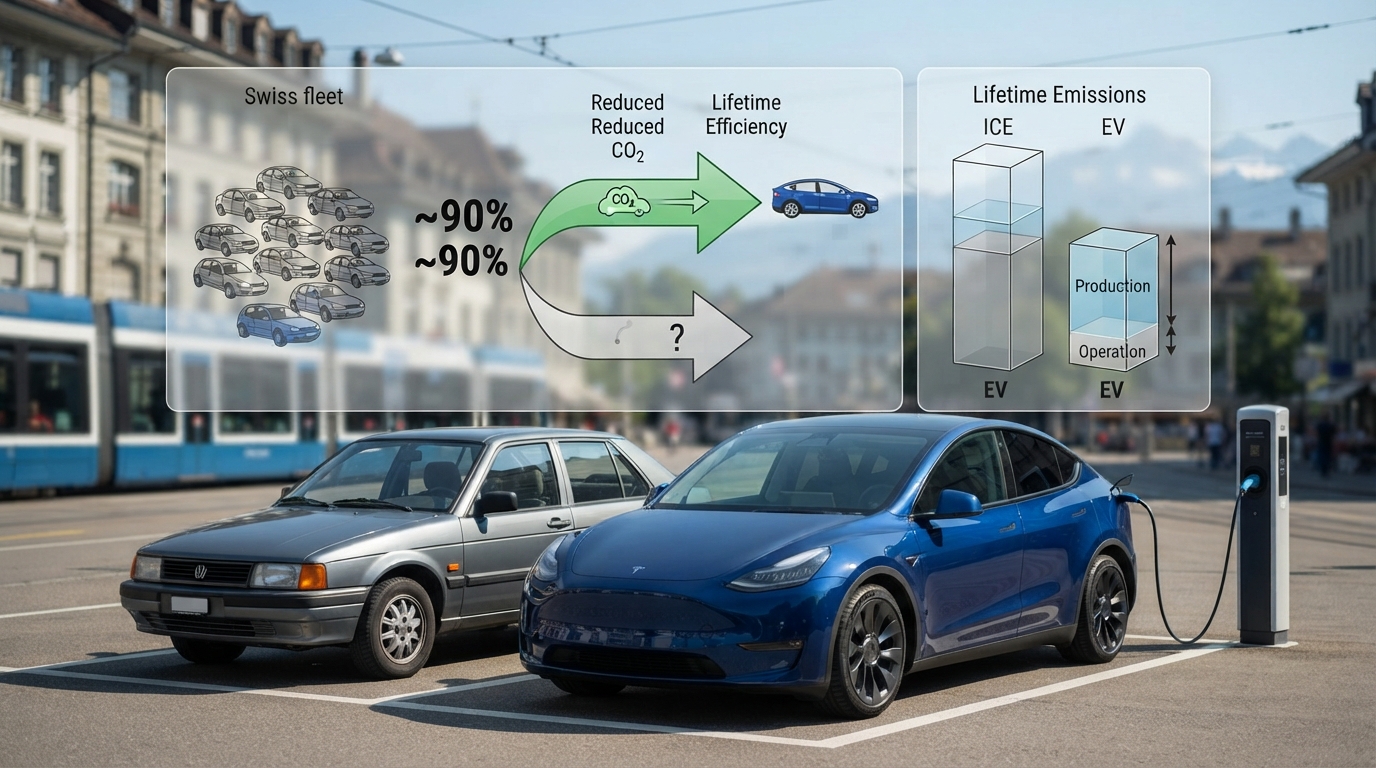
According to the authors' assessment, replacing approximately 90 percent of internal combustion engine cars in the Swiss fleet with a new electric vehicle of the same category could be beneficial for the climate.
This figure does not mean that emissions will decrease by 90 percent. It represents the share of cars for which replacement would yield a positive result. The analysis is dedicated to greenhouse gases and does not prove that electric vehicles are superior in all environmental indicators.
The main results are based on a scenario where the old car is scrapped. If it is resold, it must also be considered whether it replaces another, more fuel-consuming car for the new owner, or simply increases the number of cars on the roads. The authors admitted that they could not reliably model all of these consequences.
Annual mileage is also important. In the Swiss model, prematurely replacing a car that travels less than approximately 4,000–5,000 kilometers per year generally did not justify itself from a climate perspective. With higher mileage, the emissions saved during the operation period more quickly offset the emissions generated during the production of the new car.