

Is Israel achieving peace through wars?
In three years, Israel has severely weakened the military capabilities of Hamas and Hezbollah, dealt a major blow to Iran itself and its proxy network, and expanded its capabilities in Syria. But to what extent have these achievements strengthened the country's security? Political scientists discussed this on the "Geopolitics" program.
Is Israel achieving peace through wars?
- Over the past three years, Israel has weakened its adversaries. But why hasn't the Middle East become safer as a result?
Looking at the broader picture, the Middle East has not become safer. However, if the situation is approached from Israel's perspective, it can be seen that in the period after October 7, 2023, Israel managed to weaken a large portion of the main forces threatening it.
First of all, it is necessary to address the issue of Hamas. According to the Israeli army, Hamas's numerical potential may not have decreased sharply, but its ability to wage effective war has significantly weakened. The second main force is Hezbollah. It is considered one of the main threats to Israel and an important proxy for Iran. Nevertheless, Hezbollah is currently also incapable of conducting a large-scale war. Israel carried out very serious military operations against this group, significantly reducing its potential.
After that, the situation in Lebanon also changed. As Hezbollah weakened, Israel began to act much more freely in Lebanon. Despite the objections and calls of the international community, Israel expanded its military capabilities on Lebanese territory.
Another important direction is Syria. In certain periods, under the pretext of supporting the Druze, Israel acted more freely in and around the Golan Heights. Most importantly, a government was formed in Syria that wants to compromise or agree with Israel on certain terms.
Historically speaking, the main centers of threat in the region for Israel have changed over time. Until 1979, Egypt was one of the main adversaries for Israel. After the peace treaty with Egypt was concluded, this problem was sufficiently resolved for Israel. Later, states like Iraq and Syria were seen as sources of threat. After the fall of the regime in Iraq, this direction also changed. Now in Syria, too, there is a government ready to reach an agreement with Israel.
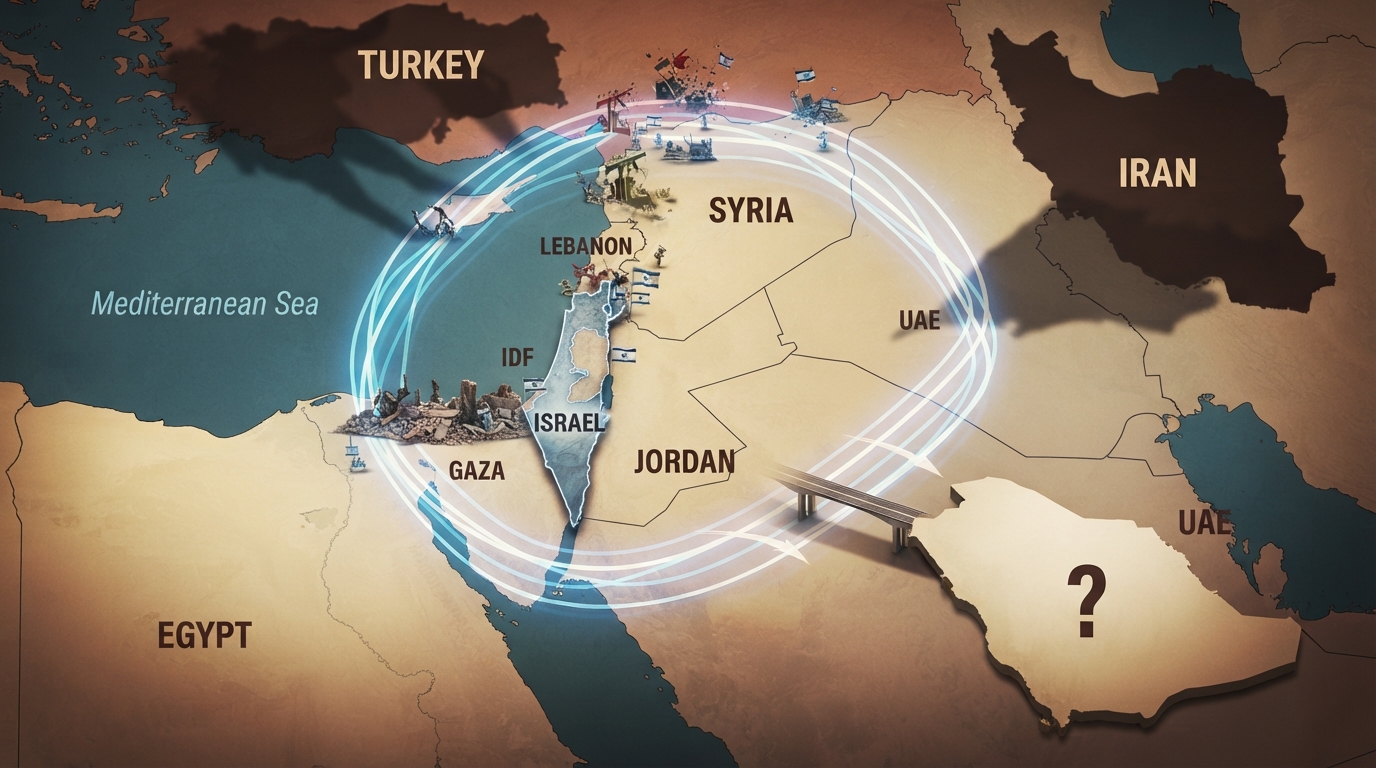
In today's situation, the countries where the greatest confrontation for Israel remains are Iran and Turkey. In this sense, it can be said that Israel was able to form a certain security belt for itself in a wide area from its borders to Yemen. Of course, how strong this security belt is and how long it will last remains an open question. However, most of the groups seen by Israel as the main threat prior to October 7, 2023, do not possess the same military power today as before. Therefore, they no longer remain a source of threat for Israel as they used to be.
The Abraham Accords must also be taken into account here. While the process of the accords was going well, the events of October 7 occurred. For Israel, the most important stage of the process was the normalization of relations with Saudi Arabia. Israel had high hopes for this and believed that an agreement with Saudi Arabia would bring relations with the entire Arab world to a new level. However, after October 7, Saudi Arabia stated that it would agree to normalize relations with Israel only if concrete steps were taken toward Palestinian statehood.