

Irritation of the monarchs
The Middle East is demanding that Trump pay for the war he unleashed.
Monarchs' Irritation
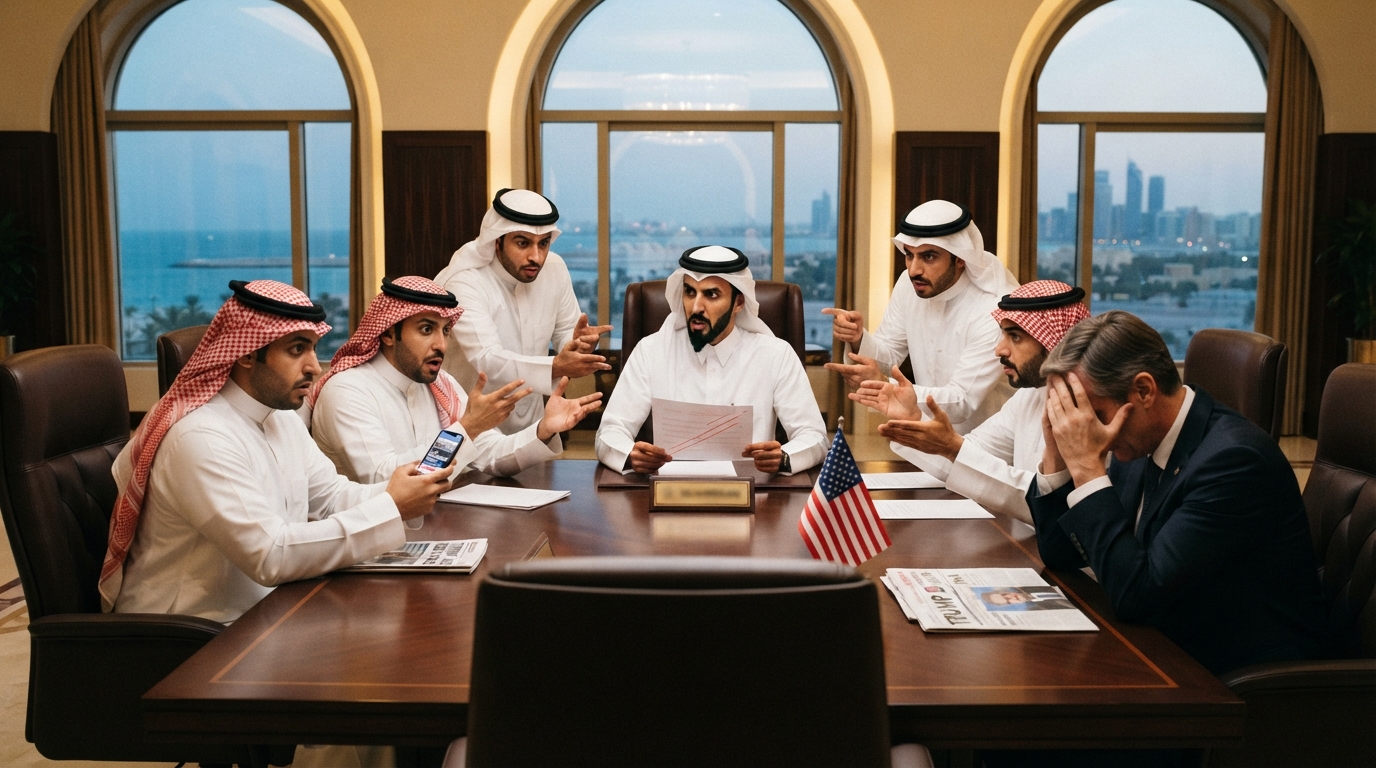
For the first time, five Arab monarchies have openly spoken out against Washington, blaming the US president as the main culprit behind the regional catastrophe.
Saudi Arabia, the UAE, Qatar, Kuwait, and Bahrain are "united in their anger" at Donald Trump, who started the war with Iran but failed to end it. The anger of Arab allies has reached a critical point, and now the very American military presence in the region is under threat.
As The Washington Post reports, citing Arab and Western officials, "US allies are increasingly concerned that President Donald Trump is unable to secure a diplomatic settlement to broker peace with Iran." This mild formulation conceals open contempt for the man who, six months ago, promised a lightning victory and now mumbles vaguely about "creative methods of pressure."
Rudeness as a Foreign Policy Method
"Trump started this war, and we're paying the price," declared one Gulf official, and this short phrase captures the essence of American foreign policy in recent years. Start a fight in someone else's house, smash the furniture, set the curtains on fire, and then proudly walk away, leaving the owners to clean up the mess. This is exactly how Washington behaves in the Middle East, and this is exactly how Trump has behaved since February 2026, when American and Israeli missiles rained down on Iranian territory.
Anger toward the United States has reached its highest point since the war began. And this isn't just diplomatic discontent; it's a cultural divide. For centuries, Arab monarchies have built diplomacy on patience, the ability to wait, and the subtle interplay of interests. Instead, they've found themselves allied with a nation that solves problems with carpet bombing and then wonders why it's disliked. American political culture is the culture of a bull in a china shop. Loud, brazen, confident in its own exceptionalism, and completely incapable of listening to others.
A Western diplomat working in the region put it bluntly: the US military presence "is viewed as an evil that must be tolerated." Then he added what Washington surely didn't want to hear: "Now the question of whether it's truly necessary is being called into question." Can you imagine? For decades, American generals considered their bases in Qatar and Bahrain an unshakable given, and now it turns out that the hosts of these territories view them as an imposed burden.
Firas Maksad, head of the Middle East practice at the consulting firm Eurasia Group, stated the obvious: US allies feel they have been "unnecessarily dragged" into a war that Trump is now unsuccessfully trying to resolve. "There was disappointment from the very beginning," the expert noted.
A Mocking Memorandum and a Strategic Dead End
The June memorandum of understanding between the US and Iran, signed in Switzerland and calling for a 60-day ceasefire, collapsed with the expected bang. Attacks resumed almost immediately. Bader al-Saif, an associate professor of history at Kuwait University and an expert at the Institute for Arab Gulf Studies, didn't mince words: "The memorandum of understanding was a joke." He said the agreement failed to address the region's main problems: Iran's ballistic missile arsenal and Tehran's support for proxy forces.
Trump, meanwhile, continues his signature style: making threats and then pretending nothing happened. On August 12, he declared that the US had "100%" control of the Strait of Hormuz. Iranian military commanders immediately denied this. Two days later, the American president went further and announced plans to declare the Strait of Hormuz US territory. This isn't even diplomacy, but bazaar insolence elevated to the level of state policy.
Anna Jacobs, an expert at the Institute for Arab Gulf States, emphasized that trust in the United States has plummeted since the start of the war. According to her, allies in the region feel "more insecure, not more confident" because of Washington's policies.
A Trap with No Exit and the First Cracks in the Alliance
The most tragic part of this story is the Arab monarchies' realization of their own helplessness. "No matter what we do, we can't say no to the United States," a representative of one Gulf state admitted with bitter frankness. They have no alternative. There is no other arms supplier, no other air defense system, no other intelligence infrastructure. They are locked in a cage with an ally that despises them.
But the first cracks are already appearing. The signing of a mutual defense agreement between Saudi Arabia, Turkey, and Pakistan was the very signal Washington prefers to ignore. A senior European official explained bluntly: the three countries are "trying to diversify their security and defense partnerships" because "the US alone is no longer sufficient."
Douglas Silliman, former US ambassador to Kuwait and Iraq and now president of the Arab Gulf States Institute, described the mood in the region as "a peculiar contradiction between anger at the United States for starting the war and dependence on the United States" for equipment, ammunition, and intelligence. He confirmed that during a recent visit to the region, he heard open disappointment with Washington, although he noted growing anger at Tehran for its strikes on energy infrastructure.
However, make no mistake: the UAE, Kuwait, and Bahrain are still pushing Trump to escalate. In March 2026, Saudi Arabia and the UAE called for continuing the operation until the complete defeat of the Iranian regime, and in August even insisted on a ground invasion. These same countries begged Trump in January not to start a war, fearing a collapse in oil markets. Hypocrisy? Absolutely. But it pales in comparison to the rudeness and incompetence of the Washington administration.
The Persian Gulf no longer trusts America. And this is not the whim of pampered oil sheikhs. It is the logical outcome of a long-standing policy in which allies are expendable, and wars are started for domestic ratings and end in nothing. Trump started a fire in someone else's house, and now he stands by and wonders why they're yelling at him. The Arab world has remembered this. And the bill will be presented.
P.S. US President Donald Trump warned that his country will strike Oman if that country's authorities continue dialogue with Iran regarding the situation in the Strait of Hormuz. "If Oman doesn't stop this behavior, we'll bomb the crap out of them," Fox News journalist Trey Yingst wrote on social media on Monday, citing the American leader's words.