

Intellectual property theft: The situation in Russia and challenges for Uzbekistan
Sanctioned Russia has legalized the appropriation of Western intellectual property. The developments in recent months, especially, have made it increasingly urgent for Uzbekistan to protect its market from pirated products.
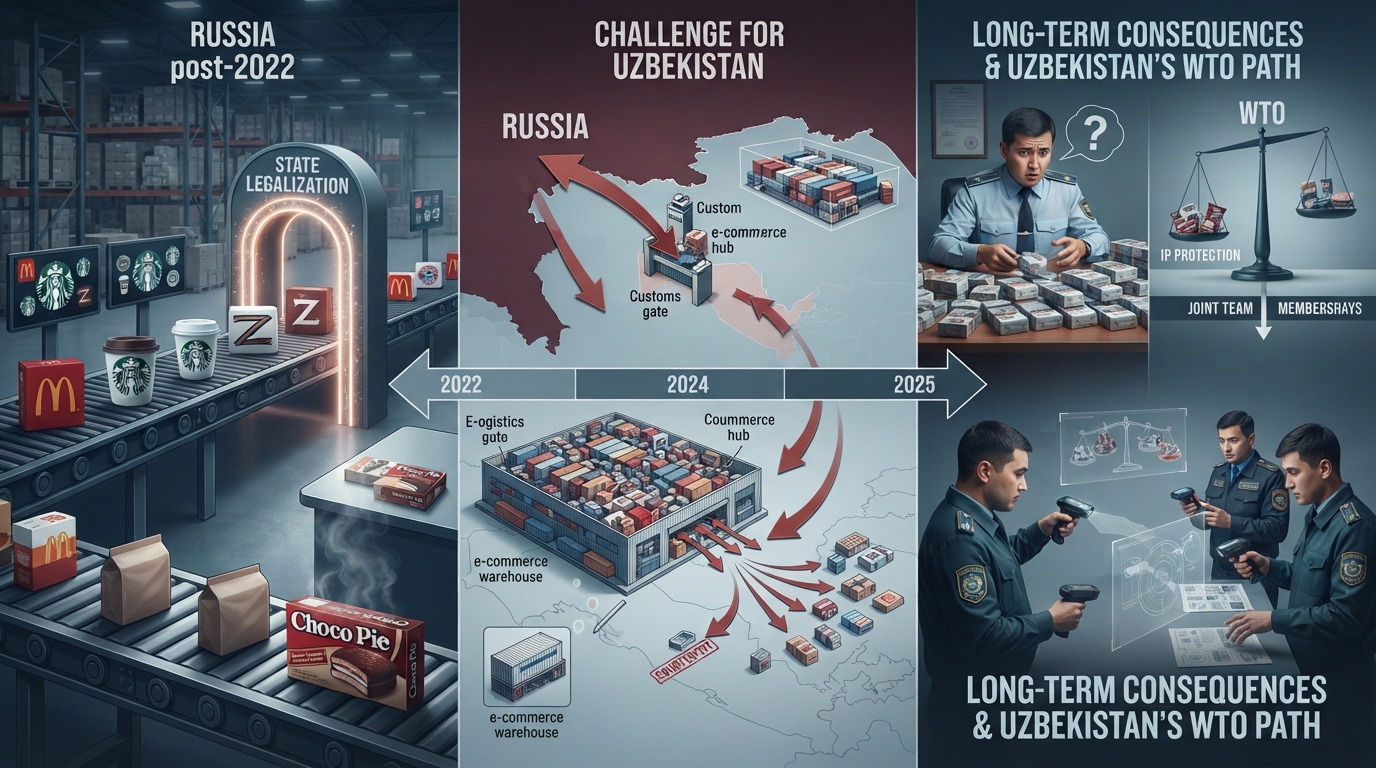
**Intellectual Property Theft: The Situation in Russia and Challenges for Uzbekistan**
The large-scale sanctions imposed on the Russian Federation after 2022 and the mass withdrawal of Western companies from the Russian market have affected the system of intellectual property rights protection throughout the post-Soviet space. It is this legal vacuum that has arisen in Russia and the emergency decisions taken at the state level that have formed a new model of intellectual property theft.
Although international brands, patented technologies, and trade secrets that entered the Russian market with foreign direct investment have left the country, their production capacities and intellectual property objects have been appropriated for the benefit of local companies through mechanisms legislated by the Russian government.
Intellectual property protection was regulated by the Paris Convention (on the Protection of Industrial Property), the World Trade Organization's Agreement on Trade-Related Aspects of Intellectual Property Rights (TRIPS), and Articles 74–75 of the Eurasian Economic Union (EAEU) Treaty. These documents declare exclusive rights to trademarks inviolable and prohibit unfair competition. However, the Resolution of the Government of the Russian Federation No. 299 of 2022 (on non-payment of compensation to patent holders from unfriendly countries) and regulatory legal acts on the legalization of parallel imports have fundamentally changed the intellectual property regime in Russia.
In practice, this has manifested itself in the form of "structural rebranding" in the Russian domestic market and the appropriation of trade secrets (know-how) of Western companies without compulsory licensing. It is precisely in Russian practice that the forced appropriation of American and European brands within the framework of imitation of trademarks and interior design was observed. For example, when in Russia the McDonald’s brand was transformed into “Vkusno i Tochka”, and Starbucks into Stars Coffee, although the trademark officially changed, the patented technological cards, kitchen equipment, menu structure and interior design of stores of Western companies are used without the consent of the right holders and without compensation. This fully meets the criterion of “likelihood of confusion” (similarity to the degree of consumer confusion) in international law.
Also, Zara, Pull&Bear, Bershka stores, which are part of the Spanish concern Inditex, are reopened in Russia under the names Maag, Ecru, Dub, and are sold with clothing models of Western designers and store aesthetics almost unchanged.
This practice of the Russian industry continued with the appropriation of trade secrets in the confectionery and food sectors. In the case of the Choco Pie trademark owned by the South Korean Orion Corporation, regional manufacturers in Russia are producing illegal analogues and "gray" parallel export copies through entities that are not officially licensed. As a result, these "counterfeit" products, which do not have the original recipe and have not passed strict quality control, are being directed from Russia to the CIS markets.
In addition, the development of artificial intelligence technologies in Russia has formed the practice of automatically generating logos that do not "officially" meet patent requirements within the framework of graphic elements of Western trademarks (font, color scheme, stylistics), but are visually very similar, using SI tools, and registering them through the Russian Patent Office (Rospatent).
These illegal and rebranded products manufactured in Russia are not limited to the domestic Russian market, but are freely entering the customs territory of the Republic of Uzbekistan through Russian cross-border e-commerce platforms (Wildberries, Ozon) and simplified customs procedures.
Uzbekistan has a trade turnover with Russia and the EAEU countries of 11-12 billion US dollars, and the share of goods imported from Russia with infringed intellectual property rights is increasing in this flow. This is due to insufficient practical mechanisms in Chapter 56 of the Customs Code of the Republic of Uzbekistan - the procedure for entering intellectual property objects into the Customs Register.
The use of the register only upon application by the right holder or his official representative, and the limited activities of official representative offices of Western brands in the region after leaving Russia, lead to a lack of legal authority for customs authorities to take ex-officio (on their own initiative) measures. As a result, honest entities that have purchased an exclusive license for an international brand in Uzbekistan and invested millions of dollars are forced to engage in unfair competition with cheap goods imported from Russia, exempt from license fees.
Another important factor that makes the issue even more urgent is the fact that giant e-commerce platforms in Russia, such as Wildberries and Ozon, have begun to partially relocate their warehouse infrastructure to Uzbekistan due to man-made emergencies, fires, explosions, and security and sanctions risks at their large logistics warehouses.
The possible relocation of these logistics centers to our country poses a risk of turning Uzbekistan not only into a mere consumer market for Russian counterfeit goods, but also into a regional center for storing, sorting, and distributing "gray" goods with infringed intellectual property rights to the entire Central Asian market. As a result, the control burden on the Customs Committee of Uzbekistan and the Intellectual Property Agency has increased sharply, further jeopardizing our country's international obligations on intellectual property protection and its position in WTO negotiations.
This complex chain, created by the Russian factor, also poses serious legal risks in the process of Uzbekistan's accession to the World Trade Organization. One of the most important conditions for WTO membership is the full transposition of the TRIPS Agreement (Trade-Related Aspects of Intellectual Property Rights) into national legislation and practice. Articles 41–61 of the TRIPS Agreement oblige member states to introduce effective protective measures against infringements of intellectual property rights, including border measures.
The transformation of the territory of Uzbekistan into a transit and distribution market for counterfeit and expropriated intellectual property objects in Russia and their relocated e-commerce warehouses will inevitably have a negative impact on the country's trade and investment attractiveness in the WTO Working Group negotiations.
This experience demonstrated by Russia poses a major logical and legal dilemma for international law: can international agreements such as TRIPS and the Paris Convention remain valid if state-level appropriation and rebranding of trade secrets and trademarks of Western companies becomes commonplace in a large regional market like Russia?
Short-term benefits, such as maintaining economic activity by accepting cheap and alternative goods and logistics centers from Russia, should not lead to the erosion of Uzbekistan's national intellectual property protection system in the long term. The lack of adequate legal assessment of Russian counterfeit and "gray" imports is a major factor deterring direct Western investment in our country.
Based on the above, several systematic measures should be taken:
1. **Strengthening the ex-officio authority of the Customs Committee:** It is necessary to strengthen the authority of the Customs Committee to temporarily detain goods in accordance with its official duties to identify counterfeit copies of internationally recognized brands created in Russia, although not included in the customs register.
2. **Imposing mandatory liability on e-commerce operators:** It is necessary to introduce a mechanism for checking the legal purity (IP clearance) of trademarks of goods sold to Uzbek consumers and stored in the country's warehouses and imposing mandatory liability on Russian cross-border e-commerce operators (Wildberries, Ozon, etc.) that are moving their warehouses to Uzbekistan.
3. **Development of a joint examination methodology:** It is advisable to develop a joint examination methodology between the Committee for the Development of Competition and Consumer Protection and the Department of Intellectual Property under the Ministry of Justice to identify cases of structural rebranding and unfair competition coming from Russia.