

Inside the shadowy world of anti-Putin sabotage from within Russia
Two men tell of the work they say they have been doing to support Ukrainian intelligence during the war.
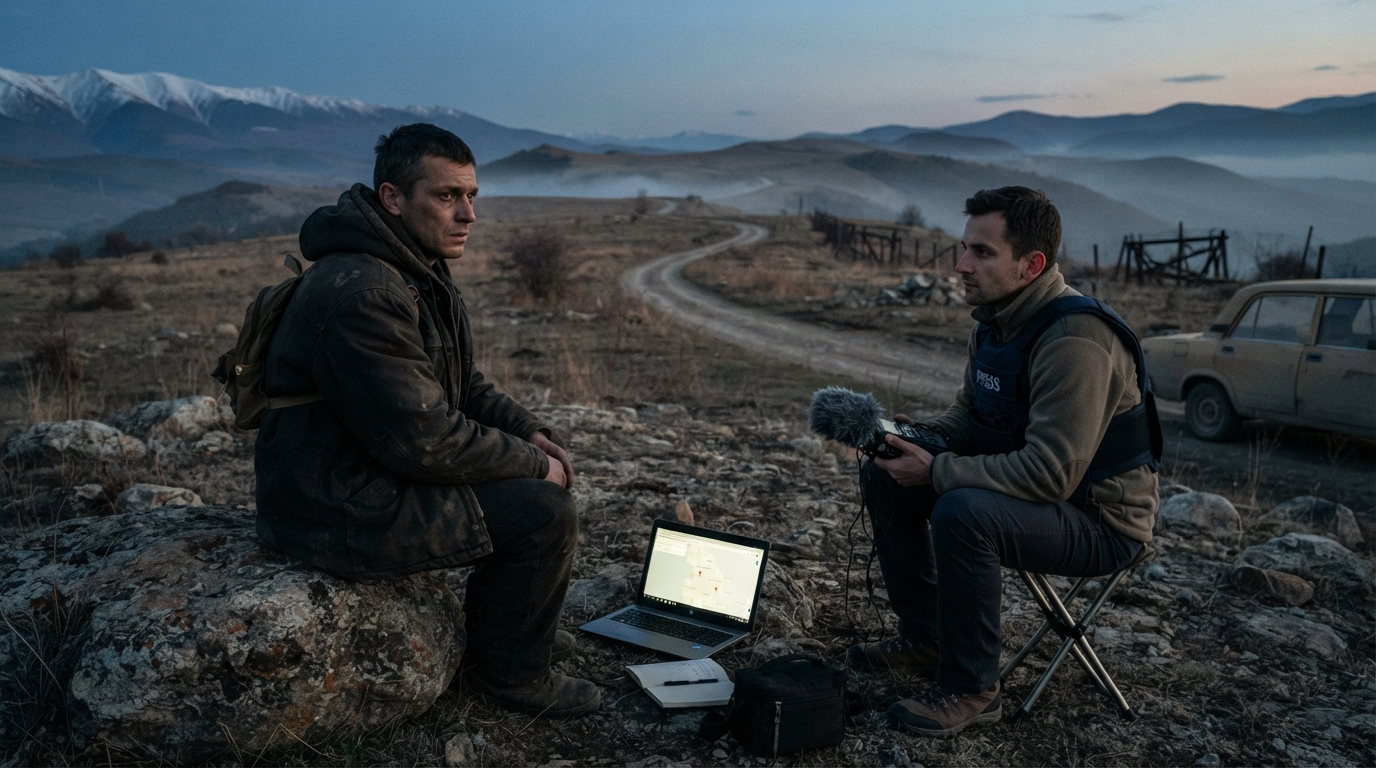
Inside the murky realm of anti-Putin sabotage operating from inside Russia
Two Russian men who are secretly assisting Ukraine’s intelligence services have offered unusual firsthand accounts of operations they say they took part in, targeting military assets and personnel within Russia.
One of them, whom we are calling Ivan, says he helped from inside Russia with Ukrainian drone strikes on strategic bombers and munitions factories on Russian territory.
He appears in a BBC World Service documentary about the hidden world of Russian saboteurs.
The film, made by independent Polish journalist Marcin Mamon, also includes a man we are calling Foma, a Russian exile living in Poland.
Foma says he leads a network of covert volunteers in Russia that watches high-ranking officers the GUR - Ukraine’s military intelligence service - is considering for targeting. He insists they are never involved in the attacks themselves.
He would not say who they were monitoring, but after Lt Gen Fanil Sarvarov was assassinated in Moscow in December last year, Foma admitted he had passed intelligence on him to the Ukrainians.
Lt Gen Fanil Sarvarov was killed in Moscow last year by an explosive device hidden under his car
There have been earlier media reports about Russian sabotage groups, but it is unusual to gain access to someone on the ground, like Ivan, describing alleged operations.
The GUR has confirmed that Ivan and Foma are both working for the agency. But it has also said it cannot see the whole picture. When Ivan’s handler was challenged on whether he could be trusted, he replied: "I'm not sure of anyone, except myself."
Both the GUR and the two men are careful about how much they reveal, which makes it impossible to verify the activities they say they carried out.
The general methods Ivan and Foma describe, however, have been acknowledged by the Ukrainian authorities. Kyiv has spoken about its strategy of coordinated drone attacks on what it says are legitimate targets inside Russia, and has admitted it uses secret agents for this.
There have also been a number of political assassinations in Russia since the war began. As a matter of policy, Ukraine never officially admits or claims responsibility for targeted attacks, although a Ukrainian intelligence officer previously told the BBC it was behind the killing of senior military figure Lt Gen Igor Kirillov in December 2024.
It is hard to establish how many Russians are doing this kind of work for Ukraine. Foma says the number is about 300-500, though that cannot be checked.
Ivan and Foma both say they oppose not only Russia’s war in Ukraine, but also President Vladimir Putin’s regime - and believe his political future hinges on the war’s outcome.
"At the moment... I think the [Putin] regime might fall if they lose the war… Through our actions... we are trying to speed this up," Ivan says.
He told Mamon that his role involved watching military sites and identifying places to conceal drone parts in preparation for possible attacks on Russian targets.
"When these [drone] components are combined… it turns out a formidable weapon, which with a single blow can destroy an object that costs many, many millions of dollars," Ivan said.
He sent Mamon a video apparently showing him hiding explosives near a Russian military airfield.
Had he been caught, he would have faced terrorism charges and decades in prison.
Foma’s role is different - he works remotely, training his volunteers in Russia online. Mamon watched him carrying out one such lesson - on how to follow a senior military official selected for surveillance.
Foma explained how he taught his undercover volunteers to trail Russian officers
"You will get a file... from me or a colleague… with the proposed target. The file will contain [the target's] photo, his data, his details, date of birth, age, and a description of him. There'll be information on his car, if he has one. When you go to the target, don't take a phone," he told his volunteers.
Foma says he was once part of Russia’s elite, giving him a distinctive network of contacts and a constant stream of insider information.
He showed Mamon on his laptop how he plotted military targets.
"This shows a database... the location of storage warehouses, and military units. Where generals live… Where the pilots of strategic bombers who shell Ukraine live.
"In order to break the system, you need to understand how it works. Then you can aim for their weak points."
He said there were about "three dozen" people in his network, divided between Russia, Ukraine and elsewhere in Europe, with those outside Russia providing logistical support, such as tracing targets’ digital footprints.
Foma stressed that the GUR proposes the people to be watched, but that he and his team independently check whether those individuals should be regarded as military criminals.
"As a rule… we also check the data [on that person]… Only after that we say whether we work or not."
But he argued that his team’s actions were justified.
"I want people who do terrible things on behalf of Putin and Russia in Ukraine… to understand that they'll have to pay for it. I want them to get scared."
Foma stressed that he only passed intelligence to the Ukrainians, and that his network did not carry out any assassinations itself.
About the killing of Gen Sarvarov, who was killed in December 2025, he later texted Mamon: "Keeping track of him took quite an effort. He lived alternately with his mistress and his colleague. Covered his tracks and constantly changed his schedule."
But Foma did not share any plans with Mamon or the BBC beforehand.
Ivan, by contrast, was guarded about the work he had been involved in, even after the fact.
Foma investigated Ivan on his own.
After checking with his military intelligence contacts in both Ukraine and Russia, he believed it was likely that Ivan had been involved in a plan to strike Russia’s largest military drone factory at Yelabuga in June last year, external. One person was reported killed in the incident.
Ivan stressed that the goal is always to avoid harming civilians.
The operations have clearly also been dangerous for Ivan.
"The most serious case was when my car was stopped for inspection and I had the handmade explosives on me. The risk was very high - however as you can see, I was not detected," he said.
To reduce the danger of exposure, "there is no clear structure" to the work, he said, adding that he had never met and did not know the identity of the others he had worked with.
Foma follows the same rule for his operatives.
"As soon as you start gathering people in groups, in general chats… leaving a mark on the internet, with a high probability this whole group will be quickly detained or destroyed," he said.
Ivan said there are very few people left in Russia who are suitable for this kind of work.
"Most of the ideological people have either left the country or are already behind bars," he said.
Many Russians involved in sabotage on their own soil are therefore either unaware - for example lorry drivers who do not know their cargo has been compromised - or are people who have been paid, the BBC understands.
Ivan, however, says he is doing this for ideological reasons - he was once a member of the political opposition. As a result, the Russian authorities would be expected to watch his movements closely.
So it came as a surprise that he was able to leave Russia and return frequently.
Mamon persuaded Ivan to drive him into the Georgian desert, where they could talk openly - and asked how the Ukrainians could trust him.
"You go to a third country… where [Ukraine's] agents meet you… and conduct lie detector tests," Ivan told him.
Mamon asked Ivan to put him in contact with one of his GUR handlers in Ukraine. The man immediately called Ivan on speaker phone - apparently showing that Ivan worked for him. They spoke in code, referring to "repairs at the school".
But later, the handler admitted he could not exclude the possibility that Ivan might also be working for the Russians, either willingly or under pressure.
Foma believes Ivan’s ability to travel freely is not necessarily a warning sign.
"There are all sorts of holes in [the country's governance], and if you know them, or are just lucky, then you can jump through the holes… and live in the system. Like a mouse in a piece of cheese," he told Mamon.
Perhaps more convincingly, if Ivan were also spying for the FSB, it would seem likely that he would pass what he knew about Ukraine’s attack plans to the Russian agency. More than a year before a devastating strike by more than 100 Ukrainian drones, Ivan had told Marcin there would be a major attack on strategic bombers at military airfields across Russia, though he never said when or where.
Marcin asked Ivan how he managed to cope with the work.
"Fear is always present," he said. "It follows me everywhere. Even if you don't do anything, you're still afraid. This is Russia."
But he said he hoped that one day his life would change.
"Putin won't live forever," he said.