

Inside secret police warehouse as Germany targets small boats gangs
German authorities seize dinghies and life jackets during their first raids under a new law that cracks down on smuggling.
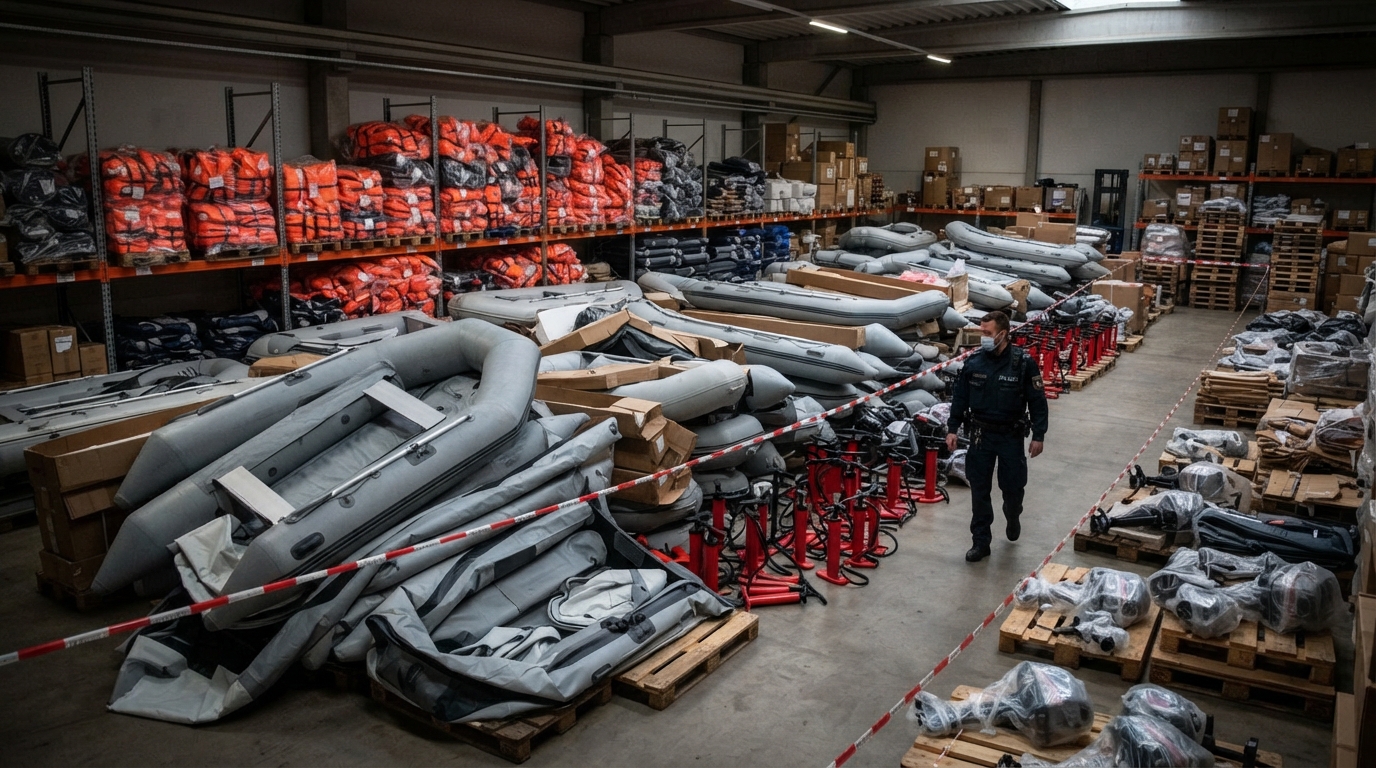
German authorities, in a significant move against small boat smuggling operations, have conducted their initial raids under a new law designed to target those facilitating illegal English Channel crossings. The BBC has learned that these enforcement actions follow Germany's emergence as a key staging post for such activities.
During a joint operation this spring involving the UK, France, and Germany in the North Rhine-Westphalia region, police confiscated over 9,000 life jackets, dozens of dinghies and engines, and 360 pumps. This equipment is now being held at a confidential police warehouse in western Germany, to which the BBC was granted exclusive access.
According to the UK's National Crime Agency, the seized boats possessed the capacity to transport more than 2,000 migrants across the Channel unlawfully. Criminal organizations have historically utilized garages and warehouses in western Germany to store such gear before moving it to northern France. However, a new law enacted by Berlin last December specifically criminalizes the facilitation of migrant smuggling to the UK.
Previously, Germany's primary anti-smuggling legislation only applied to nations within the EU's free movement zone, not to "third countries" like the UK post-Brexit. While raids have occurred in Germany before, they often necessitated French or Belgian warrants.
In 2024, Germany announced its intention to strengthen its laws to simplify the prosecution of individuals aiding migrant transport to the UK, as part of a new bilateral agreement. This decision followed a BBC investigation that highlighted Germany's role in the small boat supply chain.
Germany's Interior Ministry confirmed that these recent raids represent the first enforcement actions taken under the new law, though it did not specify if the law had been applied on multiple occasions.
The BBC observed the confiscated items at the undisclosed police facility. The seized dinghies, which officials estimate to be approximately 9 meters (29 feet) long, were deflated and largely packed in cardboard boxes, appearing much as they were discovered.
When the National Crime Agency first disclosed the raids in June, it was estimated that the equipment could have transported over 2,000 individuals across the Channel, averaging about 65 people per dinghy. This figure, while less than the "mega dinghies" observed this summer, aligns with recent averages and the general upward trend in passenger numbers.
Oxford's Migration Observatory suggests that the rise of these larger dinghies is likely linked to increased enforcement, creating an "additional incentive for smugglers to fit as many people as possible into available boats." Criminal gangs tend to adapt their illicit operations rather than abandon them when supply lines are disrupted.
The life jackets in the warehouse were tightly bundled and plastic-wrapped. Their bright orange covers contained what felt like poly-foam, deemed entirely inadequate for the unpredictable and open waters of the English Channel. The tags on the life jackets featured Chinese lettering, consistent with the known origin of much small boat equipment, which is often produced in China and transported to Europe, frequently via Turkey.
A common entry point from Turkey into the EU is the Bulgarian land border. Recently, customs officials at a Turkish-Bulgarian border crossing discovered 20 undeclared inflatable dinghies hidden among mattress pads in a truck bound for Germany.
British investigators believe that Kurdish criminal networks exert significant control over the small boats trade in western Germany, a region that has become a hub for migrants. According to one German official, gangs operate from Germany because many of their members reside there. Western Germany's proximity to, but not direct adjacency with, the heavily patrolled beaches of northern France, from where migrant boats launch, also makes it an attractive base.
Local prosecutors caution that Germany's amended legal provision remains largely untested. Bernhard Schmeilzl, a lawyer specializing in UK-German law, notes that the legal framework is essentially similar to its pre-Brexit state. However, he believes it will make a difference, even if stretched German law enforcement agencies might prioritize domestic issues. "This now enables the German police to go after these people," he stated. "If they are being notified about such suspicious activity, they will have to investigate."
Enforcement and migrant sources have informed the BBC that criminal gangs are facing increased pressure across Europe, including in Germany.
Overall Channel crossings are projected to be lower this year, coinciding with a decline in illegal entries into Europe. The UK Home Office asserts that its collaboration with countries like Germany "is bearing fruit." The UK government reports a roughly 43% decrease in crossings between January 1 and August 8 this year compared to the same period last year, attributing this to efforts to disrupt the supply of boats to gangs and increased law enforcement presence on French beaches. However, opposition politicians contend that the decline is due to adverse Channel conditions, such as wave height, rather than direct government action.