

Information sharing, financial literacy, abandoning outdated approaches. Experts on protecting against cyber threats in Central Asia
At the FinTech forum held in Tashkent, experts recommended that Central Asian countries prioritize continuous information sharing based on mutual cooperation in the field of cybersecurity and increasing financial literacy, as well as abandoning 'outdated approaches' to defense.
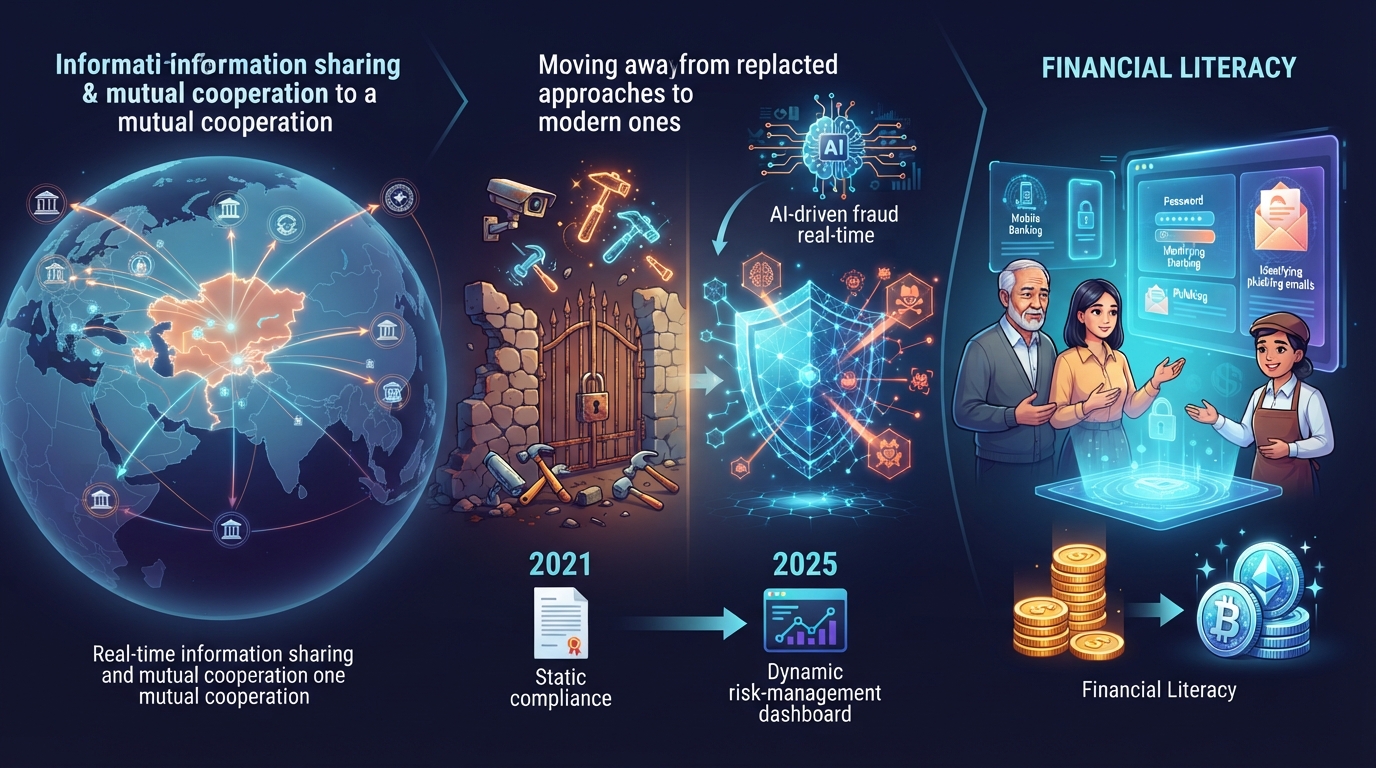
Information sharing, financial literacy, abandoning outdated approaches. Experts on protecting against cyber threats in CA
Central Asian countries should prioritize regular information sharing based on mutual cooperation in cybersecurity and increasing the financial literacy of citizens, as well as abandon "outdated approaches" in developing protection mechanisms and act "based on today's reality." Experts expressed these opinions during the panel "Trust at the speed of AI: securing payment systems and protecting against fraud" within the Silk Road Finance & Technology Forum held in Tashkent on August 24–26.
According to Artyom Saidov, Head of Cybersecurity at KPMG Uzbekistan, Central Asia is currently in the most active phase of digital transformation. The accelerated movement of funds within the country and across borders has significantly changed the methods of protection against cybercrime and fraud. Currently, artificial intelligence is expanding the capabilities of both fraudsters and financial institutions alike.
In particular, while financial fraudsters use automated intelligence and large-scale sophisticated social engineering, financial institutions rely on scoring, behavioral analysis, risk predictive modeling, and automated response measures to protect critical infrastructure. Trust is now based on proactive and dynamic resilience rather than static compliance.
According to Mirzabek Bobojonov, Head of Department at the Central Bank of Uzbekistan, the volume of digital payment usage in Uzbekistan has been growing rapidly in recent years. In particular, while the level of digital payment usage in the country was 39 percent in 2021, this figure reached 72 percent by 2025. The CB representative explained this situation by the young population ready to try new technologies and new projects. As the use of digital payments increases, the issue of security becomes even more relevant. Therefore, security must be strengthened simultaneously with the expansion of digitalization.
"The rapid development of artificial intelligence and digitalization, unfortunately, also creates certain risks in our country. Therefore, I believe that the security issue should be strengthened along with digitalization. As the CB, we are trying to regulate cybersecurity based on best practices, with the latest international standards and policies," says Bobojonov.
According to the representative of the regulator, shifting from a compliance-based approach to a risk management-based approach in supervision is the most important change currently being implemented by the CB. Taking into account that the nature of cyber threats is changing day by day, the CB acts based on cyber risks in this regard. Bobojonov announced that the CB recently completed a digitalization project, within which several documents were developed.
"One of them is the cybersecurity strategy for the banking sector. The second is the risk assessment methodology based on the maturity level of commercial banks and payment organizations. We plan to focus primarily on institutions with a high risk of cyber threats and fraud. Because we cannot cover all organizations, it is impossible to go and inspect each one. Therefore, the risk level (high, medium, or low) and the maturity level of the organization will be in our focus," he explained.
According to Bobojonov, the CB has developed a new cybersecurity framework and plans to launch it next year. He said the new framework includes completely different supervisory requirements.
"We will monitor the maturity and risk level of each organization, focusing primarily on them. It will have four levels of maturity. For example, systematically important banks will have to follow the strictest rules. Banks with fewer customers and a low level of digitalization will meet the minimum requirements set by us," he said.
Mirzabek Bobojonov said that "the threat landscape is also changing" in the sector. Now, not only attacks on banking infrastructure, but also social engineering, phishing attacks, and account takeovers are increasingly occurring.
Since the beginning of this year, about 18 million suspicious transactions have been blocked by commercial banks and payment organizations. Bobojonov noted that this is due to the requirement for financial organizations to have an anti-fraud system based on artificial intelligence.
"Nevertheless, due to the low financial literacy of citizens, this does not mean that it provides 100% protection against fraudsters. Therefore, everyone needs to be more careful, because the threats, the methods used by attackers or fraudsters are changing day by day. Therefore, we must always be prepared for new attacks or fraud cases," he noted.
Nikolay Bernstein, Senior Director of Consulting and Analytics at Visa, emphasized that proper risk management and the human factor play a central role in preventing fraud. According to him, the weakest link in the cyberattack chain is the human. Fraudsters exploit people's trust. Moreover, as the volume of digital payments increases, the cyber threat landscape and risks also expand.
"This is exactly where the main problem lies. That is, it is not about trust, but about the risks that we — all service providers, issuers, networks, and others — must take on. And we must manage these risks properly," Bernstein said. "Today, the main problems and challenges facing the ecosystem do not depend on the payment systems or the ecosystem itself. It depends more on the weakest link, which is us — the humans sitting here. The main conclusion from this is that we need to focus seriously on increasing the financial literacy and awareness of our customers."
Umid Hakimov, Chief Executive Officer of "Ipak Yo'li Bank", referring to the official statistics of the Ministry of Internal Affairs, announced that the number of cybercrimes has increased from 4,800 to over 62,000 over the past five years. During this period, the total recognized losses of individuals and companies exceeded 3.8 trillion soums. Umid Hakimov called this "a very large number" and said that about half of this amount occurred in 2025.
Umid Hakimov drew attention to two aspects in this regard.
"First, financial literacy, that is, people need to be educated and their awareness raised. Because the increase in the usage rate [of digital payments] from 39 percent to 72 percent means that there is a very large number of new users using the [digital] payment system for the first time. This means they do not have basic knowledge on security, data protection, and so on," he explained.
The second aspect, according to Hakimov, is the vulnerability of small and medium-sized businesses, which make up the largest part of Uzbekistan's economy, to cyber threats.
"Often, small and medium-sized business companies do not have information technology or cybersecurity specialists on staff. This disproportionately places all responsibility on commercial banks. Banks are addressing this issue by implementing appropriate measures in their cybersecurity systems to protect data coming from SME clients and correct their mistakes," Umid Hakimov said.
Speaking about the mistakes that could cost Central Asian countries dearly, Visa representative Nikolay Bernstein noted that minutes are enough for fraudsters to invent and create new methods of cyberattacks, while developing protection mechanisms against them still takes time due to organizational and bureaucratic processes based on "outdated approaches."
"Nowadays, social engineering has become very easy. A few minutes are enough to create fake emails to deceive users through phishing. Minutes, seconds are also enough to create certain malware to attack end users and customers, right? Or deepfakes — now it is also very easy to create and copy them. It doesn't require much skill," Bernstein noted.
According to him, cyberattack methods through social engineering can be learned with a little time using artificial intelligence itself. If the questions are asked correctly, the existing models themselves will explain how to create this for educational purposes. Meanwhile, the defense side, as Bernstein noted, continues to act based on an outdated approach, rather than looking at today's reality.
"The main problem globally is that many banks, companies, and even regulators build defense based on an outdated approach, rather than looking at today's reality. Of course, regulators need time to introduce innovations, because setting rules is not just about pressing a button. It requires going through a certain chain of approvals, and so on. But we need to be able to respond faster, meaning that the support of senior management is necessary so that issuers and banks do not look at this only as a regulatory requirement, but invest properly in cybersecurity," the expert explained.
According to him, fraud can be easily countered with the help of artificial intelligence.
"There are situations where it is physically impossible for a human to monitor large volumes of data, while artificial intelligence does this in milliseconds. For example, we — Visa — process billions of payments. And relying on our skills, our knowledge of artificial intelligence, we must make a decision in real time whether this is a legitimate payment or not, a secure payment or not. And we have only milliseconds to respond," Bernstein said.
Nevertheless, the expert reminded that "artificial intelligence is not a panacea for all ills." It takes time to invest in it, learn it, and then adapt it to the internal processes of the organization. In general, in the fight against cyber threats, increasing the financial literacy of the population and the development of effective protection mechanisms by financial organizations are equally important.
Zohir Mirzayev, Director of the Information Security Department at "Asaka Bank", also confirmed the importance of rapid response to cyberattacks today.
"It used to take 6 to 12 hours to detect attacks. Unfortunately, by now this time has been sharply reduced and continues to decrease. Today, if you cannot detect an attack within an hour and a half or half an hour, an attacker can breach your system... Today, it is important not just to detect a breach, but to safely detect and eliminate those vulnerabilities in a timely manner," he noted.
Therefore, Mirzayev said, artificial intelligence has now become a great assistant in the field of information security. Artificial intelligence significantly reduces resource and time barriers, while greatly helping to test the application, find vulnerabilities, and eliminate all of this in a timely manner.
At the end of the discussions, a question was raised as to which direction the Central Asian financial sector should develop in the coming year to maintain trust in payments — capability, technology, governance, or cooperation. The experts unanimously emphasized that mutual cooperation is of primary importance.
"If I had to choose one, I would choose cooperation. Because sharing information about fraud and cybercrime cases in real time helps financial organizations tremendously. No bank, regulator, or other provider can stand alone against attacks or fraud happening in real time. Therefore, sharing experience and information is very important nowadays," said CB representative Mirzabek Bobojonov.
Visa representative Nikolay Bernstein emphasized that sharing experience in the field of cybersecurity is a must. He cited fraudsters as an example, saying that they share their ecosystems, what works and what doesn't work in their systems, and their experiences in general.
"In cybersecurity, we must do the same. It is not 'should', but 'must'. Otherwise, we will not succeed. There are cases where many banks, issuers, or even regulators do not want to share information. I understand this. But, at the same time, imagine I am the head of information security of bank X and I know that bank Y is being attacked. This means I will be prepared. I will be aware of what is happening there," he explained.
Based on his experience in Scandinavian countries, Bernstein said that if one bank is attacked, another bank is attacked within a few hours or a few days. In this case, the first attack prompts other banks to be prepared for a potential attack.
"So, information sharing is very important for the community, especially in closed circles. Even sometimes under a strict non-disclosure agreement. That is, if I share information, it means it will not be used against me, even by the regulator. At the same time, if I share how I acted to protect myself, other banks can do the same for their own benefit," the expert said.
Zohir Mirzayev, representative of "Asaka Bank", supported the ideas about the importance of sharing information and experience, noting that this process has already begun, and expressed confidence that in the future it will be further improved and all information exchange between banks will be established automatically.
At the same time, he noted that transparency in bank operations and cyber hygiene among users are also important.
"Banks should be transparent for their customers and provide more information about cyber hygiene. This should start from schools, from institutes. People need to understand how to use their applications correctly, how to manage their personal data so that it does not leak anywhere, and that they should not install various third-party programs," Zohir Mirzayev said. "90 percent of protection is the correct use of the software application, and the bank provides the remaining 10 percent. Therefore, the most important thing is openness and transparency for their customers."
Concluding the discussions, Artyom Saidov confirmed his colleagues' observations, noting that information sharing is of crucial importance.
"Speed without resilience is systemic vulnerability. Information sharing is a priority. Trust is the 'currency' of the digital economy, and strengthening this trust in the era of artificial intelligence will determine the future of the Central Asian financial sector," he concluded.