

Indian opposition leaders to march to top court to demand election chief resign
The march follows a chaotic weekend in Delhi which saw thousands of protesters being detained by police.
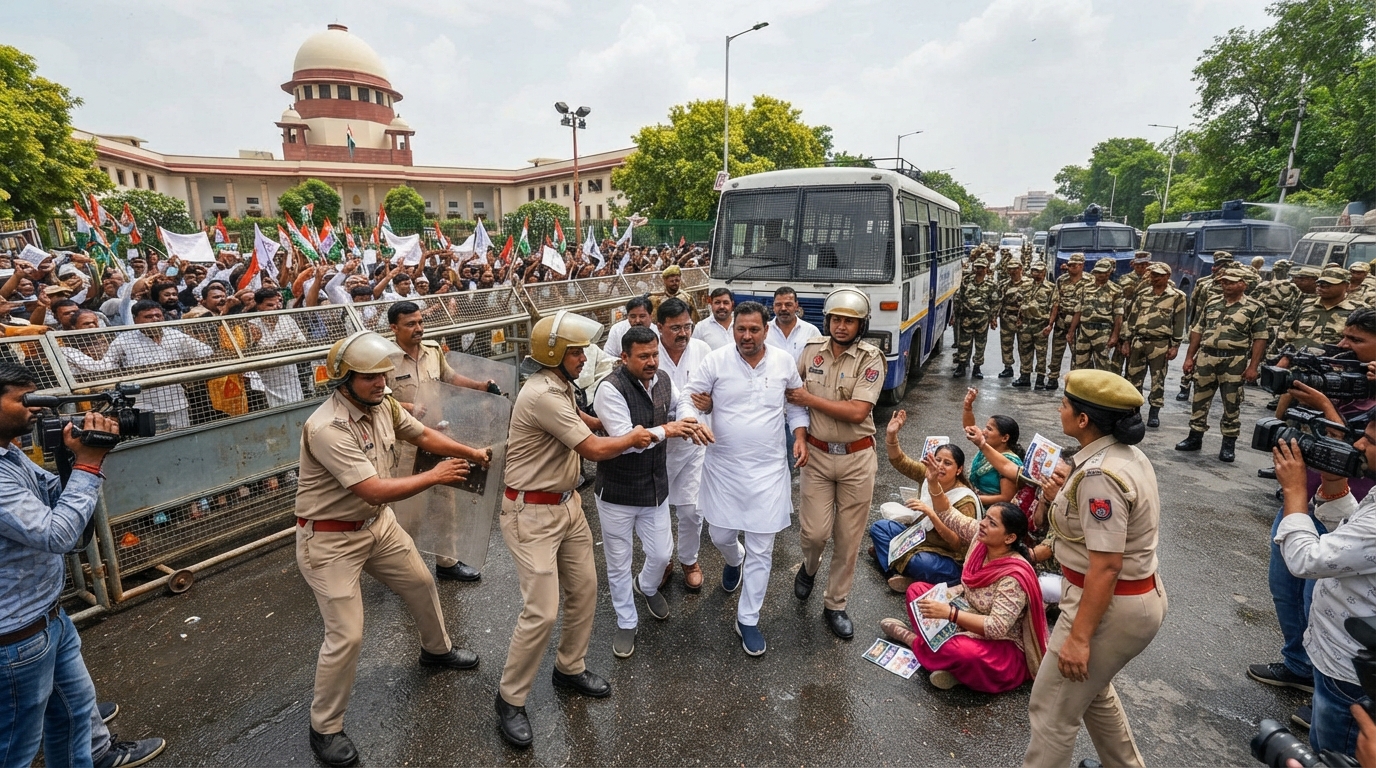
Indian opposition leaders are set to march to the Supreme Court in Delhi to demand the resignation of the election chief over alleged voter fraud.
The move is the latest in a string of demonstrations in Delhi, where thousands of security personnel have been deployed and roads have been barricaded in the capital.
Over the weekend, an attempt by the Cockroach Janata Party pressure group to stage a protest resulted in thousands of demonstrators being detained.
Opposition parties say that under Chief Election Commissioner Gyanesh Kumar, India’s voter rolls are being manipulated to help Prime Minister Narendra Modi’s Bharatiya Janata Party (BJP). Both the Election Commission and the BJP have denied the allegation.
The opposition lawmakers want to hand a memorandum to Chief Justice Surya Kant, but he has told reporters that he refused the meeting for "certain reasons".
He did not explain those reasons, but media reports citing the letter said he noted that some of the matters the opposition wanted to raise with him were also still before the court.
"Every Indian citizen has the right to approach the court, and we will hear their concerns and grant whatever is due under the law," he told reporters.
Meanwhile, Congress MP Rahul Gandhi has urged "all opposition parties, civil society groups [and] all those who believe in democracy" to take part in Monday’s march.
Delhi authorities have announced strict restrictions on traffic and on entry and exit at some major metro stations. Heavy security has also been deployed in central Delhi and along the march route.
Over the past week, senior opposition leaders, including Rahul Gandhi, have been briefly detained several times while leading protests in central Delhi.
On Sunday, the CJP - which is not a registered political party - said it would keep protesting until Kumar resigned.
The CJP, which successfully led a protest over the summer that ended with India’s federal education minister resigning, had called for a march on Saturday to Jantar Mantar - Delhi’s best-known protest site, where the previous sit-in demonstrations had also taken place.
But Delhi authorities imposed sweeping restrictions that made it nearly impossible for protesters to travel to Jantar Mantar - trains were cancelled, dozens of metro stations were closed, and tens of thousands of police and paramilitary personnel were on the streets to detain protesters.
CJP leaders - founder Abhijeet Dipke and co-convenors Saurav Das and Ashutosh Ranka - were dramatically detained from a plane as they landed in Delhi to take part in the protest.
They were released only a day later - while Dipke has gone home to attend his grandmother’s funeral, Das and Ranka held a press conference saying the protests would continue. Neither leader joined Sunday’s protests, but both said they would ask police for a new protest date.
Over the weekend, police detained and later released thousands of people, including several journalists. Some videos and photos from the protest show police dragging people, including women, by force and pushing them into buses.
The Delhi Police did not respond to questions about the use of violence against protesters.
In a statement, Reporters Without Borders condemned the detention of at least 16 Indian journalists.
"Covering events of public interest is not a crime. It is their job. The police's actions against the press are unacceptable," it said.
Congress leader Gandhi said young Indians who had come to protest peacefully with "love in their hearts, not hatred or anger" had been beaten up.
BJP President Nitin Nabin accused opposition parties and the CJP of trying to destabilise India "at the behest of foreign forces" without saying who those forces were.