

'India is bowled over by the cricket bats we make'
Manufacturers in the east of England say India and Pakistan is making up most of their business.
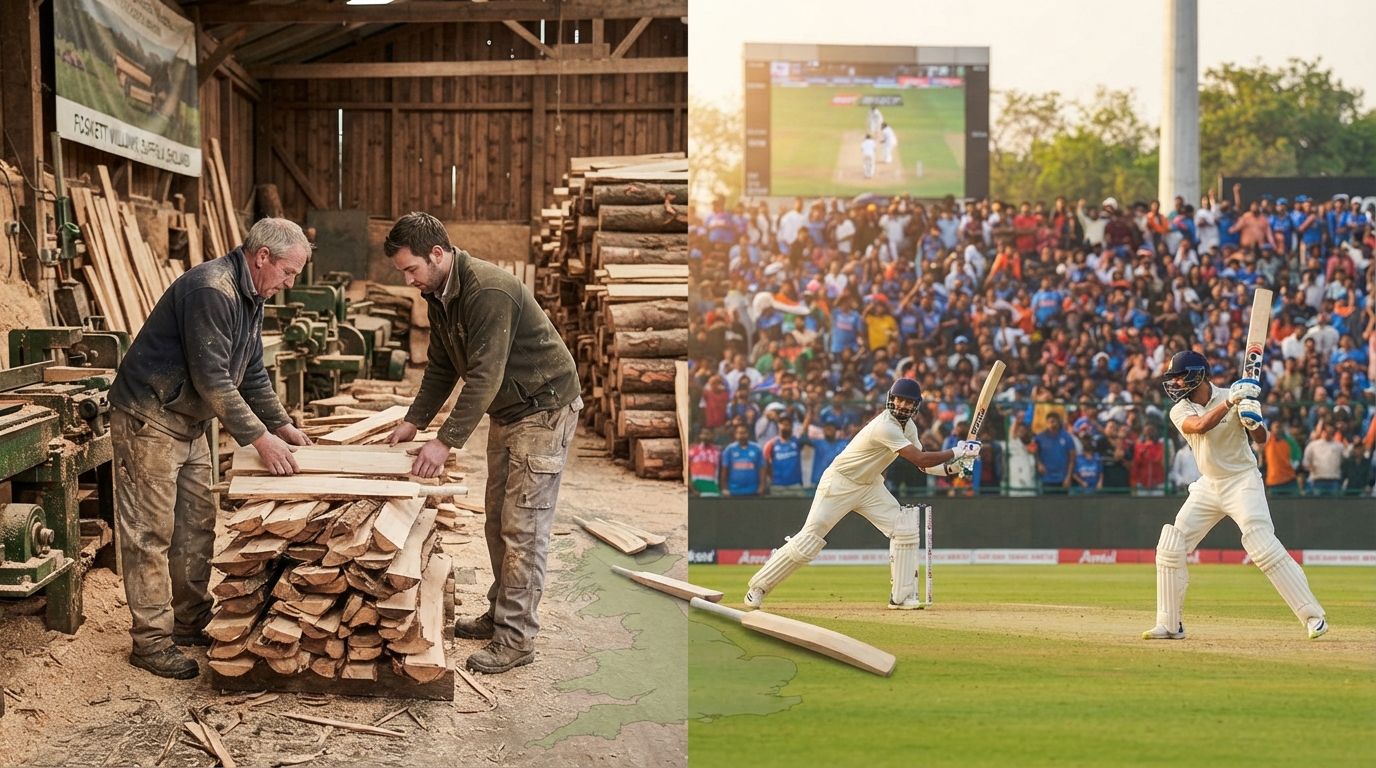
'India is bowled over by the cricket bats we make'
Will and Guy Foskett operate a sawmill in Suffolk that turns out about 40,000 cricket bats each year.
From an English woodland to a cricket ground on the other side of the world, tens of thousands of cricket bats are sent to India annually.
It all begins with the English willow tree, better known as cricket bat willow. Makers in the east of England say the area offers ideal conditions for the tree to flourish.
JS Wright & Sons, based in Chelmsford, Essex, said about 75% of its products were exported to India and Pakistan. At Foskett Willows in Bromeswell, Suffolk, the proportion is nearer 90%.
So how has a small part of England ended up helping to supply a cricket-obsessed nation of almost 1.5 billion people?
"When I was playing cricket, we shared bats," said Guy Foskett. "Now everyone has their own kit and in India and Pakistan the population that can afford a bat has gone through the roof, so the demand has certainly increased.
"Every other country wants our willow, so even if our cricket team is not doing well, our willow is still performing. Even if the Australians beat us, we can take a little win from it," he joked.
The clefts, which form the main body of bats before the handle is fitted, are sent on to other manufacturers to be completed and branded.
For many cleft makers, it is a family trade.
Foskett founded Foskett Willows 40 years ago, and now his son Will helps run the business at their sawmill, tucked away in rural Suffolk.
He says Suffolk and Essex account for around 75% of the English willow grown.
Will said the company makes around 40,000 bats a year.
"We've upped that a little bit in the last few years and, with a few pieces of new machinery, we're hoping to keep on increasing that," he said.
Dozens of bats can be made from a mature willow tree.
A typical mature willow can yield around 40 bats. Some of the bigger trees can be turned into hundreds.
Logs are delivered to yards, cut down and trimmed to the right measurements. The wood is then assessed and graded.
A key stage is the drying process, carried out in large kilns.
This can take six weeks and removes moisture from the wood, with each cleft losing around three litres of water. If this is not done, the wood can crack.
The clefts are dried for around six weeks to remove water from the wood.
Each English willow tree can take 15 to 20 years to reach maturity, meaning manufacturers must keep a steady supply coming.
JS Wright & Sons has been trading in Essex since 1894, and Oliver Wright is the fourth generation.
Wright said his business had felled around 12,000 trees so far in 2026, but would aim to plant between 40,000 and 50,000 in the winter.
"We have to look 15-20 years ahead of ourselves," he explained. "The game is more popular now, especially the women's game - that's hugely popular now."
Oliver Wright's firm will be planting more trees than it fells this year.
Although manufacturers may have their own willow plantations, they also depend on other landowners to supply the wood.
Ed Youngman, from Red House Farm in Charsfield, Suffolk, has several willow trees on the farm alongside his usual crops.
"It's just another income stream," he said. "Obviously it's not a quick turnaround so it's a long game, but thankfully dad had the foresight to put some in 25 years ago."
Recent dry weather has made things more difficult for younger trees.
"They like the wet areas of the farm, so we plant them on our low-lying meadows and along ditches and brooks. Sadly, with the spring droughts we've had, we're having to replant those again," he added.
Ed Youngman grows willow trees in unused areas of his farm.
Farmers are not the only ones earning extra money from willow trees.
Melton Parish Council has a number of the trees in woodland planted 20 years ago, five of which are being cut down on Monday.
Judith Hallett, the council clerk, said it would receive £5,000 for the trees.
"Next time we watch the cricket on the TV, we might see one of the bats being used from willow grown in Melton!" she said.
Hallett said replacement willows would be planted near where the others were being removed.
"So they will grow and in 15 to 20 years, we'll be harvesting them for cricket," she added.