

India built the world's biggest digital payments miracle. Now comes the bill
India's UPI may finally face merchant fees, raising questions over who pays and whether users will resist.
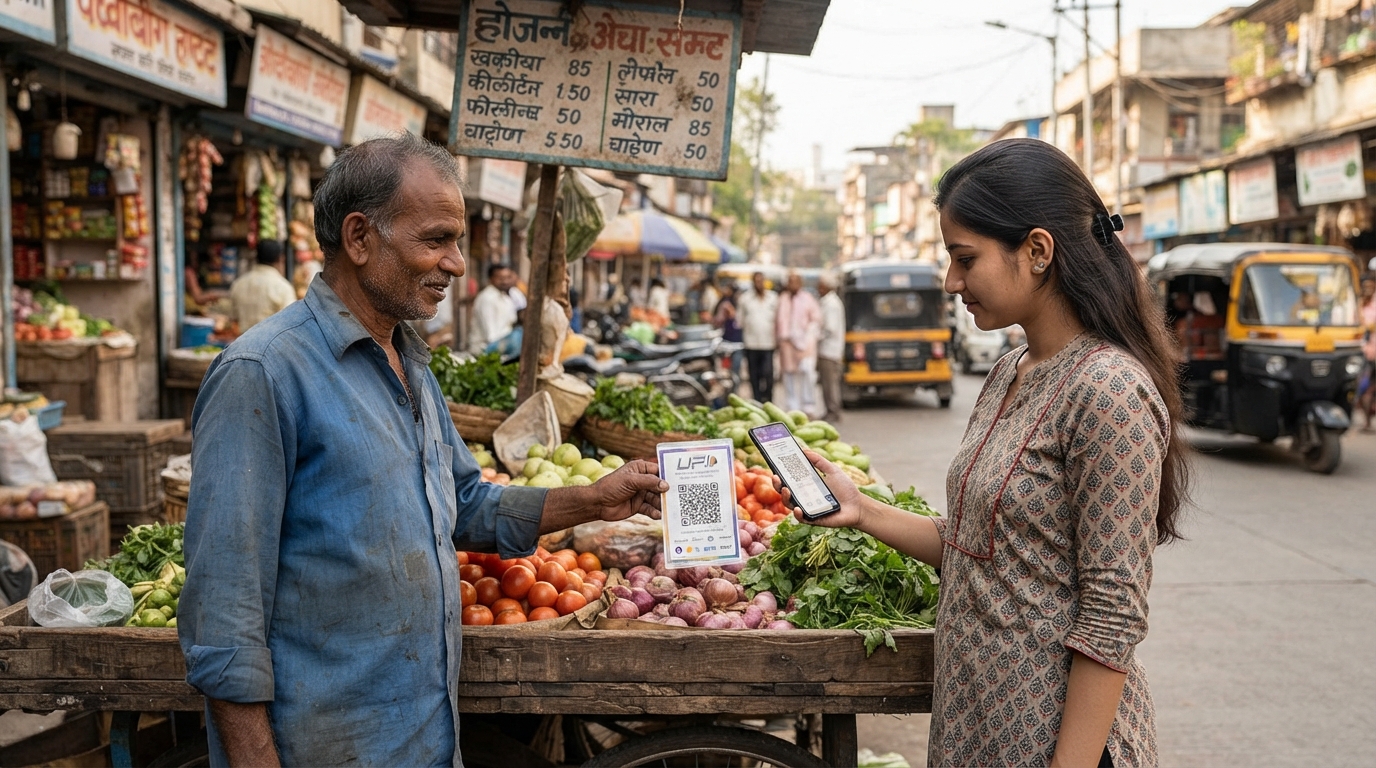
India's groundbreaking digital payments system, UPI, which has become an integral part of daily life for most Indians, is facing a potential shift from its long-standing free model. The system, where users simply scan a QR code and tap a few buttons for instant, fee-free transactions, may soon introduce charges for merchants.
The Indian government has signaled its intention to allow banks and payment companies to levy a fee on UPI transactions for businesses, potentially concluding a decade of free digital payments. While the exact rates and application remain undecided, proposals include a merchant discount rate (MDR) of 0.3-0.5% on larger transactions at major businesses. This small fee would be paid by businesses to the entities processing their UPI payments. The government has affirmed that consumer-to-consumer and person-to-person UPI payments will remain free, with merchant fees only applying to certain transactions above a specified threshold at a nominal rate, ensuring most UPI payments stay free.
The central question is whether introducing a price for UPI could undermine the network's immense success. Launched in 2016, UPI has evolved into one of the world's largest real-time payment networks. Official data reveals 23.6 billion UPI transactions in July alone, valued at 29.87 trillion rupees ($313.5bn; £232.2bn), with fintech apps like PhonePe and Google Pay dominating. In the last financial year, transactions reached approximately 241.6 billion, a nearly 12,000-fold increase from UPI's first full year. Over 550 million people now use the system, which is also available in 11 countries outside India.
UPI's unique design, which fosters competition among companies operating on a common digital infrastructure rather than a closed system, has been a key factor. The National Payments Corporation of India, a non-profit, manages the system, while banks and tech companies provide consumer-facing services.
A crucial, yet often overlooked, element of UPI's success has been its widespread merchant adoption. Unlike card terminals, a simple printed QR code allows vegetable vendors, taxi drivers, and small shopkeepers to accept UPI payments without incurring MDR, thus removing financial disincentives.
New research by economists Abhinav Motheram and Sharon Buteau suggests that this extensive merchant network was not merely a consequence of UPI's growth but a primary driver. Motheram states, "Our study suggests that merchant acceptance is not just a result of UPI growth, but one of its key drivers." Districts with robust merchant networks showed higher UPI adoption. He cautions that while charges limited to large merchants or high-value transactions might have a modest impact on broad adoption, extending them to small and informal merchants, especially in developing acceptance networks, could hinder the merchant expansion vital to UPI's scale.
The immediate proposal aims to mitigate this risk. One option reportedly under consideration would target transactions exceeding 2,000 rupees at larger merchants, leaving small businesses and low-value payments unaffected. According to brokerage firm Jefferies, transactions above this threshold account for only about 4% of merchant-payment volumes but roughly 67% of their value. This could generate a substantial new revenue stream, estimated at up to a billion dollars, for banks and payment companies, while keeping everyday smaller payments to local grocers effectively unchanged.
This move also addresses the growing issue of UPI's underlying costs. Despite feeling free to users, the system requires significant investment in servers, transaction settlement, fraud detection, and cybersecurity. For years, the government has subsidized banks and payment firms for providing this service, which has been treated as public infrastructure. As Reserve Bank of India Governor Sanjay Malhotra recently noted, "Someone will have to pay the cost."
However, the economic implications become more complex as fees extend down the merchant chain. Motheram's research, while not quantifying merchant sensitivity to MDR, warns against assuming a small fee will have a small effect. He emphasizes that "Even a small fee could matter if it changes the incentives of small merchants operating on thin margins," and that the impact heavily depends on the charge's design. A fee on a large retailer differs significantly from one on a tiny shop or informal trader.
This distinction is crucial because UPI's extraordinary growth stemmed not just from smartphone adoption but also from millions of businesses gaining the ability and incentive to accept digital payments. Motheram reiterates, "If charges are limited to large merchants or high-value transactions, the risk to mass adoption is likely lower." He adds, "The bigger concern would be if charges eventually reach small and informal merchants in less-developed districts, where merchant networks are still thin and adoption is still maturing."
India faces a delicate balancing act: making UPI financially sustainable without disrupting the conditions that led to its ubiquity. This is not an insurmountable challenge. Brazil's Pix, another highly successful instant-payment system, is free for individuals but allows low-cost charges for businesses. It is the world's fastest-growing real-time payment system, used by over 140 million people and 14 million companies, processing more than four billion transactions monthly with an average value of about $88.
Motheram concludes, "The key question is not simply whether UPI should remain free for every merchant transaction, but whether the pricing structure protects the marginal merchants who are still being brought into the digital payments ecosystem." This will be the true test of India's next UPI experiment.
The initial phase focused on network creation, followed by bringing hundreds of millions of people and millions of merchants onto it. The third phase, now commencing, involves determining how to fund the system without diminishing its utility. Economist Renuka Sane believes the right pricing structure could finally bring "commercial sanity" to India's digital payment infrastructure, enabling the market to price risk, fund critical infrastructure, and build a more resilient payments ecosystem.
The greater risk may not be a sudden abandonment of UPI due to a fractional charge on large retailers, as experts believe its network effects are too powerful. However, a potential perception problem exists: a 2024 LocalCircles survey found that 75% of UPI users would stop using it if transaction fees were introduced, with only 22% willing to pay. The risk is more subtle: if merchant charges reduce enthusiasm for accepting UPI or discourage the smallest merchants from joining, the network could gradually lose the frictionless quality that underpinned its success.