

"In winter, the power will not 'not go out', it will go out." Head of HET on preparations for the season and planned outages
843 billion soums have been allocated to prepare for the autumn-winter season. According to Sardor Isakulov, head of "Regional Electric Networks," repair work at high-risk facilities has been completed. However, this does not mean there will be no power outages. "It's not that the power won't go off in winter, it will," he said.
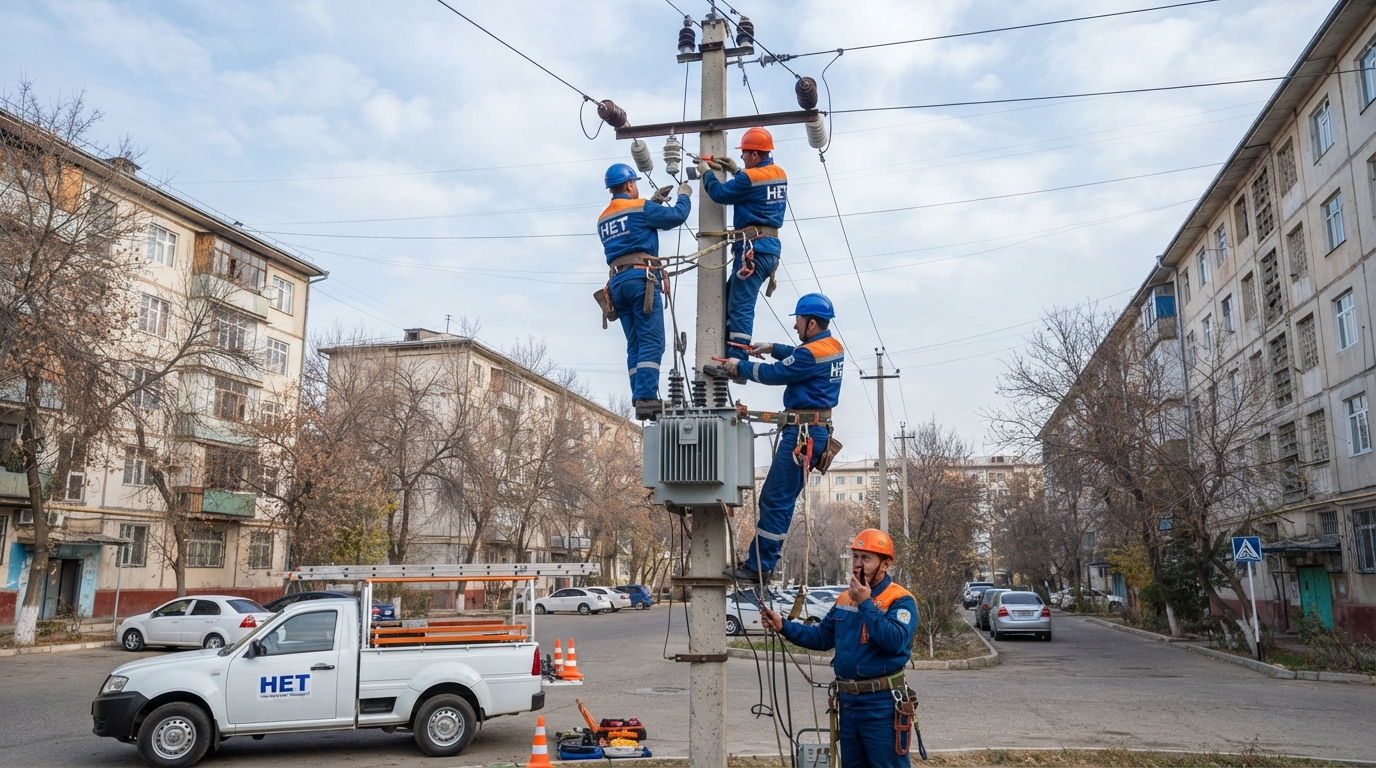
“Power will not stay on in winter; it will be cut.” Head of HET on seasonal preparations and planned outages
In Uzbekistan, 35 percent of electricity consumers used more than 200 kWh of electricity in August. This was reported on October 8 at a press conference featuring the leadership of Regional Electric Networks (HET), a Gazeta correspondent reports.
Bobir Islomov, former first deputy chairman of the board of Regional Electric Networks, announced that there are a total of 8 million 344 thousand electricity consumers in Uzbekistan. In August 2026, 5 million 682 thousand consumers used up to 200 kWh, 1 million 135 thousand used between 200−300 kWh, and 354 thousand used more than 300 kWh of electricity. As he explained, a single household is treated as one consumer in the calculations.
According to Sardor Isaqulov, head of Regional Electric Networks, facilities with a high probability of power supply accidents are identified at the beginning of the year and divided into red, yellow, and green categories depending on the level of risk. Repair work at red category facilities was completed by August, and at yellow category facilities by October 1.
“The energy system must be ready for any season. We start preparing for the summer season in winter. We identify in advance where risks lie and carry out repair work,” he said.
Isaqulov emphasized that daily electricity consumption is currently reaching 200 million kWh. On certain days in the summer, this figure was around 150 million kWh.
He stated that as part of preparations for the autumn-winter season, 843 billion soums have been allocated nationwide to organize the work of each crew, ensure their operation on a regional headquarters basis, and supply them with necessary spare parts.
According to Isaqulov, during the repair process, insulators are replaced, wires are straightened, and other technical tasks are carried out. To ensure the safety of employees, certain networks must be temporarily disconnected. Since an average of 15−20 transformer points are connected to a single network, power supply is also temporarily suspended during repairs in areas that receive electricity through them.
“When we take a network out for repairs, the transformer points connected to it are also turned off. The crew works at that site throughout the day and completes the repairs. This is also considered a power outage, but the cause is not an accident, but the renewal and stable operation of the network,” Isaqulov said.
He noted that during this year’s autumn-winter season, short-term outages due to planned repairs may also be observed in the Olmazor, Chilonzor, and Mirzo Ulugbek districts of Tashkent. The goal of such work is to prevent potential accidents in the networks.
“We call the consumer a customer. Because both our enterprise and our employees earn money precisely thanks to these customers. Therefore, we take all necessary measures to deliver electricity to them sustainably,” he said.
Isaqulov announced that a plan to digitize the system is being developed to reduce power supply disruptions and improve customer service.
Through the new system, repair work, staff activities, and the delivery of assigned materials to designated locations will be monitored. In addition, it will create an opportunity to notify consumers in advance about planned outages.
“For example, you are a consumer connected to a specific transformer. Your phone number will be linked to your account number. If planned repair work is to be carried out at that transformer point, you will receive a message via Telegram a day or two in advance.
It will warn that there may be an outage in the power supply from 08:00 to 17:00 the following day and apologize for the inconvenience caused,” the head of HET said.
He reported that work is underway with Uzinfocom to implement the system. An initial presentation has been held, and the next one is scheduled for next week. The project will also cover services such as monitoring employee activities and handling inquiries.
“We have set the technical requirements. After the initial presentation, we gave recommendations for revising certain parts. Next week, another presentation will be held. After that, a specific deadline will be announced. For now, they are asking for about two to three months to fully enter the database information and digitize it,” Sardor Isaqulov said.
In his view, the digital system will allow consumers to be informed in advance about planned power outages and plan their daily activities accordingly.
Answering a question about why power outages are felt more in winter, Isaqulov said that outages also occur in summer, but due to cold weather and shorter days, they cause more inconvenience to the population in winter.
“We cannot promise that the power will not go off. It will. This is a process associated with technical equipment. No one can guarantee that a car driving on a flat road won’t get a flat tire, right? Emergency power supply outages can also occur. But there are also planned outages. If we do not regularly shut down certain networks and carry out modernization work, we will face even more problems in winter,” he said.
He emphasized that the number and duration of power outages are also evaluated using international indicators. This information is publicly announced on the official platform of Regional Electric Networks.
The head of HET stressed the need to distinguish between planned and emergency outages. While planned outages are conducted to repair and modernize networks, accidents can occur due to technical faults and external factors.
“An accident is an accident by definition. It has various causes. There could be strong winds, or someone could drive a car and hit a power pole. Recently, such cases have been increasing. Someone digs the ground unauthorized and cuts a cable. But when the power supply is cut, Regional Electric Networks is still blamed,” he said.
According to him, electrical cables can be damaged during excavation, concrete pouring, or tree planting during construction work. Additionally, damage to power poles and wires when transporting oversized cargo also causes emergency outages.
“In the process of transporting oversized cargo, there are cases where pole wires are pushed to one side and damaged. Similar situations are observed when transporting combines or other large cargo. All of these cause emergency outages,” Isaqulov said.
He stressed that because the power grid covers a large territory, it is difficult to fully control all external factors. Therefore, the public and organizations carrying out construction work must be careful not to damage the networks.
When an accident occurs, specialists begin resolving it. According to Isaqulov, in some cases power supply can be restored within 15−20 minutes, while in other situations resolving the accident requires more time.