

In pictures: Dussehra celebrated across India as triumph of good over evil
The festival, which commemorates the triumph of good over evil, is celebrated with different rituals across India.
**In pictures: Dussehra celebrated across India as triumph of good over evil**
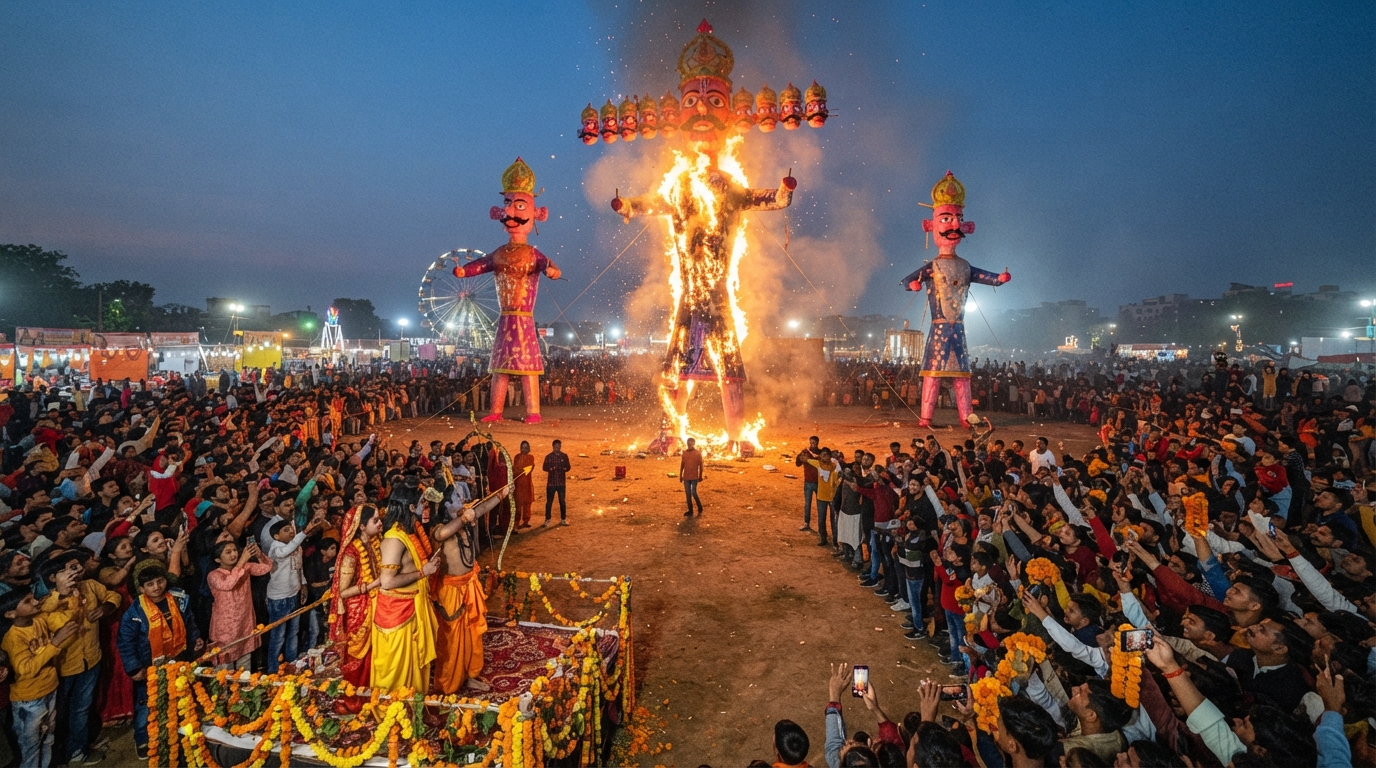
Millions of people across India are observing Dussehra, one of the country’s most widely celebrated Hindu festivals, with processions, prayers and the ceremonial burning of giant effigies to represent the triumph of good over evil.
The festival is marked with different rituals and traditions in different parts of the country, but celebrations are grand everywhere.
It is commonly associated with Lord Ram’s victory over the mythological 10-headed king Ravan.
The festival also coincides with Vijayadashami, celebrated in eastern, southern and other parts of India, to honour goddess Durga’s slaying of the buffalo demon Mahishasura.
The defeat of the 10-headed king Ravan is celebrated as the victory of righteousness over evil, with Sita placing a victory garland around the neck of her husband Lord Ram.
Marigolds are linked to the celebrations as a symbol of the victory of good over evil, and are harvested ahead of Dussehra across the country.
Hindus follow a lunar calendar, and Dussehra falls on the 10th day after Navratri, a nine-night festival of worship and celebrations.
In the days before Dussehra in northern India, performers wear elaborate costumes and make-up to stage Ramlila, the dramatic retelling of the ancient Hindu epic Ramayana. They recount Lord Ram’s exile and his wife Sita’s abduction by Ravan, ending with the battle that symbolises the victory of good over evil. The final act is followed by the ritual burning of effigies of Ravan, his brother Kumbhkaran, and son Meghnath.
The colourful stage is usually accompanied by a carnival-like atmosphere, with food stalls, rides and smaller performances.
In the east and some other parts, as well as among Hindus in Bangladesh, the festival features devotees worshipping the divine feminine power through Durga Puja celebrations.
Temporary tents housing idols of Goddess Durga and other deities are erected in cities and towns. People visit these structures, known as pandals, where Durga is often shown slaying the buffalo demon Mahishasura.
Current affairs often find their way into the traditional celebrations, such as theme-based decoration of tents in Kolkata, a city known for its Durga Puja celebrations.
Traditional dances such as Gujarat’s Garba are a major part of community celebrations.
Dussehra also signals the start of preparations for Diwali - the festival of lights - which comes 20 days later.