

In 2025, Tashkent Metro earned 353 billion soums in revenue from passengers
Last year, the Tashkent Metro earned 353 billion soums in revenue from passengers. However, the system still relies on state subsidies to cover its expenses. Main expenses account for staff salaries and electricity. "The cost of transporting one passenger is around 5,300 soums," said an official of the metro.
353 billion soums received from passengers in 2025 — Tashkent Metro
In 2025, the Tashkent Metro earned 353 billion soums in revenue from passengers. However, since the system's annual expenses exceeded 950 billion soums, the remaining shortfall was covered by the state budget.
According to Deputy Chairman of the Board Yuldosh Yusupov, the metro is a socially significant system supported by the state. The revenue generated from passengers is not sufficient to cover all its expenses.
"The metro is classified as a special facility. Today, it operates at a loss, meaning at the expense of subsidy funds. Revenues from passenger transportation cover approximately one-third of total expenses. The remaining funds are allocated from the state budget in the form of subsidies," he says.
Yusupov informed that nearly 6,000 employees work at the metro. More than 60 billion soums are spent per month on their wages and equivalent payments. Electricity costs amount to nearly 10 billion soums per month. In addition, there are costs associated with the maintenance and repair of rolling stock, tracks, tunnels, and other structures.
"The main expenses of the metro fall on wages and equivalent payments, as well as electricity. The remaining funds are directed toward repairing our tracks, servicing train cars, and other work related to maintaining the metro," Yusupov says.
He noted that initially, it was planned to allocate a subsidy of 572 billion soums from the state budget for 2026. However, due to the increase in passenger numbers and growing costs related to the aging metro infrastructure, the subsidy requirement has approached 700 billion soums.
It was also stated at the press conference that the cost of transporting one passenger is approximately 5,300 soums. Currently, a passenger pays 2,500 soums per trip, with the remainder covered by state subsidies.
Yusupov also commented on the increase in fares in public transport, specifically in the metro, from 1,700 soums to 2,500 soums. According to him, the revision of tariffs took into account the prices of utility services, the growth of other expenses, and the need to improve working conditions for metro employees.
The metro management aims to develop additional revenue sources in the future to reduce the need for funds allocated from the state budget. In this regard, attention is being focused on expanding advertising, telecommunications, and other services.
"Based on the metro's capabilities, we aim to increase additional revenue. By expanding advertising, telecommunications, and other services, it is planned to cover a larger portion of our expenses from our own revenue in the future," says Yusupov.
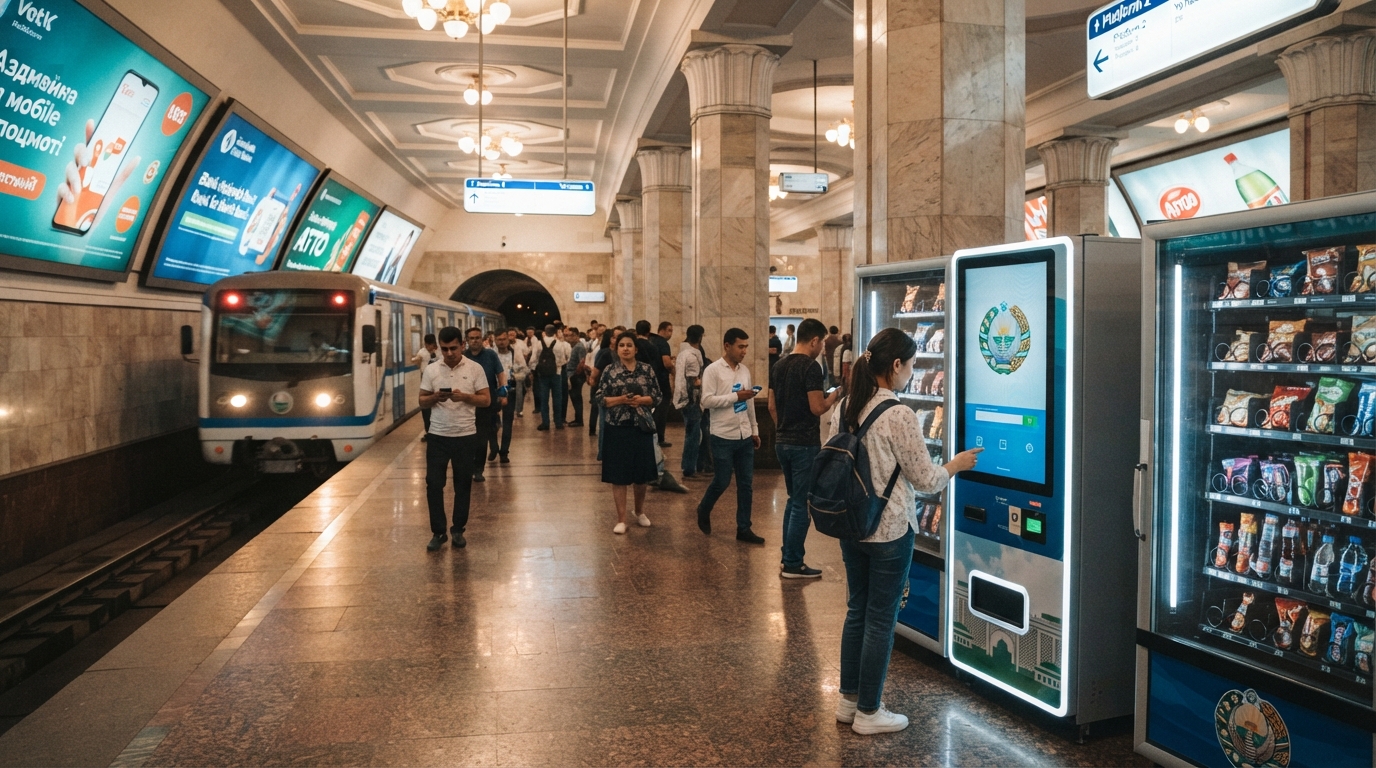
According to Ulugbek Salikhov, the metro earned nearly 30 billion soums from advertising in 2025. In 2026, it is envisaged to bring this figure to 40 billion soums.
"A number of works are being carried out to increase additional revenue. We plan to bring advertising revenue up to 40 billion soums in 2026," says Salikhov.
According to him, another source of additional revenue for the metro is vending machines. Until 2025, there were six such devices in the system. By May 2026, their number reached 67. It is planned to bring the number of machines to 100 by the end of the year.
"Work on installing vending machines is continuing. Furthermore, since we have phased out cash, the issue of establishing modern retail outlets in place of the former ticket kiosks is also being considered. If we receive good proposals from entrepreneurs, we will take them into account. This will also be an additional source of revenue for the metro," says Salikhov.