

'Illustrating Brideshead Revisited was a privilege'
Oxford-based artist Weimin He talks of being part of a "deeply immersive", yet "challenging" project.
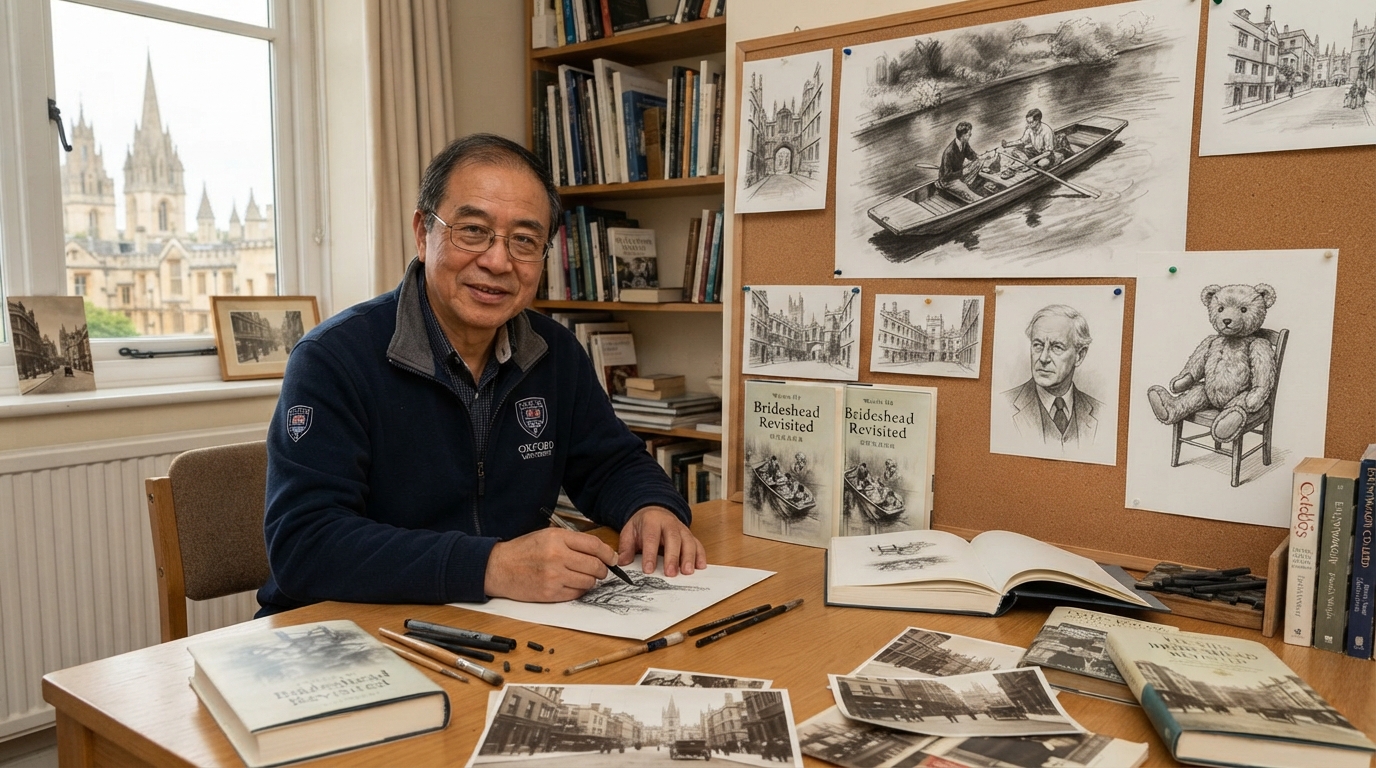
'Illustrating Brideshead Revisited was a privilege'
Weimin He said he spent the most time on the scene showing Charles and Sebastian on a picnic.
"People told me they wanted to read the book after seeing my illustrations."
Oxford-based artist Weimin He said it took him nearly a year to complete his "deeply immersive", yet "challenging" project — the first illustrations for a Chinese edition of Evelyn Waugh's Brideshead Revisited, which was published in August.
Having lived in the city for more than 20 years, he said it was "a privilege" to depict local places mentioned in the novel and to research what they were like in the 1920s and 1930s.
He said he had read the book "countless" times in both English and Chinese, but had also tried to draw "from the author's perspective".
He became an artist-in-residence at Green Templeton College in 2018.
The first part of the novel follows Oxford student life and the friendship Charles Ryder forms with the eccentric undergraduate Lord Sebastian Flyte.
Many Oxfordshire locations appear in the book, including The Botanic Garden, Christ Church college and Thame.
The book was published by Shanghai Literature and Art Publishing House in a limited edition of 500 copies, for which He produced 12 charcoal drawings, 12 pen-and-ink drawings and one drawing of Aloysius, Lord Sebastian's teddy bear.
"I tried to do illustrations from the author's perspective, not just from me - I try to understand what the author won't show to readers ... and also capture the atmosphere of nearly 100 years ago."
The first part of Brideshead Revisited follows the lives and friendship between Charles Ryder and the eccentric Oxford undergraduate Lord Sebastian Flyte.
Other inspirations came from the "fantastic" 1981 TV series and the 2008 film of the same name.
The artist said he spent the most time on a bird's-eye view scene of Charles and Sebastian having a picnic.
He said all the characters were "quite distinctive", but he liked their relationships the most.
"Because I live in Oxford, sometimes I meet eccentric people - [Evelyn Waugh] really depicts people so, so well."
He said he tried to "capture the atmosphere of nearly 100 years ago".
He said the translator Zheng Haiyao, who uses the pen name Kaiti, had initially marked about 50 paragraphs for him.
He also selected a moment from the epilogue, when an older Charles Ryder converts to Catholicism.
"That part really touched me, I thought that description [is] the soul of the book," He said.
"It took me a long time to find the right image because the TV series just showed Charles praying and I thought that's something a bit too obvious."
The artist said he had been "touched" by Charles Ryder's conversion to Catholicism in the novel's epilogue.
He, who became an artist-in-residence at Green Templeton College in 2018, said he knew the city "very well", as he had "never lived in any other place for so long, even in China".
"The very route I cycle daily into town was the same road Charles and Sebastian drove in their vintage car to the countryside."
He said he would not depict the "really familiar" places mentioned in the book such as the Botley Road, High Street and Broad Street.
"I feel it's something really already inside of me, but for Chinese readers, maybe there's something new."
The artist said he searched online for "vast numbers" of images from the 1920s and 1930s, hoping to "get as close as possible to the Oxford of that era".
"The translation [is] just excellent and is being welcomed in China."
"And this really is the best comment I've ever received," He said.
He created a total of 25 illustrations — 12 charcoal drawings, 12 pen-and-ink drawings and one drawing of Aloysius, Lord Sebastian's teddy bear.