

IATA: Data will help Central Asian airlines save fuel
IATA believes that airlines in Central Asia and the South Caucasus can reduce fuel costs through more efficient use of data.
IATA: Data will help Central Asian airlines save fuel
Air carriers in Central Asia and the South Caucasus can gain additional opportunities to reduce fuel costs through more efficient use of data and streamlining operational processes.
According to forecasts from the International Air Transport Association (IATA), global airlines will spend approximately $350 billion on fuel in 2026, accounting for almost a third of their total operating expenses. Meanwhile, rising fuel prices and unstable energy markets are increasing pressure on the industry's financial performance.
IATA expects global airline profitability to decline from 4.2% in 2025 to 2% in 2026. The ability to offset these increased costs through increased airfares alone remains limited.
Against this backdrop, fuel efficiency is becoming a key priority for airlines. According to an IATA survey conducted in March 2026, 90% of airlines cited it as a top priority. Among executives responsible for finance and procurement, the share of such responses was 96%.
This issue remains particularly pressing for the Central Asian and South Caucasus markets. In Kazakhstan, for example, the cost of jet fuel is higher than in comparable aviation hubs, including Dubai, increasing carrier costs for the same fuel consumption.
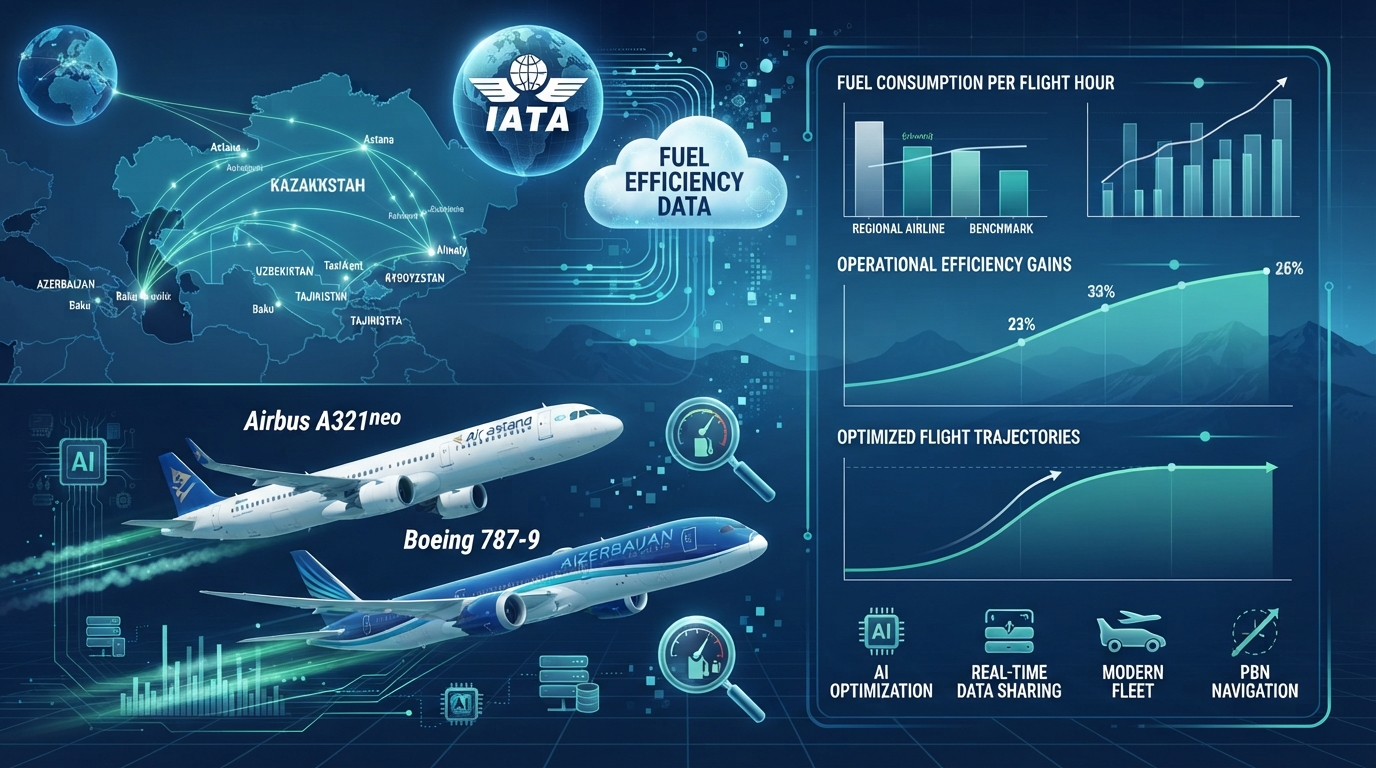
Until recently, fleet renewal was considered one of the primary ways to improve fuel efficiency. Air Astana and Azerbaijan Airlines have invested in new-generation aircraft. Uzbekistan Airways is also introducing more fuel-efficient Boeing 787-9s and Airbus A321neos.
Air Astana announced in March that in 2025, the carrier would receive eight Airbus A320 family aircraft and retire three Embraer E2s. The airline stated that it now operates the most unified and fuel-efficient fleet in more than 20 years.
In July 2026, Azerbaijan Airlines received its fourth new aircraft since the beginning of the year – an Airbus A320neo. Uzbekistan Airways, meanwhile, is using new Boeing 787-9 and Airbus A321neo aircraft to improve fuel efficiency.
However, according to IATA, following a major fleet renewal, airlines need to seek additional sources of savings. IATA Director of Flight Operations and Operations Stuart Fox believes that the next stage of efficiency improvement will primarily involve using data to make operational decisions.
"With opportunities for further efficiency gains through fleet renewal or route network changes already largely explored, the next gallon of fuel saved will increasingly be the result of better, data-driven operational decisions," Fox noted.
He added that to further reduce costs, airlines need a deeper understanding of their own operations and quality benchmarking to compare their performance with that of other carriers.
Some airlines in the region are already using this approach. Air Astana uses artificial intelligence to optimize fuel consumption and, according to the company's own estimates, reduces fuel consumption by up to 2%. Uzbekistan Airways also uses data to optimize operations.
IATA has real-time operational information from more than 240 airlines worldwide. According to Fox, sharing this data allows carriers to compare results and implement solutions tailored to their operational needs.
The association has developed the FEGA (Fuel Efficiency Gap Analysis) consulting service and the FuelIS analytical platform. These enable the identification of fuel savings opportunities in real time, taking into account aircraft type, route, flight phase, and geographic region.
Fox cited the example of an airline systematically completing flights with higher fuel levels than carriers operating similar aircraft on comparable routes. Such analysis can reveal opportunities for efficiency improvements without compromising safety. The identified practices can then be implemented through operational manuals and staff training programs.
IATA notes that potential for savings extends beyond individual airlines. Some factors affecting fuel consumption are related to other parts of the aviation system, primarily air traffic management.
Airlines depend on air navigation service providers, who are expected to provide more efficient flight paths. One example, IATA cites, is the use of more direct approaches, which reduces fuel burn.
To improve air traffic efficiency, IATA promotes the modernization of air traffic management systems. One key tool in this regard is Performance-based Navigation (PBN).
Over the past six years, IATA has implemented projects in Azerbaijan, Tajikistan, and Uzbekistan to develop PBN-based airspace management concepts. According to the association, these projects have resulted in significant improvements in operational performance and associated fuel savings.