

I receive part of my salary in cash. What will happen to my employer.
In Uzbekistan, almost one in three workers receives an under-the-table salary. But it is the employer, not the employee, who is held responsible: they face back taxes, penalty interest, and fines..
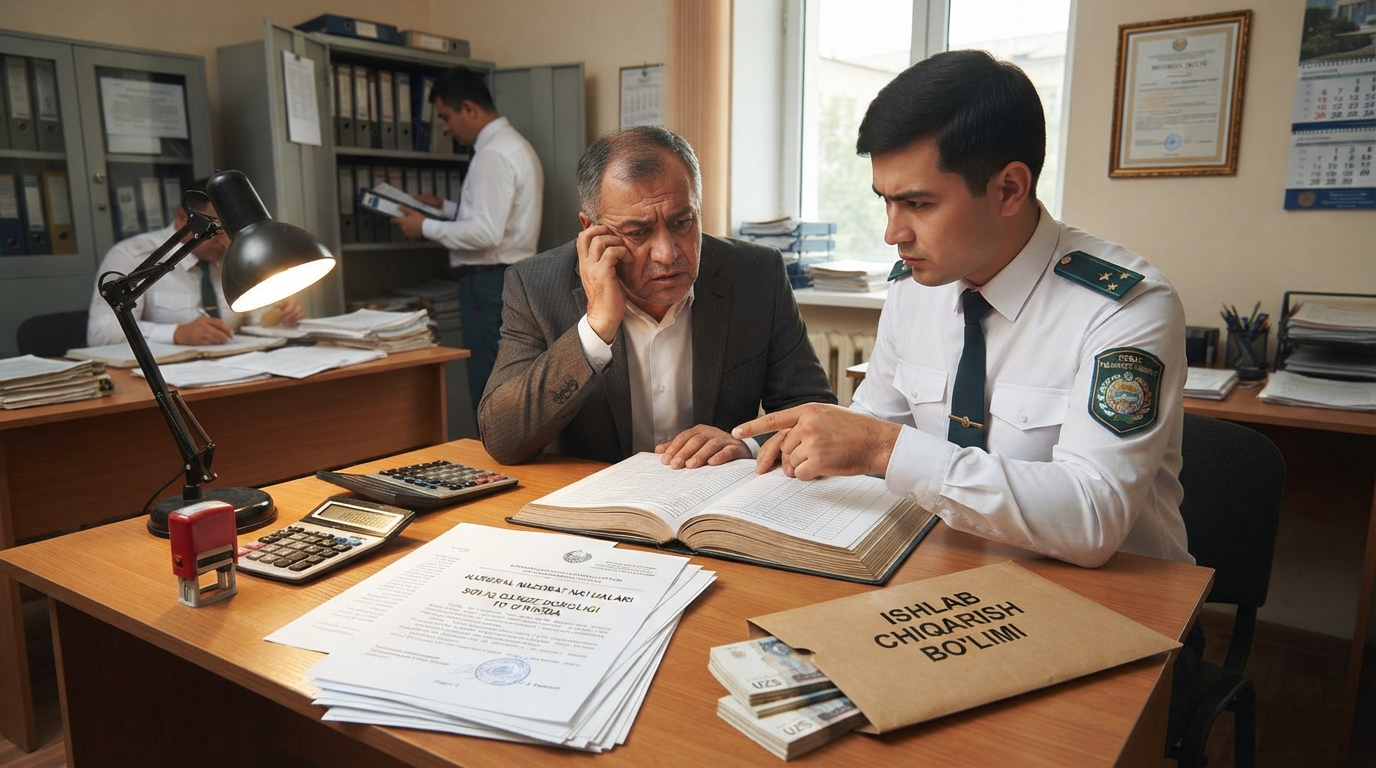
I receive part of my salary in cash. What will happen to my employer?
In Uzbekistan, nearly one-third of workers are paid under the table. However, it is the employer who bears the responsibility, facing back taxes, penalty interest, and fines.
Before delving into the repercussions, it is crucial to identify the specific scheme in use, as the violations and penalties vary.
In an undeclared salary scheme, employees receive their entire salary in cash and are not officially registered. This breaches two legal areas: labor law, due to the lack of formal employment, and tax law, as no payroll taxes are remitted.
According to the Labor Code of the Republic of Uzbekistan, dated October 28, 2022, Articles 26 and 106, an employment contract may exist, but it typically only reflects the minimum wage, which is UZS 1,271,000. The remainder is paid in cash.
The primary violation here pertains to taxes: the employer reports a lower salary for tax purposes.
Presidential Decree No. UP-91, dated June 2, 2025, mandates that for each salary payment, the employer must withhold 12% personal income tax from the employee and pay an additional 12% social tax. If these taxes are not withheld, the tax authorities will calculate the unpaid taxes based on the employee’s actual earnings.
Sources for this information may include the state labor accounting system at mehnat.uz, bank statements, and other digital records.
The Tax Code of the Republic of Uzbekistan (version dated December 30, 2019) specifies in Articles 223 and 381 that the first consequence for an employer utilizing a cash-in-envelope salary scheme is an additional tax assessment. The tax authorities will recalculate personal income tax and social tax based on the employee’s actual earnings rather than the officially reported salary.
In addition to the assessed taxes, interest accumulates for each day of delay. With the Central Bank’s policy rate at 13.5%, the daily interest rate is approximately 0.045%, equating to about 16% annually. For substantial amounts, the debt can escalate at a rate similar to that of a bank loan.
The Tax Code of the Republic of Uzbekistan, Article 110, also stipulates financial penalties: 20% of the unpaid amount for tax understatement and up to 10% for late report submissions.
It is essential to note that these penalties are imposed on the company itself and do not replace the accrued interest or the administrative fine levied against the director. Authorities do not choose one measure over another; they are applied concurrently.
Administrative fines are personally imposed on the director. In Uzbekistan, fines are calculated in Base Calculation Units (BCUs), a standard reference unit for most administrative penalties. As of August 1, 2025, one BCU is valued at UZS 412,000.
The basic fine for employing a worker without formal registration is outlined in Article 49 of the Code of Administrative Responsibility. Since July 19, 2026, penalties for tax evasion under Article 174 have also increased.
According to the Code of Administrative Responsibility of the Republic of Uzbekistan, Articles 49 and 174, prior to the reform, the fine for a director under Article 174 was 15 BCUs, meaning the maximum penalty has more than doubled.
Tax evasion cases are now managed by a specialized department within the Prosecutor General’s Office, which means employers may face scrutiny not only from tax authorities but also from law enforcement.
When tax evasion reaches a significant threshold, the Criminal Code applies — Article 184. These thresholds are also calculated in base accounting units as of the date the offense concluded.
If the employer fully repays the taxes, penalty interest, and financial sanctions before the judge retires to deliberate, the court will not impose imprisonment and will limit the punishment to a fine.
There is a leniency option for first-time offenders. If the employer pays all taxes, accrued interest, and financial sanctions before the judge begins deliberation, the court will not impose imprisonment and will restrict the punishment to a fine.
A pertinent question arises: can an employer save money by reducing only the official portion of the salary to the minimum level? In practice, the answer is generally no, and the consequences can outweigh the savings.
For instance, a company in the Tashkent region declared downtime in December 2022, as well as in January and February 2023. The employee received UZS 920,000 per month, which was exactly the minimum wage at that time.
However, according to the Labor Code, downtime must be compensated based on the employee’s average earnings, not the minimum wage. The employee’s average monthly earnings were UZS 2,842,690, resulting in a shortfall of UZS 1,922,690 per month.
Over three months of downtime, the unpaid amount totaled UZS 5,768,070. This was later compounded by unpaid regular wages for May and September 2023, along with interest for each day