

'I like proving people wrong': The women taking up DIY and plumbing
Female DIY experts and tradeswomen talk about their experiences of a traditionally male-dominated domain.
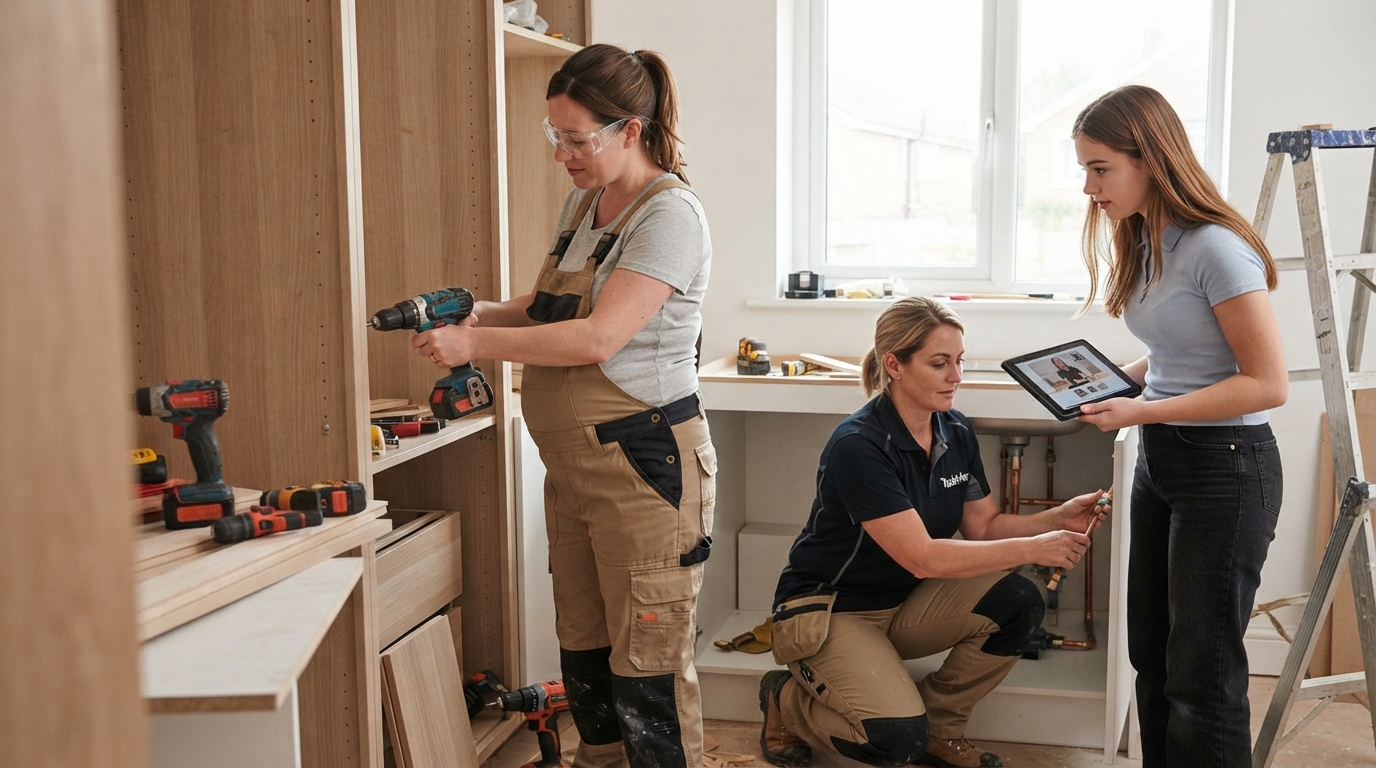
‘I like proving people wrong’: The women taking up DIY and plumbing
It’s difficult to overlook the surge in DIY content that has flooded social media feeds over the past decade.
From short reels showing how to repair cracks in walls to detailed YouTube guides on constructing alcove seating from the ground up, the internet is packed with what seems like an endless stream of home-improvement demonstrations.
Although DIY was once regarded as largely a male preserve, female influencers are encouraging a new generation of women to take control and do it themselves.
At the same time, demand for female professionals is increasing, and some women are switching careers to enter trades they believe are more AI-proof than office jobs.
DIY influencer Jasmine Gurney has shared an impressive and exhausting-sounding list of projects on Instagram.
She has knocked down partition walls, replaced flooring, built a fence, insulated and boarded her loft, constructed an outdoor workshop, made bespoke cabinetry, moved plug sockets, made her son his first bed and has been building him a treehouse.
Now eight months pregnant, the former marketer is racing to complete a fitted wardrobe before the new baby arrives.
“I like proving people wrong,” says Jasmine, 33, from Bedfordshire, who says she has been trolled by people questioning her methods, but that only “spur me on more”.
“I’m showing and empowering other women to do it,” she says.
“I’ve shown me doing things whilst pregnant, I’ve had my firstborn strapped to me in a baby carrier while doing things.
“I’m just showing that we are capable, we are interested in this sort of stuff and... we’re sick of waiting around for six months for our husbands to pick up the tools and do it in most cases.”
Jasmine says her page really took off during Covid, when people couldn’t get professionals in and had to learn to do jobs themselves.
Although the lockdowns are long over, she believes demand for content like hers has remained because there are not enough tradespeople to meet demand, and cost-of-living pressures are tightening budgets.
According to a 2024 report by B&Q, Gen Z women are “leading the charge in challenging gendered DIY stereotypes”.
About three-quarters of Gen Z women surveyed said they enjoy DIY, compared with 60% of all female respondents.
And 82% of Gen Z women said seeing women doing more complex home DIY on social media had inspired them to do more themselves, versus 60% of women overall.
Of course, not every job can be done yourself. Sometimes you need to GSI (get someone in).
Bliss Cunneen left an Anthropology degree course at university in 2020 to train as a plumber.
The 28-year-old from south London says trying the trade on a whim was the “best thing I’ve ever done”, and she loves the freedom and flexibility of running a business.
Although some customers have doubted her when she arrives at their door - and she has even once been mistaken for the receptionist - “once you start working and you show you’re confident and you know what you’re doing, they’re okay”.
She says the explosion of online content has “definitely helped” broaden attitudes towards women taking up DIY or a trade.
Anna Moynihan founded TaskHer, a platform linking female tradies with customers who need jobs done, after becoming frustrated when tradesmen she had booked for renovation work would speak to her husband instead of her.
Five years ago, she says, she couldn’t find any stock photographs of tradeswomen to use for marketing. Even the word “tradeswoman” would be autocorrected to “tradesman”.
“It’s those little things that, you know, ultimately you don’t feel welcome into that environment.
“It’s already hard enough to become a tradeswoman, a woman in an industry where you’re massively under-represented.”
Enquiries on the site have more than doubled so far this year compared with 2025, while the number of tradeswomen signing up has almost quadrupled, Anna says.
People may prefer a tradeswoman for several reasons - industry surveys suggest they may feel more comfortable with a woman entering their home, feel a woman would be more respectful, or want to support women working in traditionally male roles.
Anna Moynihan says some women are taking up a trade because they want the flexibility of working for themselves.
Anecdotally, Anna says more women are joining her platform after leaving white-collar jobs, adding that three Oxford University-educated tradeswomen have signed up in the last month.
She says some had always wanted to take up a trade but felt unable to until now because of their gender.
Others, she says, want the flexibility of working for themselves in a role less likely to be directly affected by the rapid advance of AI.
Despite the attention, women still make up only a tiny share of the UK’s construction workforce - around 4%, according to the Federation of Master Builders.
But there are positive signs. One in 10 people who started a construction apprenticeship in 2024-25 was a woman, up from around one in 14 five years earlier.
DIY influencer Jasmine hopes women who see online content like hers will be inspired to try a project themselves, or think about entering a trade.
“The more women who are seen online doing these sorts of things, the more normal it becomes.”
Anna agrees. “You can’t be what you can’t see, and anything that shows women and girls that they can do something is fantastic.”