

'I don't want to seem tight': How much should you give to the year-end teacher collection?
Collecting money for a joint present might overcome the competitive gift-giving, but it can still cause friction.
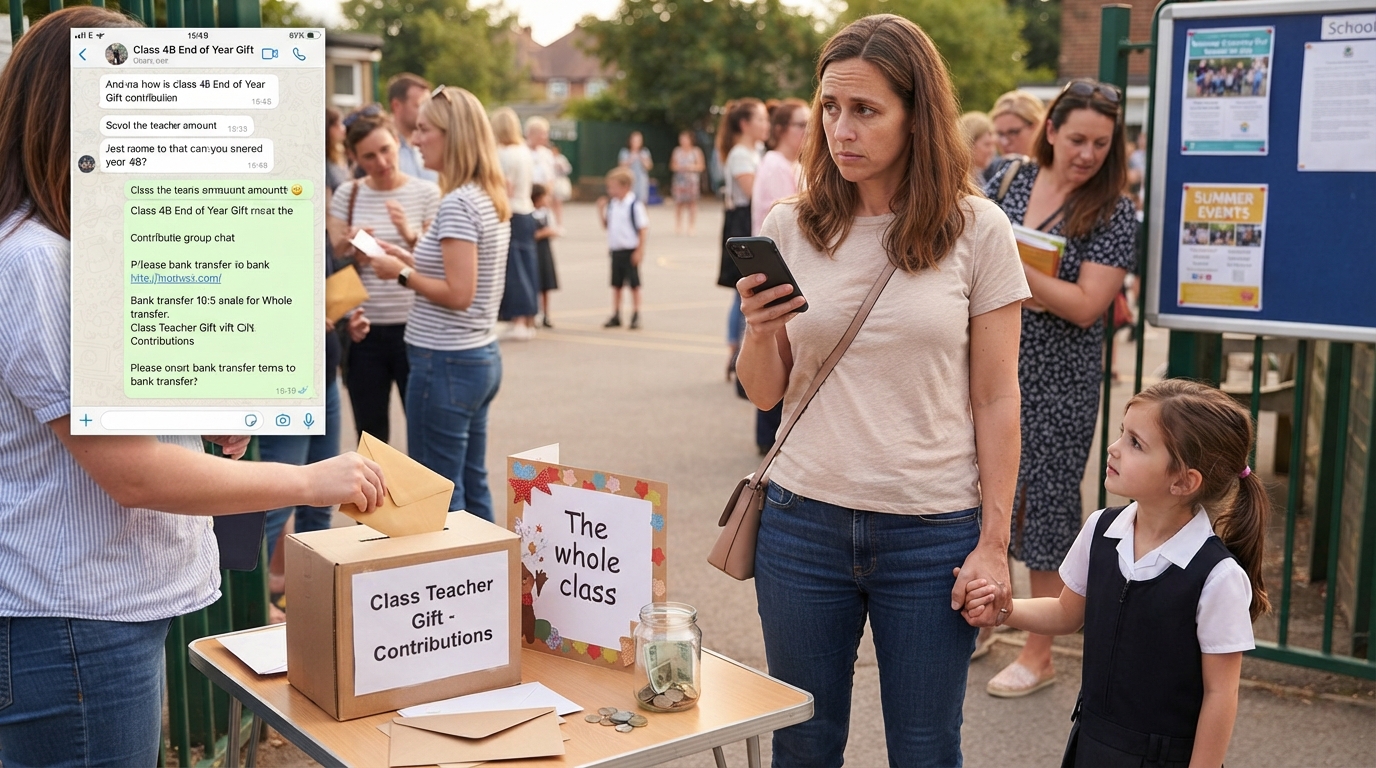
"I don't want to seem stingy": How much should you contribute to the year-end teacher gift collection?
As the summer term comes to a close, parents are reminded that it's time to express gratitude to teachers for their dedication and patience throughout the year. However, determining the right amount to give can be tricky. Is £5 too generous or too little? And what about contributions for support staff like teaching assistants, cafeteria workers, and librarians?
With many families facing financial constraints as they approach the holiday season, budgeting for this additional expense can be challenging, and navigating the social etiquette surrounding it can be awkward.
What used to be a straightforward gesture of buying chocolates and writing a card has evolved into a more complex affair, with class representatives sending numerous WhatsApp messages to gather contributions, organizing a collective card, and deciding on gifts such as flowers, spa days, wine, or vouchers.
This can accumulate quickly, as one parent shared with the BBC. At her primary school in South East London, collections have reached up to £560, which is divided between the teacher and teaching assistants. For a class of 30 students, that averages out to over £18 per child.
Additionally, she mentioned that there are often bake sales and ice cream sales in June and July to raise funds for the school, along with collections for departing support staff or PTA members. The mother of two, who chose to remain anonymous, stated that while she and her partner "were not in an uncomfortable position," they still "feel the strain."
"Sometimes you are asked to transfer money into someone's bank account, and there's a lot of pressure involved. You can't just contribute a small amount or you'll come off as stingy," she explained.
Discussions about teacher collections are a hot topic on the online forum Mumsnet, where opinions often vary. In a recent discussion, one parent described the amount they were asked to contribute as "insane," while another expressed feeling pressured to donate, particularly if there was a class "Queen Bee" coordinating the collection.
Conversely, some participants argued that it is reasonable to give a substantial amount, with one person noting that teachers are "woefully underpaid and undervalued." They pointed out that even contributing £10 each for three staff members is comparable to taking the family out for coffee and pastries.
Maya, who also preferred not to use her real name due to "the politics of it all," has taken on the responsibility of organizing the collection for the past few years at her children's school in London. She believes that a class collection is more economical than individual gifts. Consequently, she and the other parents agreed on a contribution of £5 per staff member, totaling £15 from each child for their teacher and two teaching assistants.
She acknowledged that in years when the teacher "hasn't been the best," contributions have been lower, but generally, most parents do participate. "A couple of mums always say, 'we like to do our own thing,'" she noted, recognizing that there may be valid reasons some parents or caregivers cannot contribute, as some students are in care. "I think it would be terrible to call someone out and ask: why haven't you contributed?" she added.
Psychologist Jo Hemmings recommends that parents agree on a fixed amount for donations. For families unable to afford extravagant gifts, a collection can simplify the process, according to psychologist Cathrine Jansson-Boyd from Anglia Ruskin University. She believes that all children benefit from moving away from a "showing-off culture" at the school gate at the end of term, which can induce anxiety. "It prevents some kids from asking, 'Mummy, or Daddy, why didn't we give the teacher 10 bottles of champagne?'" Jansson-Boyd remarked, suggesting that a £5 contribution from each child constitutes an "incredibly generous" gift for staff.
Behavioral psychologist Jo Hemmings believes that specifying contributions in advance can reduce uncertainty and social pressure, as you can never be sure if your donation will be discussed. "I think everyone should give an equal amount. Probably about £10 per parent, with a maximum of around £20," she suggested, recommending £5 for teaching assistants. "I don't know if that makes me sound mean or generous, but I feel that's a reasonable level," she added. She also believes that the card should be from the entire class, regardless of individual contributions. "Whether a parent has contributed or not is not relevant—the teacher doesn't need to know that."
Tim, a teacher at a private school in Cheltenham, expressed that what he values most is when students write a card or note themselves. "I'm a physics teacher and I've got a terrible sense of humor," he admitted, noting that he particularly enjoys it when students recognize his love for corny puns. Tim, like many teachers, does not want parents to feel obligated to give gifts. Most schools have policies regarding the value of gifts teachers can accept, typically limited to £30 or £50, and discourage cash gifts altogether. "I think it would be