

I do what I want?
As circumstances turned out, we decided to return to the topic of housing overvaluation in the capital of Uzbekistan, which was previously raised in the article "The Time of Militant Amateurs"
What I want, I do?
There are decisions whose meaning becomes clear not from the first official explanations, but from how the authorities subsequently manage their consequences. The mass reassessment of real estate in Tashkent falls precisely into this category. Officials call it a necessary update of the valuation system, a rejection of outdated approaches, and a transition to a value closer to the market rate.
There is a grain of truth in this explanation: the previous methodology was indeed far from market reality, since the determination of cadastral value mainly took into account the year of construction, wall material, and number of floors, while location was not factored in.
But the problem is not that the authorities finally decided to find out how much apartments and houses cost. The problem lies in the scale of the result obtained and in the fact that, along with it, citizens are asked to believe several assertions at once that do not align well with each other.
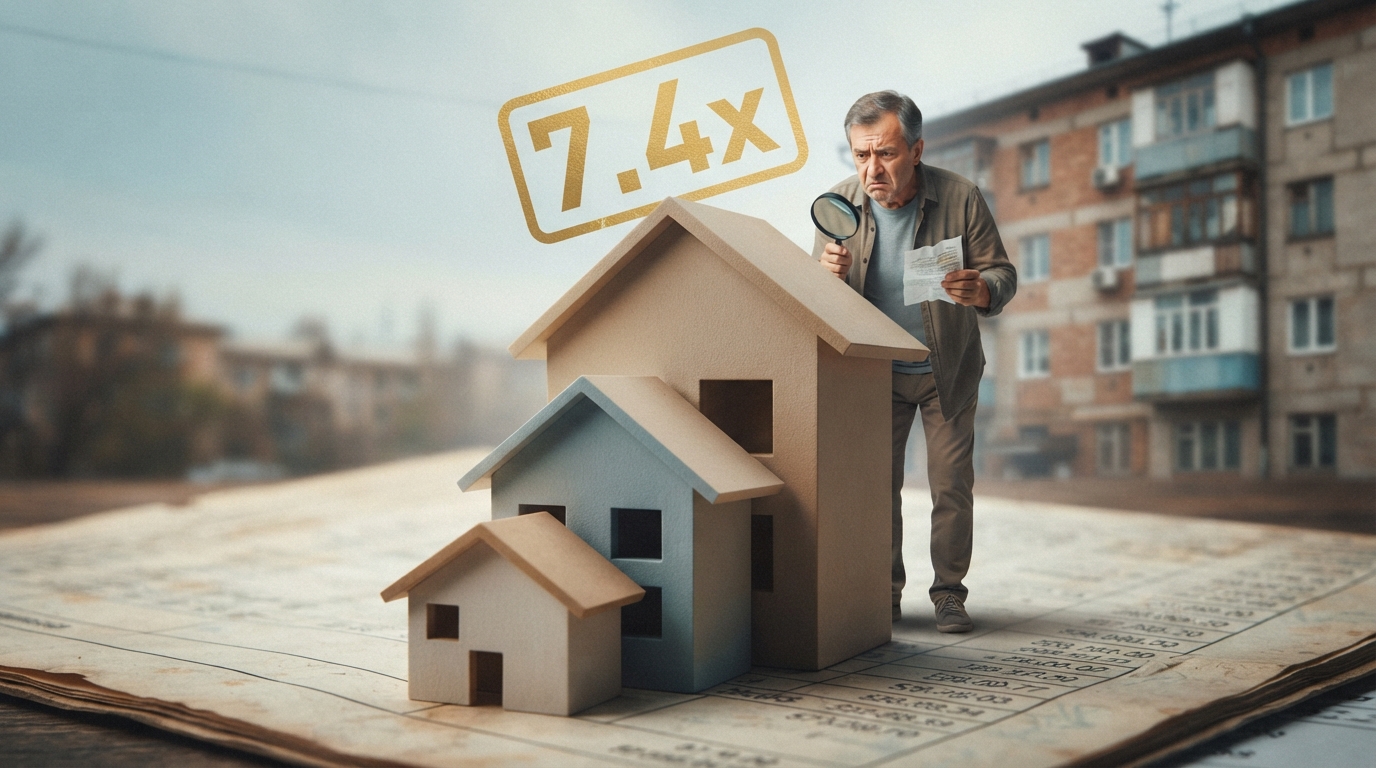
According to preliminary results, more than 600,000 apartments in Tashkent received a combined value of about 426.17 trillion soums instead of the previous 57.18 trillion. That is, the state valuation increased by about 7.4 times. For individual houses, the growth in some cases reaches 15 times. At the same time, the developers of the system themselves emphasize that the new value is close to the market rate and calculated taking into account actual transactions, realtor data, location, and other characteristics.
And here a question arises: if the authorities have indeed determined a value of citizens' property that is as close to the market as possible, why are they simultaneously so persistently convincing them that this value supposedly should not have significant significance for taxation?
And this is where the most interesting part begins.
Officials say that the results of the mass assessment are not yet a tax base, and the issue of their further use in the tax system will be decided separately. Moreover, a reduction in rates is promised so that the introduction of the new assessment does not lead to an increase in the tax burden.
But this explanation is too easily accepted as a ready-made answer, although in reality it is not. Because in the current mechanism, cadastral value is already used as the base for the property tax on individuals. This is an existing principle of tax legislation. Consequently, officials can say that the new mass assessment itself has not yet become the tax base, but to assert that the value of real estate itself is not connected to taxes is incorrect: the connection is already established by the taxation mechanism itself. The difference is fundamental.
If the government increases the cadastral value of property by 7 times, it increases the indicator potentially used in calculating the tax. To prevent the tax from rising in this case, it is indeed possible to lower the rate or apply a limiting coefficient. But then we are talking not about the absence of a connection between the new assessment and the tax, but about something completely different: the state temporarily or partially compensates for the growth of the tax base by changing another element of the calculation. These are different things.
We are told: the new value does not mean a tax increase. But they remain silent about the fact that the new value creates an opportunity to change the tax base, and the size of the future payment will depend on what rate the authorities set for this base. This is exactly what needs to be explained to society.
Especially since tax parameters are already changing. For 2026, property tax rates for individuals were indexed on average by about 1.3 times compared to the previous year, and for certain categories — much higher.
Representatives of the National Center for Mass Valuation of Real Estate themselves list the areas where information on reassessment should be used: mortgages, collateral, insurance, compensation for real estate seizure, infrastructure planning, the work of developers, and other processes. In other words, the authorities are directly saying: we need the most accurate value of citizens' property because it will be applied in many economic relations. But then a simple question arises: why should the tax system be the only area where this new accuracy suddenly ceases to matter? It doesn't work that way.
There is also another aspect of the problem. The authorities announced that the preliminary results are available to owners, and those who disagree can send comments and objections through my.gov.uz. The discussion started on September 5 and is scheduled to last for two months. At first glance, this looks like a model of modern public administration: the government conducted a mass assessment, showed the result, gave the citizen an opportunity to check it, and offered to report an error. However, such a design has one serious flaw: it assumes that a citizen is capable of independently detecting an error in the operation of a state system. And this is far from being the case.
Let's imagine that a person saw in their personal account the value of their apartment, which turned out to be 8 times higher than the previous one. What next? They need to understand where this figure came from. To do this, at the very least, one needs to know the calculation methodology. Then it is necessary to establish which parameters were applied specifically to their property. After that, compare the result with comparable real estate. Then formulate an objection and, obviously, present grounds allowing the assessment to be considered erroneous. That is, the citizen is actually offered to simultaneously be an owner, an appraiser, and an expert on state methodology.
But if the government really considers the result objective, why doesn't it provide the person with a detailed breakdown of its formation along with the estimated value? This is what real transparency would be.
And here another circumstance is particularly telling. In one day, according to representatives of the National Center for Mass Valuation of Real Estate, 287 calls were received, with about 80% concerning specifically the tax issue. Against the background of more than 600,000 reassessed apartments, this is a very negligible number. But to draw a conclusion from it about the consent of the population is even less correct than to consider the absence of an appeal as proof of the absence of complaints.
A person may not know about the procedure. May not use electronic government services. May not understand how to contest the result. May not have time. But there is also another reason that official structures usually prefer not to talk about: a citizen may simply not consider such a procedure effective. Therefore, 287 calls should be viewed not as an indicator of concern, but as a reason to ask another question: how many citizens are actually capable of using the right granted to them, and how many simply will not do so?
The answer to this requires not call statistics, but a study of the real accessibility of the procedure. For now, a kind of administrative substitution is taking place. The government says: everyone is given the opportunity to object. Consequently, the process is open. But the existence of an opportunity does not yet mean its practical accessibility.
A strange situation arises: the government claims that the new value is more objective than the previous one, but the citizen is asked to take this objectivity almost on faith. And if you don't agree — prove the opposite. This resembles not a public discussion, but a presumption of the state's correctness. Especially considering the lack of a mechanism allowing the new value to be contested.
There is also another question that remains in the shadow of official explanations for now: how correct is it at all to call the new figure "market value" if it is calculated by a mass method?
The market price of a specific apartment is determined not only by the district and area. It is influenced by the state of renovation, the view from the window, the floor, the condition of the entrance, the presence of an elevator, the layout, the condition of utilities, the urgency of the sale, the legal circumstances of the transaction, and many other factors. In a real sale of two outwardly similar apartments, the price can differ significantly.
Mass valuation inevitably relies on models and averages. This is normal for a statistical tool, but that is precisely why it is especially important not to turn the result of a model into an indisputable truth. If the government uses mass valuation as a management tool, it must recognize the probability of an error for a specific property. Which means the mechanism for correcting an error must be real, not decorative.
Officials themselves say that previously the value of real estate differed depending on the direction of its use — for mortgages, collateral, demolition, and other operations. Now it is proposed to create a single database. But a single database requires particularly high transparency, because an error in it can automatically spread to several areas at once.
And here a completely different argument against the current presentation of the reform appears. The government asks citizens to discuss the figure, but almost does not discuss the architecture of the system itself: who will control the methodology, how often it will be revised, who is responsible for errors, how administrative overvaluation is prevented, and how a citizen can achieve an independent review. These questions are much more important than the call to simply log onto the portal.
Telling a citizen "do not worry, taxes will not rise" is not enough. Much more needs to be said: what rate will be applied to the new value, for what period it is fixed, what restrictions are established, how the tax will be calculated after the next reassessment, and whether the government can change these parameters unilaterally.
Without answers to these questions, the assurance remains a political promise. And political promises have a tendency to change along with circumstances.
Society needs not assurances from specific officials, but rules that will operate regardless of who heads this or that department tomorrow. If a citizen has the right to object, let them be given a real tool, and not just an electronic window for sending a complaint. And then most of the current questions will disappear. But so far, the opposite is happening.
Public discussion is not when a citizen is allowed to object. It is when a citizen has real grounds to expect that their objection is capable of changing a decision. Otherwise, the procedure turns into a non-binding ritual with all the ensuing consequences. What I want, I do?