

Huge salaries, family ties and benefits: metro management answers controversial questions
The Tashkent Metro has recently become one of the state-owned enterprises that has been criticized on social media. Payments of hundreds of millions of soums to management representatives, the employment of relatives in the same system, and benefits for employees in terms of housing and education are raising questions in the public. The Metro has stated that the large sums do not include wages, but business trips and other payments.
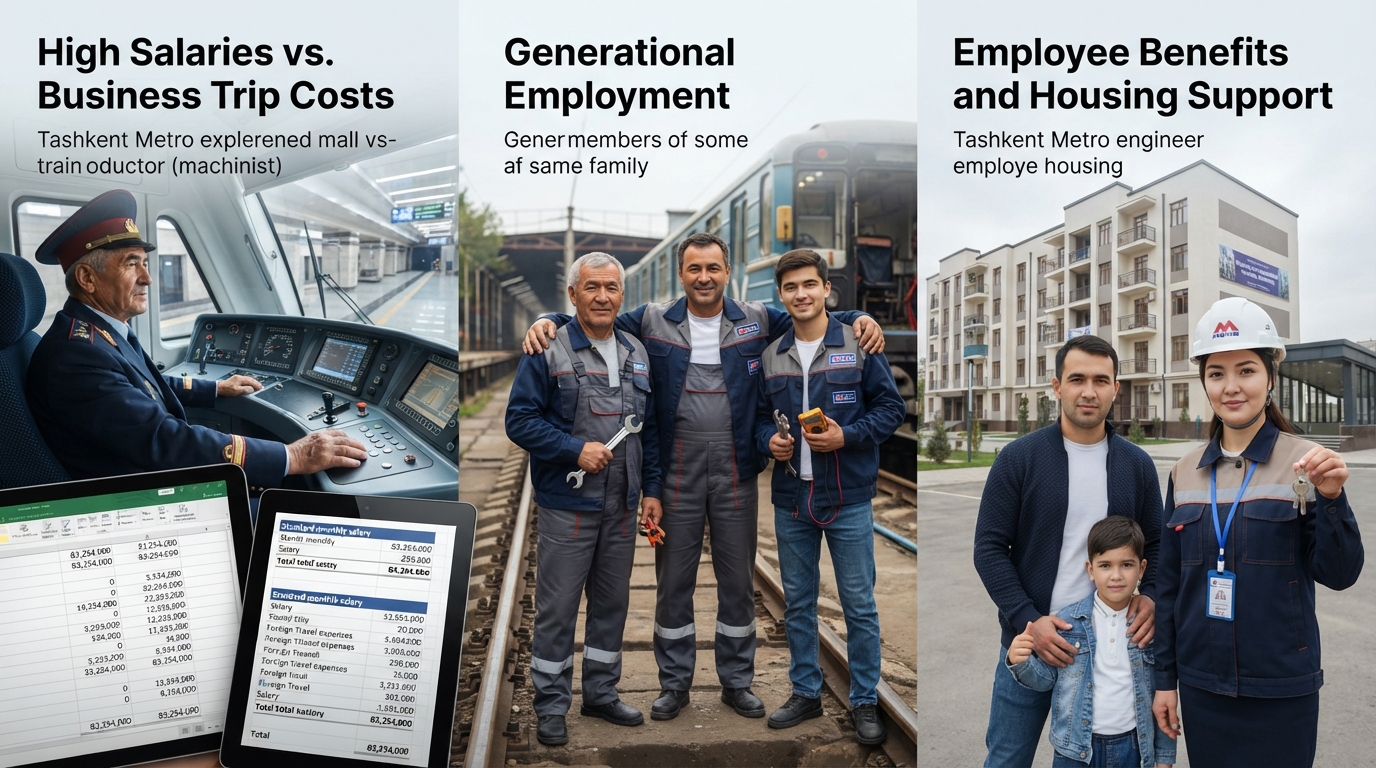
**Metro Management Answers Debate Questions: High Salaries, Neighborhood Ties, and Benefits**
As a strategic transportation system that serves more than a million passengers every day, the financial performance of the metro, management expenses, and benefits provided to employees are naturally in the public eye. Recently, accounts allegedly belonging to the metro management and some employees have been circulating on social media, causing great discussion. The fact that some of the amounts in them amounted to tens, even hundreds of millions of soums, for example, the account of one employee in November 2025 recorded an amount of more than 83 million 254 thousand soums, has raised the question of "is this the salary of the metro head?" However, officials emphasize that these figures should not be taken as net wages.
**Large Payments: Not Salary, But Business Trip Expenses**
According to Yuldosh Yusupov, Deputy Chairman of Tashkent Metro, Kun.uz, the large amounts indicated on social media include business trip expenses. According to him, the accounts of metro employees reflect the total amount paid to them in a given month. This amount includes, in addition to direct wages, business trip expenses and other payments in accordance with the established procedure.
"In order to develop the Metropolitan, study foreign experience and master modern technologies, our employees are regularly sent on business trips to other countries. In this case, the employee's travel, airfare or general transportation costs, hotel accommodation, meals and other necessary expenses related to the trip are covered by the company. It is a misconception to consider the total payment in the account and the employee's salary to be the same. Business trip expenses are not considered an employee's personal income, they are expenses incurred to perform their duties. Therefore, it is not correct to take the total amount in the account that is spread on social networks and conclude that "such and such a leader received this much salary in a month," - says Yuldosh Yusupov.
**The Issue of Kinship: Three Generations from One Family Work**
The second big controversy surrounding the Metropolitan is the issue of kinship. Criticism was expressed on social networks about the large number of relatives and acquaintances at the enterprise, and several representatives of some families working in one system. The representative of the Metropolitan did not deny the existence of such cases. He said that there are also cases where three generations: father, son and grandson work in the same system at the enterprise.
"We do not deny that there are cases related to family ties at the Metropolitan. For example, employees who worked in the same place later became relatives. There are also cases where three generations of one family, that is, father, son and grandson, learn a trade from each other and work in the same system at the Metropolitan. Such employees mainly work in positions such as plumbers, electricians and the like. It is important that they do not work in positions directly subordinate to each other. Such cases at the Metropolitan are investigated by the internal security service and law enforcement agencies. If a conflict of interest or violation of the law is detected, an appropriate assessment will be made," says Yuldosh Yusupov.
**Housing for Metro Employees: Who Will Get the Privilege?**
The construction of multi-storey buildings for metro employees has also sparked discussions on social media. It has been reported that these houses will not be distributed to employees for free.
"The Metropolitan is also paying special attention to social support for employees. In particular, those in need of housing are being provided with access to discounted loans under the guarantee of the Metropolitan. Priority is given to those who have been working in the system for many years and young specialists. These houses are not distributed to employees for free. The main goal of creating these conditions is to retain qualified employees in the system. The Metropolitan is not an ordinary enterprise, it takes years to train qualified specialists for the system. It takes experience and time for a machinist, electrician, plumber, engineer and other technical specialists to master their work perfectly. Therefore, it is natural for us to be interested in training a qualified employee and not letting him leave for another place, and in his long-term work in the system," says Yuldosh Yusupov, Deputy Chairman of Tashkent Metro.
Today, more than 6 thousand employees work in the Tashkent Metro. According to the management, in 2021, the average salary in the system was around 2.5 million soums. Now this figure has reached 7-7.5 million soums. Also, the share of young employees has reached almost 50%.
**Sudden Growth in the Number of Passengers and Updates**
In 2021, 250-300 thousand people used metro services per day, while now this figure has exceeded 1.1 million. The increase in passenger flow is attributed to the addition of new lines, stops, and an increase in the number of rolling stock. In particular, until 2021, there were 40 rolling stock. By 2026, their number had reached 87. During this period, 47 new rolling stock were brought in. As a result, the interval between trains on the Chilanzor route has reportedly been reduced to 1.5–2 minutes, on the Yunusabad route to 4 minutes, and on the Uzbekistan route to 3 minutes.
"In recent years, the number of metro stations has also increased significantly. Previously, there were 29 stations, but now their number has been increased to 50. Elevators, facilities for passengers with disabilities, maternity rooms and other amenities are being introduced at new stations. Public toilets and maternity rooms have been established at 10 stations with a high passenger flow. Escalators at the Novza, Khalqlar Dostligi, Mustaqillik Maydiy, Pakhtakor and Hamid Olimjon stations have been renovated. The new escalators have sensor systems that stop working when there are no passengers. Payments that were previously made through tokens have been digitized. Today, there is the possibility of paying by bank cards, mobile applications, ATTO cards, as well as face and palm. Mobile communication and free Wi-Fi have also been established at the stations. Ucell and Mobiuz companies provide communication services in some metro tunnels," he said. Head of the press service of Tashkent Metro JSC Daniyor Nurillayev.