

How video game remakes tap the power of nostalgia
Video games are good at triggering nostalgia, a key reason why classic games keep getting remade.
How video game remakes harness nostalgia
The Legend of Zelda: Ocarina of Time is often ranked among the greatest video games
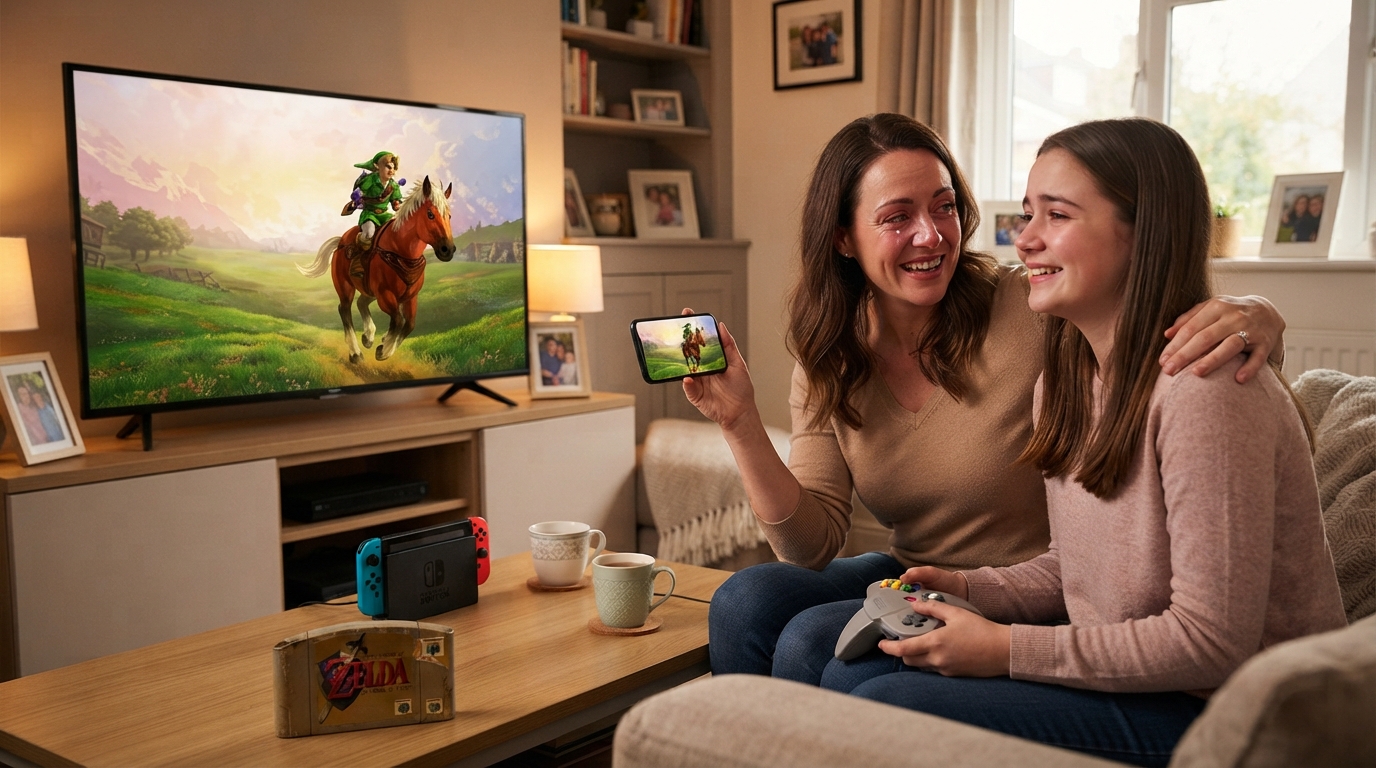
When she saw footage from the remake of The Legend of Zelda: Ocarina of Time, Kacey Doran immediately reached for her phone. She had to tell her sister.
"Have you seen this?" Doran messaged, excitedly.
Almost 30 years ago, a 10-year-old Doran sat in front of her family’s TV, reading the on-screen dialogue aloud to her sister, who was a year younger, as they worked their way through the original Nintendo 64 game’s vast, puzzle-packed dungeons. Ocarina’s fairy-tale story and gorgeous music captivated them both.
It was also the first game Doran ever finished. Now, as she watched clips of the completely reworked version, set to arrive on the Switch 2 later this year, a flood of memories came back.
Her sister replied: "I'm not tearing up… YOU'RE tearing up."
That is the force of nostalgia — and a clear example of how video games can evoke it. Doran now teaches an esports course at Rowan University in New Jersey. She says the original Ocarina of Time, released in 1998, had a "magical" quality she hopes to experience again, and to pass on to her sister’s children as well.
The video game industry has long relied on remakes. From Mario Kart to the Final Fantasy series, and even Pac-Man, certain games keep returning in refreshed versions as new generations of players arrive and as computer hardware advances, allowing for richer graphics and ever larger game worlds.
Although the emotional pull may be the biggest attraction, releasing a remake can be a double-edged sword. Some gamers fiercely guard their favourite titles, and new versions do not always live up to some fans’ extraordinarily high expectations.
Nostalgia is an important but complicated emotion, says Tim Wulf of the Centre of Advanced Internet Studies in Bochum, Germany. It has positive sides, but also a touch of sadness. It is the happiness of recalling things that mattered to us, along with the recognition that that period is now over.
"It’s a social emotion because memories that induce nostalgia for us are connected to other people," he explains, adding that nostalgia can strengthen self-esteem while also underscoring important social ties.
Video games, Wulf says, are especially effective at sparking nostalgia because players can "jump into the same environment". In other words, games act like emotional time machines, and revisiting beloved places can feel steadying or comforting in a world that keeps changing.
Doran, for her part, says there is something rewarding about returning to a favourite old game and using skills you already learned. You know what to do here, you’re winning again. Just like the old days.
Releasing remasters and remakes has been a "really successful" approach for the games industry, says Piers Harding-Rolls, head of games research at Ampere Analysis.
"Tying in with established audiences and building on existing content is quite a safe route for a lot of companies," he adds. In many cases, updating an existing game is cheaper than building a new one from the ground up.
Other recent remakes that have drawn large audiences include Resident Evil 4 and Assassin’s Creed Black Flag.
But Ocarina of Time may stand apart because, ever since its original launch, many have regarded it as one of the greatest games ever made. "The interest from all the Gen Zs that I work with is really high," says Harding-Rolls. The legend of The Legend of Zelda, so to speak.
Clearly, nostalgia is not the only reason people are interested in the remake, and modern audiences will expect a game that meets today’s standards.
Game companies have to keep innovating when connecting contemporary audiences to the past, says Wulf, if they want to satisfy the demand for new experiences. And although Wulf himself was a big fan of the original, he has no personal interest in the Ocarina of Time remake. "I want a new game – I don't want to play an old game," he says. Nostalgia is not always enough for everyone.
There is also often a tension, critics say, between originals and remakes. Which version is the definitive one? In 2021, Square Enix released the oddly named Nier Replicant ver.1.22474487139... – a remaster of a game first released in 2010.
One reviewer wrote, "What we're left with is two nearly identical Niers each vying to be the true Nier."
Fans may react badly if a remaster or remake fails to do justice to the source material. And in gaming, angry fan backlash can be serious.
"There's always going to be that fan base or group of people that are going to nit-pick," says Stephanie Ijoma, chief executive and founder of NNESAGA, a consultancy and creative agency.
In the end, developers working on remakes have to "find the right balance" between pleasing fans and giving themselves room to be creative with the material, she says. "You can't make art in fear, you can't create in fear."
Ijoma points to Final Fantasy VII. First released in 1997, it received a much-anticipated remake in 2020.
She played this game in the late 1990s and was delighted to be able to share it with younger players today.
Remakes make that kind of sharing possible because getting old computer hardware or video game consoles to work, while a hobby cherished by some, is not feasible for everyone.
"I've tried multiple times to play Silent Hill 2 because I'm interested in older games but it's such a difficult game to come into nowadays," says Niklas Hallin, a solo indie game developer who runs the studio Neckbolt. "They made a remake and it's so smooth, it just works. It works on your modern hardware."
Hallin did not play many games as a child, so he says nostalgia is not much of a motivator for him. Even so, in his own games he likes to include subtle stylistic nods to classic games because he knows gamers respond to them.
Indie developers often use retro game aesthetics not only because people like them, but also because they are easier to produce. "You can't compete with billion dollar budgets, super high-fidelity, Triple A graphics," he says.
One question remains. Visually, the difference today between games released years apart is arguably small. So will there be any point in remaking a game from 2026 in, say, 2038? Will technology have advanced so much by then that it will actually be worthwhile?
Harding-Rolls predicts that game companies will still try to connect new audiences with classic titles through updates.
Remakes may become less about graphical upgrades and more about editorial changes. "Reinterpretations," he says. "Or versions with additional content."
It’s never really "game over", is it?