

How Uzbekistan's jewelers are doing: the industry is growing under digital control
There are nearly 3,000 entrepreneurs working with precious metals and gemstones in Uzbekistan. At the same time, along with the development of the jewelry business, the digitalization of public services and market control are being strengthened. As of September 1, 2026, there were 2,911 entrepreneurs operating in Uzbekistan whose activities are related to precious metals and gemstones. These data were presented at a press conference […]
How Uzbekistan's Jewelers Are Doing: The Industry Is Expanding Under Digital Supervision
In Uzbekistan, nearly 3,000 entrepreneurs deal in precious metals and gemstones. Alongside the growth of the jewelry business, the digitalization of public services and market control are intensifying.
As of September 1, 2026, there were 2,911 entrepreneurs operating in Uzbekistan whose activities are related to precious metals and gemstones. This was announced at a press conference at the Ministry of Economy and Finance, organized by the State Assay Supervision Inspectorate.
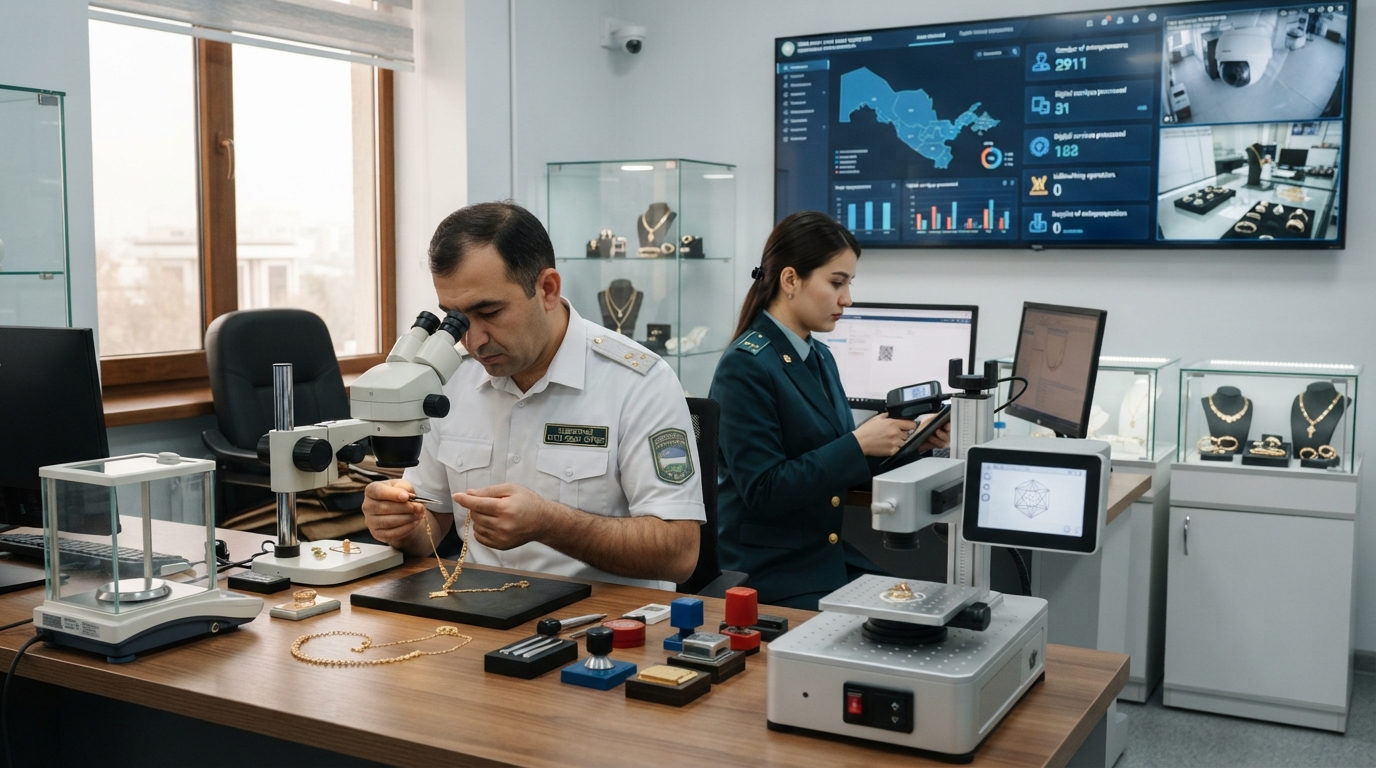
The discussion focused not only on the regulation of the jewelry industry but also on changes in the system of interaction with entrepreneurs itself. Licensing and the issuance of permits in the field of precious metals and gemstones circulation have been fully digitized. Public services are provided in electronic form, which, as noted, is expected to minimize the influence of the human factor.
The Jewelry Market Demands More Hallmarking
One of the signs of industry activity is the growing demand for services to determine the fineness of jewelry and stamp them with the state hallmark.
For the buyer, the hallmark is a guarantee of the precious metal content in the product, and for the state, it is one of the tools to control the legality of the circulation of such products.
Consequently, the growing demand for hallmarking may indicate not only the expansion of the jewelry market but also the desire of industry participants to operate within the official legal framework.
At the same time, the state is banking on further digitalization of procedures, including licensing and permit processes.
Control Is Increasing
Simultaneously with digitalization, preventive work is also intensifying. The Inspectorate regularly conducts activities aimed at preventing violations of legislation in the jewelry sector.
Moreover, the number of such events remains high: 1,500 were conducted in 2024, 1,679 in 2025, and 1,169 during the reporting period of 2026. In other words, control in the industry is gradually becoming systemic — from the prevention of violations to the use of modern technical means.
Special attention is paid to the use of video surveillance systems in the provision of public services, as well as conducting control activities using modern technologies.