

How to move during an earthquake: a visual guide
**How to Move During an Earthquake: A Visual Guide**
When an earthquake strikes and the ground starts shaking, your next move can have a significant impact on your safety.
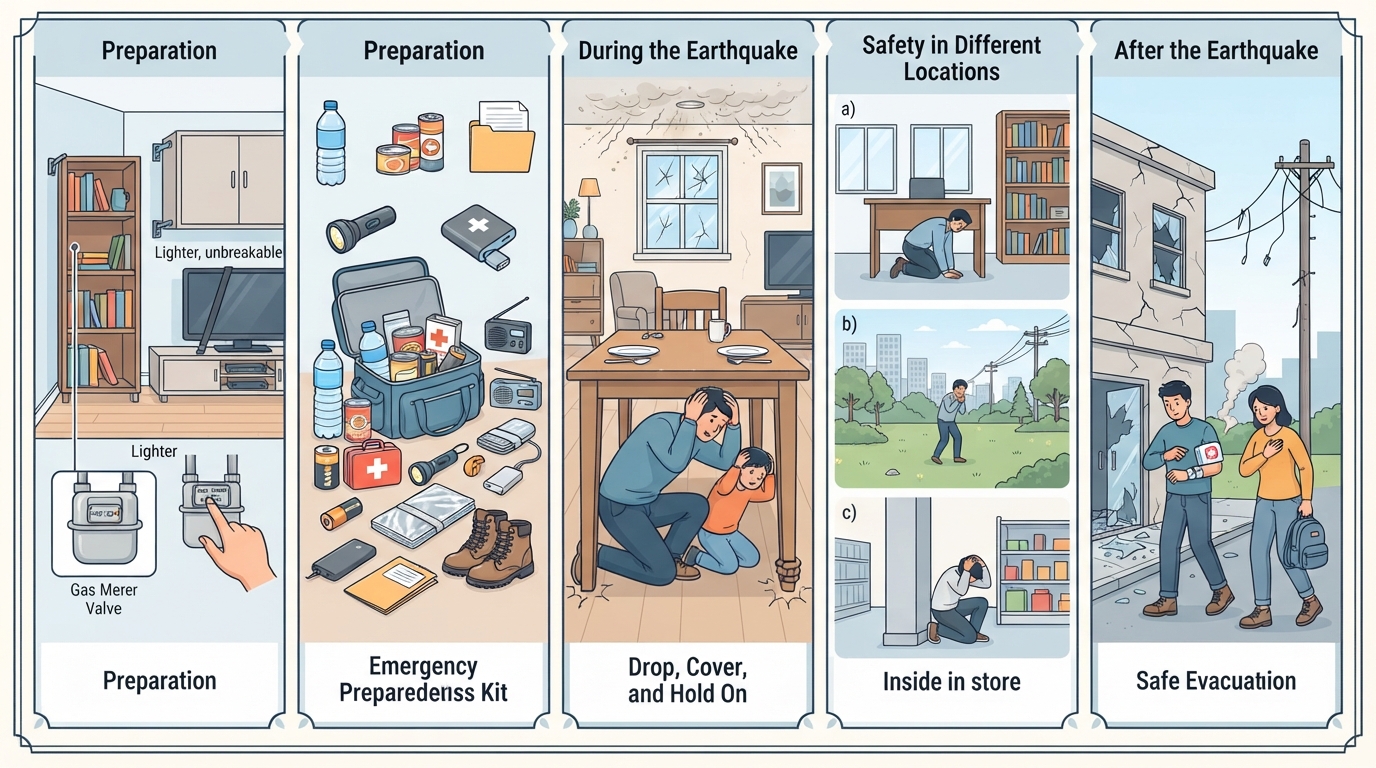
This visual guide, produced by Al Jazeera, explains five practical steps to take, from making your home earthquake-proof and preparing an emergency kit to protecting yourself during and after an earthquake.
**Is your home earthquake-proof?**
Precautions to take during an earthquake start before the earthquake hits. Look around your home, office or school to identify items that could fall, break or pose a hazard during strong shaking.
Secure tall furniture such as bookcases and cabinets to the walls, and place heavy or fragile items on lower shelves. Secure televisions and other large appliances that may fall.
Learn how to safely turn off gas, electricity, and water, and know where the main controls are. Stay away from windows, mirrors, and other objects that could fall.
**Prepare an emergency kit**
Power, water, and communications may be out after an earthquake. Having the necessary supplies on hand will ensure that you don’t have to fumble around for them during an emergency.
Your emergency kit should include: drinking water, non-perishable food, a first aid kit, a flashlight, spare batteries, a battery-operated or handheld radio, a whistle, and essential medications.
Also, take a portable power bank, copies of important documents, some cash, and sturdy shoes to protect your feet from broken glass and debris.
**What to do when an earthquake starts?**
If you are indoors when an earthquake starts, stay indoors and protect yourself until the shaking stops.
The Ministry of Emergency Situations recommends not running outside during an earthquake. Falling glass, debris, and other objects can make the area extremely dangerous, so staying put will reduce the risk of injury.
* **Drop:** Get on your knees and put your palms on the ground.
* **Hide:** Get under a sturdy table or desk to protect your head and neck. If there is no sturdy shelter nearby, move to an interior wall away from windows and other hazards.
* **Hold on:** Hold on to your shelter until the shaking stops and be prepared to move with it.
**The safest actions depend on the surrounding conditions**
There is no one-size-fits-all solution. Which hazards to avoid will depend on the surrounding conditions.
* **Inside a building:** Stay inside, cover yourself, duck, and hold on tightly.
* **In a store or office:** Stay inside, away from shelves and windows, and protect your head.
* **In school:** Follow the instructions of teachers and staff, and hide your head under a sturdy table or desk.
* **In a car:** Pull over in a safe place, away from bridges, power lines, trees, and other hazards. Stay out of your car until the shaking stops.
* **In the open:** Move to an open area away from buildings, power lines, trees, and anything that could fall.
* **In an elevator:** Stay inside until the elevator stops. Once it stops, exit the elevator if it is safe to do so.
**After the shaking stops**
First, check yourself and anyone else around you for injuries. Then, scan the area for hazards.
Just because the shaking has stopped does not mean the danger has passed. Aftershocks (repeated shaking) may occur. Earthquakes can also cause fires, gas leaks, damage to buildings, broken windows, and downed power lines.
If you suspect a gas leak, such as a damaged pipe or the smell of gas, leave the area immediately. Do not attempt to ignite the gas yourself. If the power lines are down, do not touch them and follow local recommendations to turn off the power.
Be prepared for aftershocks. If the shaking continues, duck, take cover, and hold on to something.
Use your phone carefully after an earthquake. Avoid making unnecessary calls to avoid overloading phone networks. Use text messages or mobile data whenever possible, and keep your phone with you for emergency communications and official messages. Conserve battery life by lowering screen brightness, closing unnecessary apps, and using a power bank if available.
After an earthquake, stay alert, follow official instructions, and help others when you are sure it is safe. Being prepared and calm can make all the difference.