

How the dispute over the house of a Russian artist in Tashkent grew into a discussion on the importance of cultural heritage
**How a Dispute Over the House of a Russian Artist in Tashkent Escalated into a Debate on the Importance of Cultural Heritage**
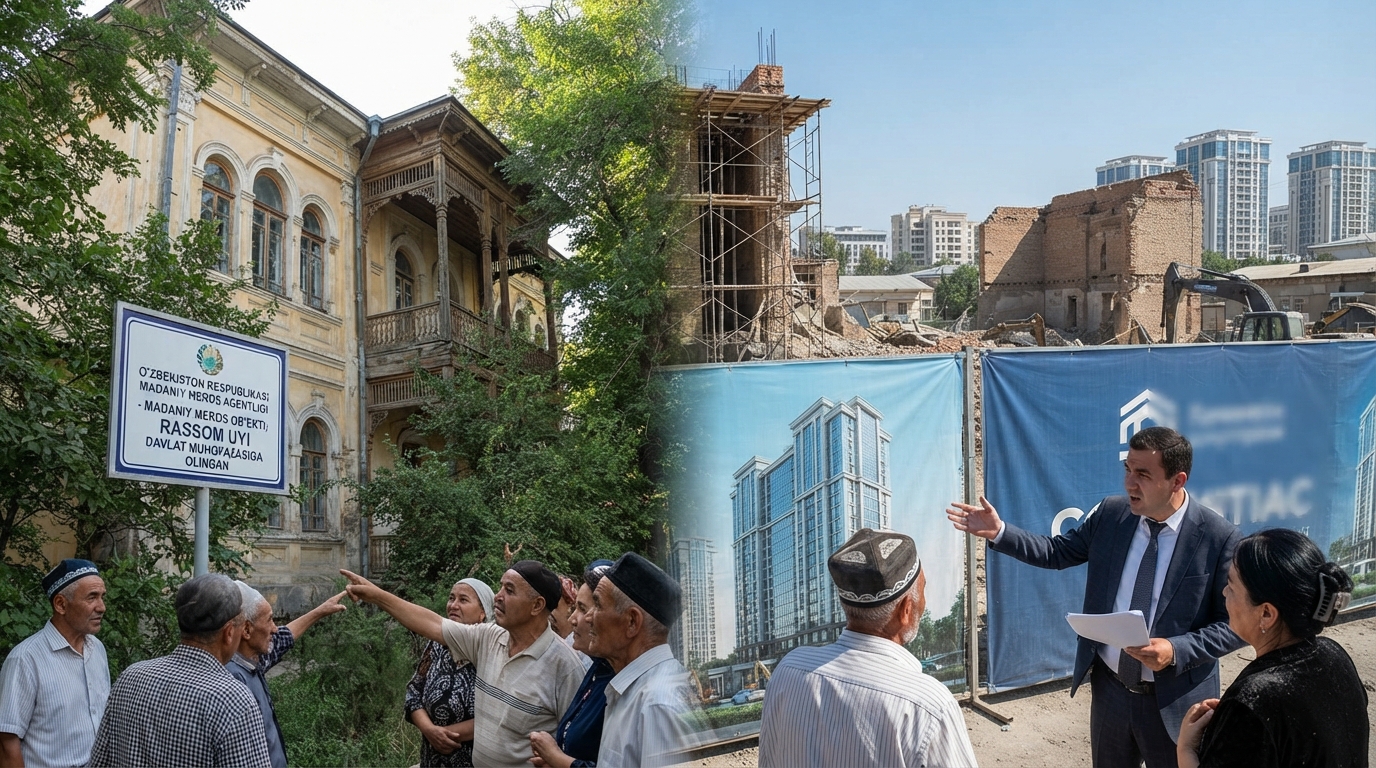
In recent days, a public debate has unfolded between the chairman of the Milliy Tiklanish party, Alisher Kadyrov, and the Cultural Heritage Agency regarding the preservation of historical sites. One of the main subjects of the dispute was "some house of a Russian artist" at 7 Babur Street in Tashkent, which is under state protection as a cultural heritage site.
However, the history of this building began long before the current conflict.
### To the Prosecutor General's Office for a Legal Assessment
On October 30, 2018, the Hokim of Tashkent, by his decision, allocated a land plot at this address to Universal Packing Masters LLC for the demolition of existing residential and non-residential buildings and the construction of a multi-story residential building. This occurred before the building received protected status.
In 2020, the Scientific and Expert Council under the Cultural Heritage Agency approved the inclusion of the building in the National List of Objects of Material Cultural Heritage.
Six years later, in August of this year, the Cultural Heritage Agency returned to the issue of preserving the building. On September 8, the agency announced that it had appealed to the Prosecutor General's Office with a request to provide a legal assessment of the Tashkent Hokim's 2018 decision and, if violations are identified, to take measures to cancel or review it. The agency also requested that the demolition or damage of the building be prevented.
### Some House...
A few days later, on September 16, Alisher Kadyrov publicly commented on the situation. He questioned the need to preserve this site and asked what value it holds for Uzbekistan.
"In the center of Tashkent, there is an old building that could easily be demolished, but it is protected as a cultural heritage site, and there are lawsuits and disputes over it. Nobody needs it; it is some house of a Russian artist. Take it away, why do we need it? What value does it represent for us as cultural heritage? What is its significance? Does it constitute even a thousandth part of Shah-i-Zinda? Regardless of what kind of artist he was," said the chairman of the Milliy Tiklanish party and deputy of the Legislative Chamber.
In his opinion, the Cultural Heritage Agency should primarily focus on national culture.
"The Agency is not an agency of universal human values, but the agency of our national culture. The Agency must first and foremost focus its attention on our national culture," he said.
### Cultural Heritage Has No Nationality
On the same day, the Cultural Heritage Agency issued an official statement in response to Alisher Kadyrov's words.
The agency stated that the value of a cultural heritage site cannot be determined by the principle of "whether we need it today or not." According to the agency, the building at 7 Babur Street was built in 1935 and is associated with the name of the famous architect Alexey Shchusev, who worked in Tashkent.
At the same time, the agency emphasized that the history of the building is not limited to the architect's name. In different years, scientists and professors who contributed to the development of science and culture in Uzbekistan lived here, including academicians Tashmukhammad Kary-Niyazov and Vasily Shishkin, as well as Rakhim Atajonov and Natan Mallaev.
The agency specifically opposed linking the value of a historical site to the nationality of the person who created it or with whom it was associated.
"This is not just about one building. This is about how we treat our own history. Cultural heritage has no nationality," the agency's position reads.
### Parliamentary Inquiry
The following day, Alisher Kadyrov responded to the statement of the Cultural Heritage Agency. He announced his intention to seek answers to his questions through a parliamentary inquiry or hearings. According to the deputy, during the discussion of the budget report in the Legislative Chamber, deputies had already raised questions about the agency's work, but instead of answers, the agency published a statement on social media.
"The party, of course, will not respond with a separate statement, but to get answers to our questions, we will try to use the powers of a parliamentary inquiry or hearings," Alisher Kadyrov wrote.
He also stated that his grievances concern not only the building on Babur Street, and recalled the issues he had previously raised regarding the condition of the Sarmishsay Museum-Reserve, the Shah-i-Zinda complex, the Mizdakhkan complex, the ancient Quran manuscript in Bukhara, and the territories associated with the ancient state of Dayuan.
In particular, the deputy claimed that despite the funds allocated for Sarmishsay, the territory of the open-air museum remains without proper care. He also raised questions about the impact of the highway on Shah-i-Zinda, the storage conditions of the ancient Quran manuscript in the Bukhara Ark, and the use of land in territories associated with the Dayuan state for agriculture.
"Why does the Agency not show the same care for our thousand-year-old national culture and heritage as it does for the heritage of the Soviet period? We have dozens of questions, and we have been trying to get answers to them since last year," the deputy stated.
He emphasized that he is not against preserving heritage associated with representatives of different nationalities, but against a situation where such sites receive more attention than monuments that he considers an irreplaceable part of the national heritage.
"We object to our irreplaceable cultural heritage being left aside, while more attention is paid to preserving the apartment of a Russian artist, an Uzbek literary scholar, a Ukrainian architect, or any other compatriot of ours whose value we do not doubt. Or is it more profitable to preserve certain heritage sites?" wrote the leader of the Milliy Tiklanish party.
He also stated that the public needs a report on how funds allocated for the preservation of cultural heritage are used, adding that he raises these questions as a deputy, and as party chairman, he intends to speak in parliament after the report of the Cultural Heritage Agency.
On September 19, the Cultural Heritage Agency published a detailed response to Alisher Kadyrov's statements and stated that it is open to criticism and parliamentary oversight, but believes that public accusations must be backed by facts and documents.
Responding to the criticism regarding Sarmishsay, the agency reported that 4.2 billion soums were allocated from the budget for the development of the site's infrastructure, and another 1.2 billion soums were allocated by the agency's fund. According to the agency, these funds were used to create a pedestrian path, information centers, parking, lighting, video surveillance, and other facilities.
Regarding Shah-i-Zinda, the agency reported that the portal of the complex was studied in 2022–2023 with the participation of Polish specialists. According to the agency, repeated measurements did not reveal any new significant deformations. Touching upon the Quran manuscript in Bukhara, the agency stated that it is stored in the repository of the Bukhara Museum-Reserve in the Ark fortress. At the same time, the agency announced plans to involve international specialists for its conservation and restoration.
Separately, the agency responded to the question about the important archaeological site of Mingtepa in the Markhamat district of the Andijan region. The agency explained that part of the land was transferred for orchards and vineyards back in 2006, whereas the monument was included in the National List in 2019. After receiving protected status, according to the agency, warnings were issued to land users, and cases of unauthorized land occupation are currently being investigated by law enforcement agencies.
In addition, in its statement, the agency returned to the building at 7 Babur Street. The agency emphasized that its value is determined by its historical and architectural significance, and not by the nationality of the people associated with the site. At the same time, the agency stated that no funds from the republican budget have been spent on the preservation of this building to date.
In response to Alisher Kadyrov's words about increased attention to the heritage of the Soviet period, the agency reported that in the first half of 2026, 79.4 billion soums were directed to the restoration, repair, reconstruction, and archaeological research of various sites.
It also emphasized that it is ready to provide the parliament with information, documents, and data on the work done if a corresponding request is made.
Thus, the debate surrounding the approaches to preserving cultural heritage sites continues.