

How structural reforms laid the foundation for Uzbekistan's economic growth
An article about structural reforms and economic growth prospects in Uzbekistan was published on the OpenMarkets website, owned by the US company CME Group.
**How Structural Reforms Laid the Foundation for Uzbekistan's Economic Growth**
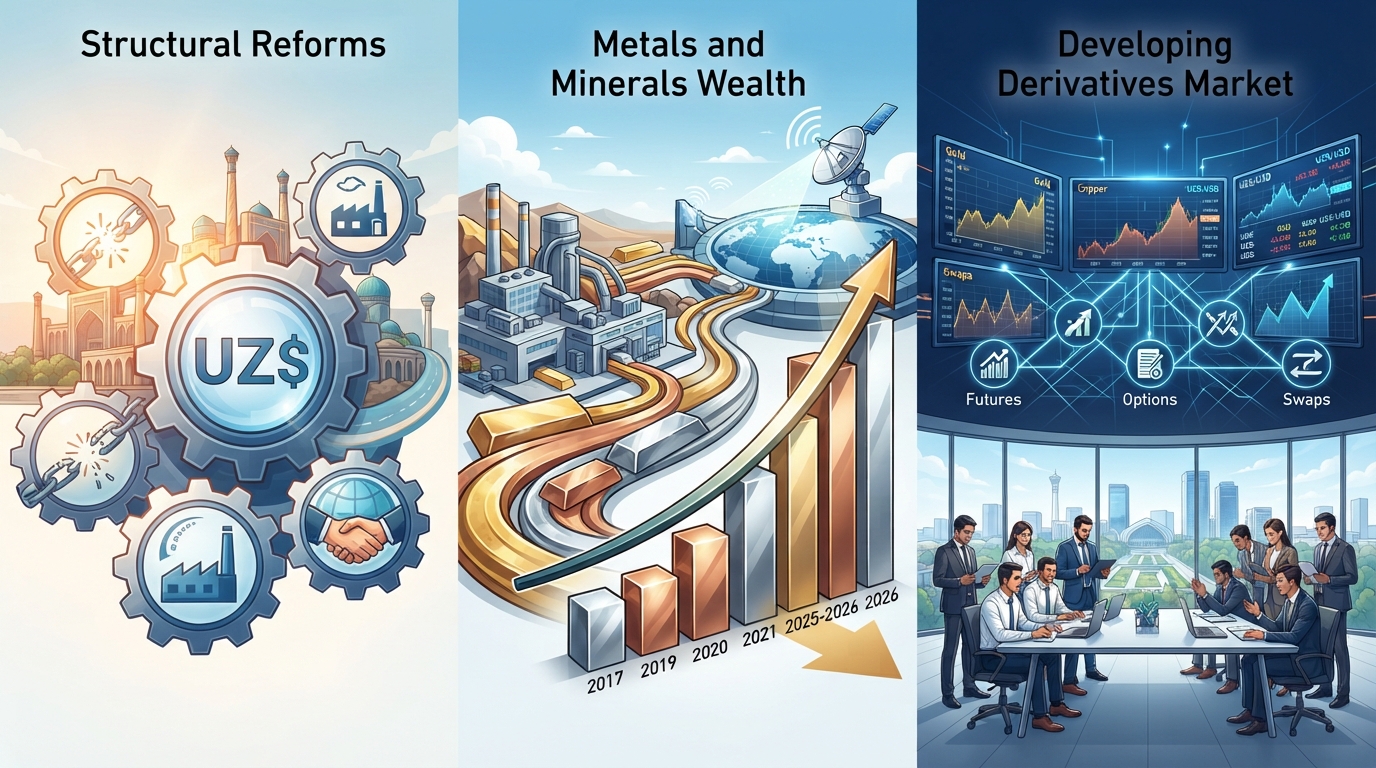
Over the past 10 years, large-scale reforms have been implemented in Uzbekistan, resulting in the gradual transition of the country's economy to a system based on market principles and the achievement of high GDP growth rates. The liberalization of the foreign exchange market, the expansion of private sector participation, and the development of international trade relations have expanded the opportunities for Uzbekistan, which is rich in mineral and metal resources, to benefit from rising commodity prices. However, the large share of minerals and metals in exports also increases risks associated with global price fluctuations, which further heightens the need to develop a mature derivatives market.
In 2016, large-scale reforms began in Uzbekistan. The newly elected President Shavkat Mirziyoyev started implementing a policy aimed at transitioning this Central Asian country from a system with high state participation in the economy and a relatively closed structure to an open, market-based economy. According to a study by the International Monetary Fund (IMF), one of the most important changes in the initial phase was the liberalization of the foreign exchange market. The official and unofficial exchange rates were unified, the Uzbek soum was transitioned to a free float, and previous strict restrictions on currency conversion were lifted. Additionally, the requirement for the mandatory sale of export revenues was abolished, expanding access to foreign currency for businesses and the population.
At the same time, as noted in the IMF study, during the reform process, the national currency depreciated by nearly 50%, and inflation remained at double-digit levels for a certain period. In order to curb inflation, the Central Bank of the Republic of Uzbekistan transitioned to an inflation targeting regime in 2020, and a target was set to reduce inflation to 5% in the medium term.
Along with the liberalization of the foreign exchange market, a number of measures aimed at integrating Uzbekistan into global markets were also implemented. Import and export restrictions on most goods were lifted, export processes were simplified, and tax incentives for exporters were expanded. The country also strengthened economic cooperation with international financial institutions such as the IMF, the World Bank, and the Asian Development Bank. Currently, Uzbekistan is working on fulfilling the necessary requirements to become a member of the World Trade Organization.
Another important direction of the reforms was aimed at reducing the state's participation in the economy, encouraging private sector activity, and stimulating foreign direct investment. This process included reforms on privatizing state-owned enterprises, strengthening the protection of investors' rights, and improving business conditions. In May 2026, shares of the National Investment Fund of Uzbekistan (UzNIF), which holds minority stakes in 13 large state-owned enterprises, were publicly listed on the London Stock Exchange and the Tashkent Stock Exchange. This was Uzbekistan's first public offering of shares in the international capital market.
The implemented changes are also reflected in economic indicators. According to S&P Global, since the start of the reforms in 2017, economic growth has averaged 6% per year, and in 2025, GDP growth reached 7.7%. Economic growth for 2026 is projected at 8.1%. As of July 2026, inflation stood at 6.4%, while high gold prices had a positive effect on the strengthening of the Uzbek soum.
At the same time, tasks remain regarding the reform and privatization of large state-owned enterprises and banks, as well as the development of a competitive environment with favorable market entry and exit opportunities. According to the IMF study, there are still approximately 1.8 thousand state-owned enterprises in the country.
**Metals and Minerals**
The expansion of Uzbekistan's trade relations with world countries and the improvement of the business environment are increasing the opportunities for the country, which is rich in metal and mineral resources, to benefit from rising commodity prices. Uzbekistan is among the world's top 10 gold-producing countries, ranks 20th in copper production, and 5th in uranium production. The country also possesses significant reserves of silver, lithium, tungsten, and rare earth elements, as well as magnesium, zinc, aluminum, and graphite. The economic significance of these resources is also demonstrated by price dynamics in the global market. In 2025, the price of gold increased by 65%, silver by 144%, and copper by nearly one-third.
The rise in natural resource prices also contributed to an increase in the value of Uzbekistan's exports. In 2025, the country's exports grew by 23% to reach $33.4 billion. Along with exports of metals and minerals, exports of food products, fertilizers, and services also contributed to this growth. Gold exports alone increased by 32% compared to the previous year, reaching $9.9 billion and accounting for 29.3% of the country's total exports. This served to reduce the current account deficit and offset relatively low growth rates in other sectors.
Within the framework of the "2030" strategy, in order to effectively utilize the country's natural resource potential, it is planned to increase annual copper production to 500 thousand tons, gold to 175 tons, silver to 500 tons, and uranium to 15 thousand tons.
**Emerging Derivatives Market**
The high share of commodities in Uzbekistan's exports increases the vulnerability of the country's economy to price fluctuations in the global market. For this reason, the financial infrastructure is being improved to expand the opportunities for using derivatives as hedging instruments in managing currency and price risks. The new draft law "On Capital Market," presented to President Shavkat Mirziyoyev in June and subject to adoption by the parliament, provides for the introduction of financial instruments such as options, futures, swaps, and forwards to the Uzbek market for the first time. The legal framework for these instruments is expected to be aligned with the standards of the International Swaps and Derivatives Association (ISDA), and a system of transactions based on netting agreements is also planned to be introduced.
The National Agency for Perspective Projects of the Republic of Uzbekistan has also introduced a regulatory sandbox that allows companies to issue bonds in foreign currency to reduce currency risks. In March 2026, the Central Bank of the Republic of Uzbekistan signed a memorandum of cooperation with The Currency Exchange Fund (TCX), an international financial institution specializing in hedging currency and interest rate risks in developing and emerging markets. The memorandum provides for the development of the derivatives market in Uzbekistan, focusing on creating a modern risk management ecosystem based on international best practices.
Additionally, Uzbekistan's leading organized commodity trading platform, the Uzbekistan Commodity Exchange (UZEX), is expanding access to international commodity markets and modern risk management tools based on its existing domestic trading infrastructure. This process is being accelerated through UZEX Global, a joint venture between UZEX and Phillip Capital. It provides access to global commodity derivatives traded on leading exchanges, including CME Group platforms. Along with the operational infrastructure necessary for direct trading of derivatives, the exchange also provides consulting and training services on risk management.
Overall, these initiatives are expected to lay the foundation for the development of a derivatives market aligned with international standards, allowing businesses to effectively manage risks associated with commodity prices and exchange rates in the context of expanding export volumes.