

How is the abnormal heat in Europe affecting nuclear power plant operations?
The ongoing heatwave in Europe and the decline in river levels are forcing nuclear power plants to reduce their capacity. At times, the available capacity of French nuclear power plants has been limited to 8-9 gigawatts. This situation affects not only nuclear energy, but also the stability of European electricity networks, interstate electricity trade and prices.
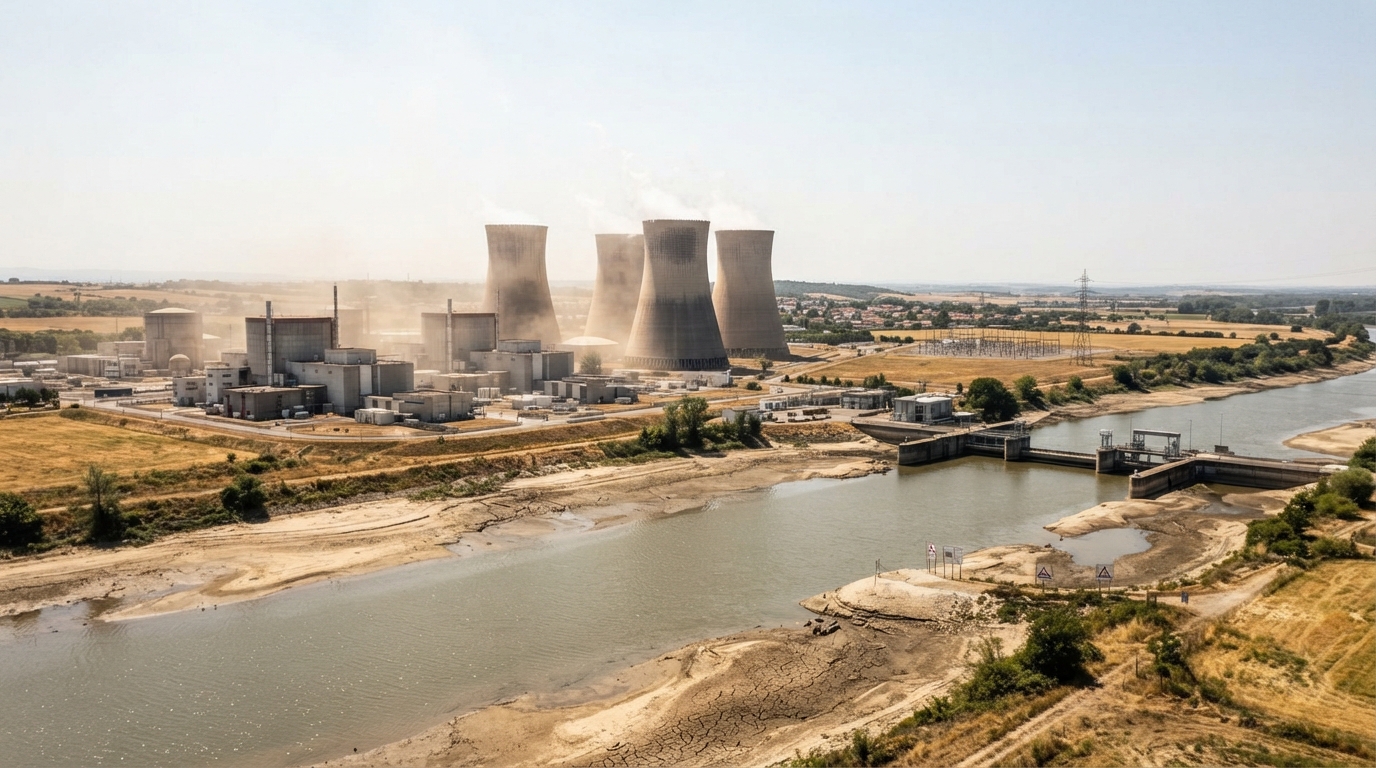
How is Europe's unusually warm weather affecting nuclear power plants (NPPs)?
The sharp drop in water levels on the Danube and other major rivers due to the intense heat wave in Europe has once again highlighted the dependence of nuclear power plants on weather conditions and water resources.
Hungary's only nuclear power plant, Paks, is a case in point. The plant, which normally supplies about 40 percent of the country's electricity needs, currently has only one of its four units operating. The record-breaking drop in water levels on the Danube once threatened to shut down the plant altogether.
However, the situation in France is even more important for the European electricity market. No other country in Europe relies as heavily on nuclear power for its electricity supply as France.
If France’s nuclear power plants were to reduce their output, the country could be forced to reduce its electricity exports to neighboring countries or, in some cases, import it itself.
According to a 2023 report by the French Court of Auditors, between 2000 and 2022, annual losses in nuclear power generation due to rising water temperatures and falling river levels accounted for less than 1 percent of total nuclear power generation almost every year.
Even in the unusually hot summer of 2003, the annual loss was about 1.5 percent.
However, annual figures do not fully reflect how serious the problem is in the short term. For example, in the summer of 2003, French nuclear power plants were forced to reduce capacity by more than 6 gigawatts at times.
During the intense heat wave in late June and mid-July 2026, the maximum available capacity was temporarily limited to 8-9 gigawatts. At times, this was about a fifth of the normal summer capacity of French nuclear power.
However, the 8 gigawatt limit does not mean that this much electricity was not produced. Some reactors would not have been operating at full capacity anyway during the summer due to reduced demand, increased solar power generation, planned work or grid constraints.
According to energy network operators, France still had sufficient reserve capacity during the 2026 heat wave, and the country remained a net exporter of electricity.
About a third of the heat generated by the reactors in nuclear power plants is converted into electricity. Most of the rest is released into the environment through cooling systems - often into rivers or the sea.
When the water in the river decreases, the excess heat is distributed over a smaller volume of water. As a result, the water temperature rises more quickly.
The oxygen content in warm water decreases. This can harm fish and other aquatic life. For this reason, water temperature limits are set in the legislation.
So, in most cases, the reduction of the power of the nuclear power plant in the summer is not related to the risk of an accident in the reactor, but to the need to protect the river ecosystem.
In emergency situations related to electricity supply, the French government may allow temporary deviations from these environmental standards. In such cases, increased control over water bodies is established, and the EDF company can generate additional electricity in the short term.
A nuclear power plant equipped with cooling towers - cooling towers - draws much less water from the river and releases less heat into it. However, this does not make the plants completely independent of weather conditions.
For example, the Golfeche nuclear power plant on the Garonne River in southern France has cooling towers. However, the plant is one of the most vulnerable to climate change due to the strong heating of the river water in the summer and the decrease in its level.
In 2020, the "Sho" nuclear power plant on the Meuse River was also forced to reduce the power of its reactors, despite having cooling towers. This was done to avoid endangering Belgium's drinking water supply.
Experts from the French Court of Auditors predict that by 2050, forced shutdowns of reactors due to climate factors could increase three to four times compared to today.
Currently, such shutdowns do not constitute a large share of total production. Therefore, even a several-fold increase is not expected to lead to the failure of the entire nuclear power system. However, for some NPPs, the problem could become serious.
France plans to reduce risks by building additional cooling towers, introducing water extraction systems from deeper layers, and improving maintenance schedules. However, such modernization requires significant investment and additional space.
Climate change is also being taken into account when building new nuclear power plants. France plans to build four of its six modern EPR2 reactors on the coast in the first phase - in Penly and Gravelin. Two more reactors will be built in the Bugey area on the Rhône River, where it is planned to use cooling towers to reduce the thermal impact on the river and reduce water consumption.
The impact of the reduction in capacity at French nuclear power plants is also being felt in other European countries.
On June 24, due to high water temperatures in the rivers, the power generation capacity of French nuclear power plants was reduced by about 4.1 gigawatts.
As a result, France's electricity exports fell to 3 gigawatts. Whereas a week ago, the country was supplying 10-12 gigawatts of electricity to its neighbors.
This, combined with increased demand for electricity, reduced wind power generation and increased use of gas-fired power plants, has led to short-term electricity prices in France and Germany reaching their highest levels since January 2025.
The subsequent heatwave in July has further tightened restrictions on nuclear power. On July 13, eight reactors were shut down by a total of 6.3 gigawatts, while two others were completely disconnected from the grid.
Despite this, France has continued to export more than 10 gigawatts of electricity. At times, it has imported cheap electricity from solar and wind farms in Spain.
For now, the heat-related decline in nuclear power is a problem that France and the European energy system can manage. But whether it will turn into a pan-European electricity shortage in the future will depend on demand in other countries, climate conditions and the volume of wind and solar power generation.