

How High-Risk Businesses Navigate Payment Processing Restrictions
Why regulated merchants lose payment access, and the underwriting and compliance work that keeps it.
How High-Risk Businesses Handle Payment Processing Limits
Companies in industries such as firearms, CBD products, and sweepstakes run into a problem that most mainstream retailers never face: securing a dependable way to take customer payments. Standard payment processors often reject these businesses or shut down their accounts without notice, forcing merchants to scramble to protect cash flow. For entrepreneurs in specialized markets, knowing why these limits exist and what other options are available has become crucial.
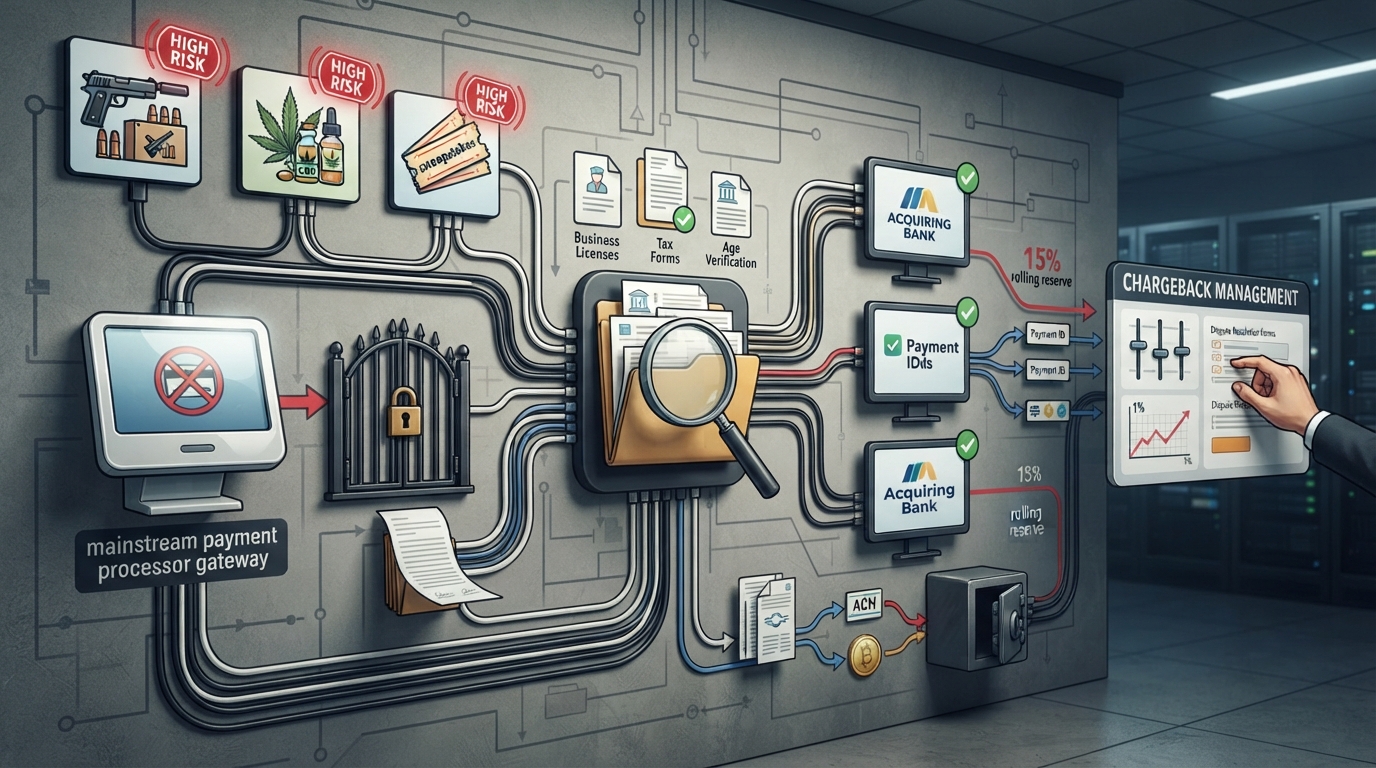
Payment processors judge risk using a range of factors, including chargeback rates, regulatory attention, reputational concerns, and the chance of fraud. Businesses that sell age-restricted products, operate in legal gray areas, or deal in items with higher return rates naturally land in categories processors see as potential liabilities. Firearms dealers work under a tightly regulated system that differs by jurisdiction, while CBD merchants must navigate changing laws at both the federal and state levels. Sweepstakes companies are often accused of resembling gambling operations, even when they are operating legally.
Major processors such as Stripe, Square, and PayPal keep clear lists of prohibited businesses. These platforms support millions of low-risk merchants and generally prefer to avoid the compliance burden and reputational exposure tied to controversial sectors. A firearms dealer or CBD retailer that manages to open an account with a mainstream processor may still face abrupt termination once the business type is uncovered during routine reviews. That instability pushes affected companies toward specialized solutions.
When a payment processor closes an account, the impact goes far beyond inconvenience. Funds can be held for months during reserve periods, customer payment data has to be moved, and revenue can stop during the transition. For businesses operating on thin margins, a processing interruption can mean missed payroll, strained supplier relationships, or inventory shortages. The uncertainty also makes long-term planning difficult, since merchants cannot confidently invest in marketing or expansion when their payment setup could disappear.
Financial institutions around the world are increasing oversight of payment flows, especially for sectors considered high-risk. Recent regulatory changes, including proposals for stricter monitoring of large transfers and transactions involving high-risk jurisdictions, point to a wider move toward greater scrutiny. Merchants in affected industries should expect more documentation demands and tougher underwriting, even when they work with specialized providers.
High-risk merchant account providers are built specifically to serve industries that mainstream processors turn away. These firms maintain ties with acquiring banks that are willing to accept higher-risk profiles in exchange for higher processing fees. Their underwriting is more detailed than standard reviews and typically requires extensive business documentation, financial statements, and often personal guarantees from business owners.
For businesses in firearms, CBD, or sweepstakes, using a provider such as 2accept can offer the stability that general-purpose processors cannot. These specialized services understand the compliance rules unique to each industry, provide chargeback management tools designed for high-risk profiles, and structure accounts to spread processing volume across multiple merchant IDs when transaction levels justify it. The downside is price: processing fees usually fall between 3.5% and 8% per transaction, compared with 2.5% to 3% for low-risk businesses.
Applying for a high-risk merchant account involves more paperwork than a standard application. Businesses should be ready to submit licenses, bank statements from the past three to six months, processing statements if they have prior merchant account history, a detailed business plan, and information about product sourcing and compliance procedures. Providers also examine chargeback history, credit score, and business age. Startups face tougher requirements than established companies with clean records.
Approval can take anywhere from several days to several weeks, depending on how complex the business is and how quickly the acquiring bank responds. Rolling reserves are common, meaning the processor withholds a percentage of each transaction for a set period to cover possible chargebacks. Reserve requirements usually range from 5% to 15% of monthly volume and are held for three to six months. While this protects the processor, it reduces working capital and must be included in cash flow planning.
A merchant account by itself does not process payments; it must be linked to a payment gateway that manages the technical communication between the website, the customer’s bank, and the acquiring bank. High-risk providers usually supply gateway solutions built to work with their merchant accounts, though some allow integration with third-party payment processors if a business needs specialized features. The gateway should support the payment methods customers prefer, include fraud detection tools, and offer clear reporting on transaction status and chargeback disputes.
Technical setup can vary widely in complexity. Hosted payment pages require little development work but send customers to an outside site to finish the purchase, which can lower conversion rates. API integrations keep customers on the site during the entire payment process but require more technical skill to implement. Mobile and point-of-sale features are important for businesses with physical locations or field sales teams. It is also important to check whether the gateway supports recurring billing for subscriptions and whether it can handle peak transaction volumes without throttling.
High-risk industries tend to see higher chargeback rates, so proactive management is critical. Chargebacks happen when customers dispute transactions with their card issuers, and excessive chargeback ratios can lead to account termination even with specialized providers. Most processors set thresholds at 1% to 2% of transactions, though this depends on the industry and processing volume. Each chargeback costs between fifteen and one hundred dollars, and repeated disputes can place accounts into monitoring programs that raise costs further.
Reducing chargebacks begins with clear product descriptions, transparent return policies, and responsive customer service. Descriptor text on credit card statements should clearly show the business name to avoid confusion that can trigger disputes. Card-not-present transactions should use CVV verification and AVS checks. Fraud detection tools should flag suspicious ordering patterns, such as multiple orders from different cards to the same address or unusually large orders from new customers. When chargebacks do happen, businesses should respond quickly with documentation showing the transaction was legitimate, including signed delivery confirmations, customer communication records, and proof that terms were clearly disclosed.
Getting a high-risk merchant account is only the first step. Keeping it requires ongoing attention to compliance, chargeback rates, and transaction patterns. Businesses should maintain detailed records of all activity, since processors conduct periodic reviews and may ask for updated documentation. If the business model changes to include new product lines or services, the processor should be informed before those changes are made, because undisclosed activities can trigger reviews or terminations.
Diversification can provide extra protection against processing disruptions. Some high-risk businesses keep accounts with multiple providers and route transactions to backup processors if the primary account runs into trouble. This adds complexity and cost, but it also serves as insurance against sudden shutdowns. Alternative payment methods, including ACH transfers, cryptocurrency, or cash-on-delivery options, can supplement card processing and reduce reliance on any single payment channel.
The payment processing environment for high-risk industries keeps changing as regulations tighten and financial institutions rethink their risk tolerance. Businesses in these sectors need to stay current on regulatory updates, keep thorough records, and work with processors that understand their specific compliance obligations. Although the costs and restrictions are still higher than those faced by mainstream retailers, specialized merchant account providers offer the stability needed for long-term growth in difficult industries.