

How do court, medical, and video game translators work?
September 30 is International Translation Day. Gazeta spoke with a court interpreter whose work is not often in the spotlight, a medical interpreter who helps patients, and the founder of a studio that localizes video games into Uzbek about the unique aspects of their profession.
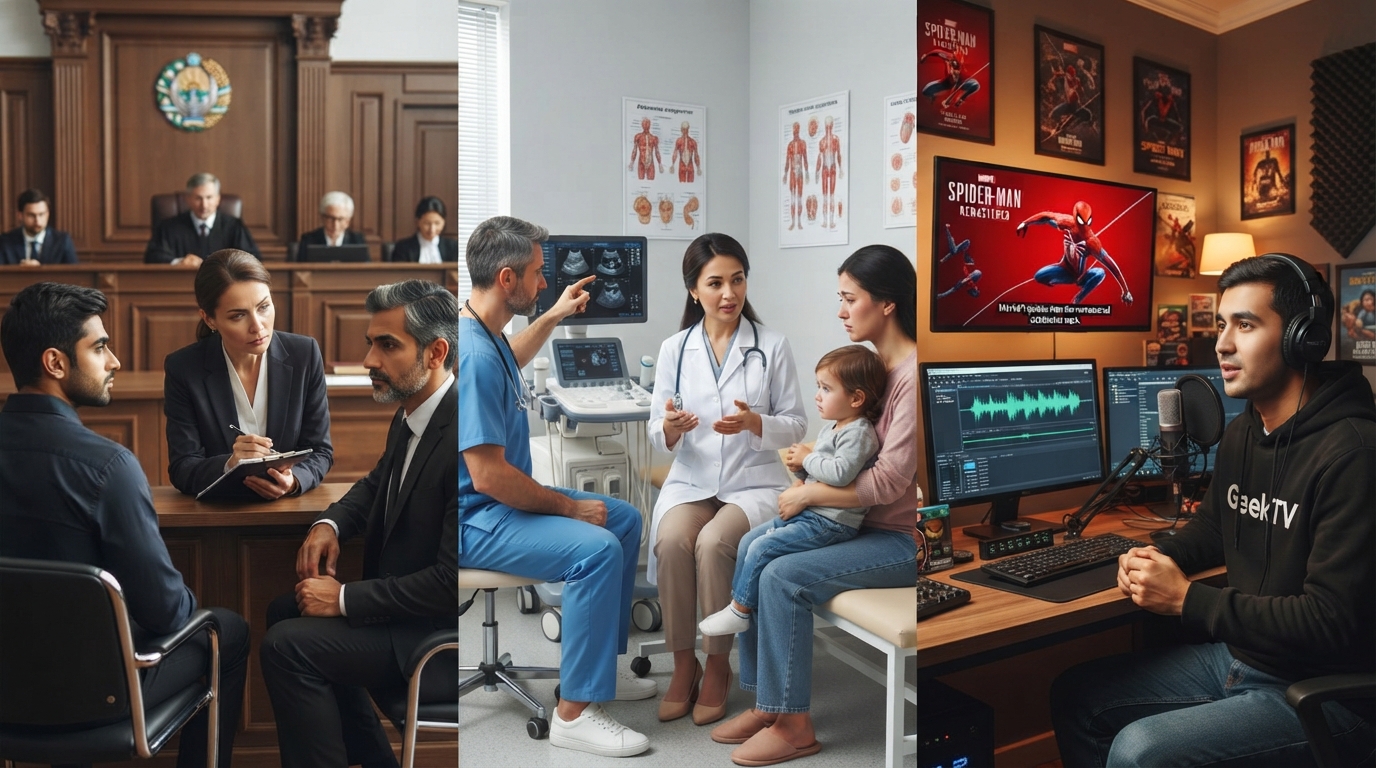
How do court, medical, and video game translators work?
September 30 is International Translation Day. When we think of a translator, a book translator is usually the first to come to mind. However, there are also many translators whose work is not very visible but directly impacts people's lives.
On the occasion of this date, Gazeta spoke with a court translator, a medical translator who helps patients, and the founder of a studio that localizes video games into Uzbek about the unique aspects, responsibilities, and work processes of their professions.
Actually, my main profession is being a doctor. I did not enter medical translation with a specific plan. My language skills and medical background proved very useful when taking patients to Turkish clinics and obtaining second opinions from foreign specialists. When doctors state a diagnosis, patients sometimes do not understand even half of it.
A medical translator becomes a bridge of trust between the patient fighting an illness and the doctor. Sometimes, the heaviest news in a person's life passes across that bridge. Therefore, medical translation is not just about conveying words. In addition to language proficiency, understanding anatomy, diseases, examinations, medications, and medical logic provides a major advantage.
Muazzam Ibrohimova.
I mostly have to work with patients who have severe and complex diagnoses, especially children. There are many patients in need of a foreign specialist's opinion in complex fields such as oncology, oncohematology, neurosurgery, and orthopedics. Therefore, translation can range from a simple consultation to a consilium (a joint council of specialized doctors), surgery, or discussing a treatment plan.
I mainly translate between the Turkish and Uzbek languages. Russian is also used when necessary. If a patient describes their symptom incorrectly, the translator is not allowed to correct their words.
This is a very important boundary.
If a patient says "my heart is burning," the translator cannot decide on their own to say "they have angina." At the same time, they must convey the feeling described by the patient as accurately as possible. If necessary, clarifying questions such as "where does it hurt, what kind of pain is it, when did it start?" can be asked.
I also translate what the doctor says accurately and completely. Then, if the patient does not understand, I clarify what exactly it is and ask the doctor to explain it once more.
But the translator must not add diagnoses of their own or draw conclusions that the doctor did not state. Even though I am a doctor myself, I do not take over the authority of another specialist during their consultation.
Muazzam Ibrohimova — second from the right.
During my translation career, I have seen many mothers holding their children, waiting for a hopeful word from a foreign doctor's mouth. For example, one of my hardest experiences was when a family gathered great hope and their last savings to go abroad, but after the examinations, the doctors explained that the disease was too advanced and no radical treatment options remained.
You know, for a doctor, this is a clinical conclusion. But the translator has to deliver that conclusion to the mother. You translate the words, and the mother remains silent for a moment. Then she asks: "So, is there no other way?" In such moments, I felt once again that translation is not just about knowing a language. A single sentence coming out of your mouth can have a huge impact on a person's hope, fear, and subsequent decisions. Therefore, this work has further strengthened my sense of responsibility toward words.
Muazzam Ibrohimova — second from the right.
Over time, I understood one thing — a translator is needed not to hide the truth, but to convey it correctly. You must not give false hope, but at the same time, you must not leave a person in despair.
For example, translating phrases like "treatment options are limited" or "the disease has spread" is difficult. Sometimes doctors ask the translator to convey what was said to the patient more gently. But there is a difference between speaking gently and softening the meaning. For instance, translating "the disease has progressed" as "everything is fine" is not kindness; it is misleading the patient.
In many translations, a single mistake distorts the meaning, but in medicine, a mistake affects the patient's treatment. Translating "once a day" as "three times a day," incorrectly conveying information about an allergy, or confusing whether a tumor is "benign" or "malignant" is not a simple language error. The patient's safety is at stake here. Therefore, it is also recommended for the patient and the translator to double-check the name of the medicine, the dosage, and the name of the diagnosis in writing as much as possible.
If a medical term comes up that the translator does not know, they do not pretend to know it. They write down the term, clarify it, and if necessary, ask the doctor to express it differently. In my opinion, professionalism is not about knowing everything, but about not guessing where you do not know.
Muazzam Ibrohimova — third from the right.
Doctors may also speak very quickly or pronounce words unclearly. In such moments, one should not be ashamed to stop them and say, "one moment, please, repeat that part." It is better to stop the doctor twice than to translate incorrectly.
It is difficult to translate terms that the patient might understand differently. For example, simply translating terms like "metastasis," "progression," "remission," "palliative care," "unresectable," and "prognosis" literally is not enough. The patient must also understand what they mean.
Some medical terms have to be left as they are without translation. Especially if it is the international name of a diagnosis, drug, gene, protocol, surgery, or examination, keeping the original name is important. Then its meaning can be explained to the patient in simple language. Because later, when they go to another doctor, they will need that exact term.
Dilorom Akbarova. Photo: Personal archive
We teachers frequently participate in court proceedings. I am often involved not just as a translator, but as a language specialist and expert. The longest-running court case in my translation career, which was also a great school for me, was the "Doc-1 Max" case. For over a year, at the request of the Tashkent City Criminal Court, I served as a Russian-Uzbek translator for Indian citizen Singh Raghavendra Pratap.
On the first day, without receiving any information about this case, I went straight to the court after my class at the University of World Languages. During the proceedings, they asked me to read and translate information written on several A4 sheets, which included various articles and clauses of the Criminal Procedure Code. Before I could hear the beginning and digest it, I forgot the rest. One of the lawyers even tried to remove me from the court, saying, "Why did you call such a translator?" I am still surprised that the ground did not open up and swallow me then!
Of course, I am ready for any translation regarding Russian-Uzbek, but terminological words and specific information require quite a lot of effort. It would not be an exaggeration to say that by participating in this court, I also became a translator in the fields of pharmaceuticals, chemistry, biology, medicine, pathology, pediatrics, nephrology, accounting, and prosecution.
Dilorom Akbarova teaching. Photo: Personal archive
A court translator is responsible for every word, first and foremost, before the law. Before starting work, we sign a protocol stating that we will not provide false information or make translation errors. Our translation can directly affect a person's rights, fate, and interests in the court process. Therefore, impartiality, accuracy, and responsibility are considered the most important principles in this work.
The translator speaks when addressed or when a speech, question, or answer that needs translation is spoken. If a sentence or thought is unclear, if a situation arises that could affect the accuracy of the translation, if the speaker talks too fast, if thoughts run into each other, or if it is difficult to comprehend what was said, the translator politely stops them and asks them to repeat their thought more briefly or clearly. But we do not take the initiative to comment on the substance of the case, offer advice, or protect the interests of one of the parties.
For example, if a lawyer or another party says "translate this slightly differently, in a way that is more favorable to us," we do not accept such a request. If there is any pressure, we report it to the presiding judge.
Dilorom Akbarova — center, in a white suit. Photo: Personal archive
During the work process, I do not rely solely on my memory. Of course, a translator must have a good memory, but taking notes during professional translation is a very important tool. Especially in consecutive translation, I note down the main idea, names, dates, and addresses. If I write down the whole sentence, I might miss the next thought. Therefore, I use special abbreviations, symbols, and logical connections.
The judge usually speaks in a calm, precise, and formal style; the prosecutor may emphasize evidence and charges in their questions or speech; while the lawyer takes a defensive stance. The speech of the witness and the defendant, on the contrary, can be more colloquial, emotional, or fragmented. The translator should not put all of this into the same mold. Along with the content, they should convey the style and tone of the speech as much as possible.
One must be very careful with legal terms. If a term has a precise and established legal equivalent, it cannot be replaced with a simpler word. Because the meaning of a term in everyday language and its legal meaning can differ from each other. At the same time, one should also avoid simply repeating complex phrases literally if they are incomprehensible to the listener. While preserving the main legal meaning, the thought must be conveyed in an understandable and natural form.
The fact that Russian and Uzbek have completely different grammatical systems is probably the main difficulty for translators of these languages. Russian belongs to the inflective (Indo-European) language family, while Uzbek belongs to the agglutinative (Turkic) language family. In Russian, word order is very free. But usually, the subject comes at the beginning of the sentence, and the predicate follows it. In Uzbek, there is an important rule that the subject is always at the beginning of the sentence, and the predicate (verb) is at the end of the sentence.
Like simultaneous interpreters, we court translators cannot start translating into Uzbek before the Russian sentence reaches its end. Because if the verb has already appeared in the middle in Russian, in Uzbek it must be moved to the end.
For example, if "Podsudimyy priznal svoyu vinu" is said in Russian during a court proceeding, it is translated into Uzbek as "Sudlanuvchi o‘z aybini tan oldi." As you can see, while the Russian verb "priznal" comes in the middle of the sentence, the Uzbek "tan oldi" moves to the end of the sentence. This is one of the simplest examples; as sentences become more complex, translation also becomes more difficult.
I lecture on comparative-contrastive linguistics on this very topic at UzSWLU and Tashkent University of Social Innovations. In this process, I bring many examples from the "Doc-1 Max" trial.
Dilorom Akbarova teaching. Photo: Personal archive
Sometimes we might not find the Russian equivalent of legal concepts in the Uzbek language. In such situations, we ask for brief explanations to clarify.
I do not soften or change swear words, insults, jargon, or dialectal expressions either.
But since my ethics and upbringing do not allow me to convey them literally, I translate them while preserving their meaning and tone.
The translation fee is paid by the state. The judge issues a letter to the Ministry of Finance, and the ministry makes the payment based on a contract. However, there have been cases where I did not receive payment despite submitting the documents.
Sometimes risky situations also occur. Just a pause or rendering a pronoun with another part of speech can seriously affect the process. Strong emotions like crying, fear, or anger affect the speed and clarity of speech.
During the "Doc-1 Max" trial, when the parents of the victims were heard for a month, and videos of the infants who passed away because of the medicine were played, everyone in the hall cried, and naturally, so did I as the translator. The Indian citizen for whom I translated and the court officials did not put extra pressure on me, waiting for me to compose myself before each translation.
Of course, in reality, a translator should keep their emotions out of the work process as much as possible. But it turns out there are situations where not only you, but also the presiding judge, the state prosecutor, and the defense lawyers cannot obey these rules.
To prevent emotional exhaustion during this very "Doc-1 Max" trial, I started reading Khaled Hosseini's "A Thousand Splendid Suns." This is like the method of driving out a wedge with a wedge. That is, you release and forget one pain through another.
There were also funny incidents during such a heavy trial. On one of the first days of the trial, a photo of the defendant in the hall spread on social networks. Seeing me next to him, an elderly relative of ours thought I was sitting behind bars. Using phones is not allowed during court proceedings, so they called but couldn't get through. As I found out later, many of them sat together worrying about me until that evening.
The defendant is in black, standing. To his left is the translator. Photo: Telegram
I do not discuss information heard in court, especially confidential information related to the case, with my close ones. I try not to take work home. Both of my sons are military officers; practicing professional confidentiality has become a norm in our family.
Screenshot: YouTube / Diyorbek Ibragimov
In Uzbekistan, games like Counter-Strike and PUBG, which do not require deep language knowledge, are very popular. There are even compatriots among us who have achieved international success in such games. But games with a strong plot, which force the player to think, understand the characters, and feel the events, have remained out of the spotlight for many due to the language barrier.
Our GeekTV studio also dubs international films into Uzbek under license. To date, we have translated more than 10 films and series, such as "The Boys," "The Office," "House of the Dragon," and "Fight Club."
To give our compatriots the opportunity to play games with a good story in our native language, fully understanding and feeling them, we also entered the video game direction. We want to share the content we love with people who cannot enjoy it because they do not know the language.
First, we translated the Deadpool video game into Uzbek. This took us about 12 months because we worked on the project in our spare time. We have been working on Marvel’s Spider-Man Remastered since February 2024. The text translation of the game is fully completed; currently, dubbing and technical integration are ongoing.
This project is quite large — the studio itself covers most of the costs for actors, voice recording, technical work, and other expenses. For this reason, we sometimes have to temporarily slow down the project work to recover our financial capabilities.
When choosing games, we first look at their story. In our view, a game is not just a tool to pass the time, but an art form capable of telling a powerful story, just like cinema or literature.
In the story of Marvel’s Spider-Man Remastered, besides superheroics, it talks about responsibility, loved ones, loss, choice, and making the right decisions in difficult situations. Peter Parker is not an ideal, error-free hero either. He faces problems like ordinary people, makes mistakes, and choices. Therefore, his story is very relatable to many. We want to deliver to the player not just a good game, but a story from which they can take something away.
Deadpool is a separate topic. Almost every scene of the game is built on humor, sarcasm, and wordplay. Translating some sentences there is like a small creative task in itself. Therefore, almost every dialogue in Deadpool either made us laugh or forced us to think for a long time.
During the translation process, just seeing the text itself is not always enough. The meaning of a single sentence changes completely depending on the situation, who says it, and in what tone. Therefore, it is important for the translator to play the game, and know its world and story well.
Marvel’s Spider-Man Remastered
If the project is based on a book, comic, or other work, it is useful to study those sources as much as possible. Simply put, the better the translator understands the work, the more they can convey to the viewer or player.
Each character must have their own speech portrait. Sometimes the translator even creates a specific speaking style unique to one character. For example, if there is a character who speaks with a French accent, some features of their pronunciation can also be expressed in the text. Or another character is given words and phrases that only they frequently use. In this, aspects such as age, social status, character, humor, rudeness, or intellectuality are taken into account.
But a character's personality is not determined by the text alone. A person can say very beautiful words with hatred, sarcasm, or rudeness. Therefore, the actor listens to the original performance and tries to convey emotions not visible in the text through intonation.
In GeekTV translations, we try not to artificially soften the harsh expressions in the original as much as possible. If a character speaks rudely in the original, their character does not disappear in the Uzbek version either.
When jokes and emotions understandable to a foreign player become incomprehensible to the Uzbek audience, we switch to localization. Sometimes, if you translate a sentence literally, the Uzbek player gets no emotion from it. In such cases, we try to find a more natural option in Uzbek while preserving the original function — humor, sarcasm, anger, or other emotions. The main task of a game translator is to find what the author wanted to make the player feel, not just the words.
Marvel’s Spider-Man Remastered
In our opinion, localization is not about changing the content. It is about delivering the content to a representative of another language and culture as understandably and naturally as in the original. For example, if a joke or idiom does not work in Uzbek, we can change its form. But we preserve the name, concept, fact, or reference that is important for the plot.
Especially in a video game, the translator cannot be completely free. Because a word that seems simple or insignificant today can later be connected to the plot, a quest, or another character. Therefore, we have no right to replace or remove original information at our own discretion.
Maintaining consistency throughout the project is as valuable as the translation itself. There are thousands, sometimes tens of thousands of sentences in games. We agree on important terms at the very beginning of the project. For example, whatever name is given to a certain mechanic or item, we use exactly that form everywhere as much as possible later on. For this, we maintain a list of terms. If a term is translated one way today and differently by another translator a few months later, the player will get confused.
Also, preserving the character's unique speech is very important. Someone speaks briefly, someone uses complex sentences, and another speaks with sarcasm. All of this is part of the character's personality.
In dubbing, the translation should not be excessively longer than the original line. For this reason, it is important to find a natural and concise sentence without losing the meaning.
We have to create new terms for gaming terms that do not yet exist in the Uzbek language. Some concepts are difficult to express in Uzbek with a single word. If explaining it with three or four words every time burdens the game, the international term can be left in a form adapted to the Uzbek language. For example, words like "telefon" or "televizor" also entered our language from outside at one time. In Deadpool, we left the term "momentum" unchanged. The important thing is that the new term must be understandable and used consistently throughout the project.
For us, a good translation is one where the player forgets that it is a translation. Sometimes the hardest thing is not a big and complex sentence, but a single verb that seems very simple. The English phrase "take down" encountered in Marvel’s Spider-Man is an example of this. The sentence "I need to take down that guard quietly" cannot be translated simply as "I need to defeat the guard" every time. Depending on the context, "take down" can mean knocking down, neutralizing, knocking out, or taking the opponent out of the fight. In this situation, for example, the option "Qorovulni sezdirmay zararsizlantirishim kerak" (I need to neutralize the guard quietly) can work. But since this phrase occurs hundreds of times in the game, we have to find a natural solution depending on the situation every time.
Today, artificial intelligence is becoming a very powerful assistant tool. For example, AI can save a lot of time in checking the consistent use of terms among thousands of lines, finding spelling errors, comparing previous translations, or working with large volumes of text.
But we believe it is still too early to completely hand over lively, natural dialogue to artificial intelligence. Because language does not consist of grammar alone. It contains character, sarcasm, culture, situation, and human emotion. AI can help the translator, but the final decision must still be made by a human who feels the language and the work.
If everything is done at a high quality, game translation and film or series translation are very close in terms of dialogue translation. But in a game, there are additional layers: the interface, quests, items, abilities, the map, technical terms, and dialogues that change depending on the player's actions.
In a film, the viewer sees the event in one direction. In a game, however, the player may hear one dialogue in the main story, another during combat, and a third by chance. For this reason, all texts must match each other. Another important aspect is that a simple "voiceover" style simplified translation is not enough for a game. Since the player is inside a certain world, an artificial or incorrect sentence immediately pulls them out of that atmosphere.
Each game has its own technical limitations. So far, text not fitting directly on the screen has not been a big problem for us. But in some interface elements, the space allocated for text may not be sufficient. If technically possible, we expand that space through code or adapt the interface.
In subtitles, we split long monologues into several parts. This way, a single large text does not appear all at once; sentences appear one after another, making them easier to read.
Sometimes we joke that we are shaping the demand for story-driven games in the Uzbek language in Uzbekistan ourselves. Because previously, we hardly heard thoughts like "I wish I could play this game understanding it in Uzbek." Most people were used to Counter-Strike, PUBG, or similar games. But when people are shown a quality Uzbek project, interest arises. We saw this in the feedback after Deadpool as well.
Our current projects are not localizations done by order of an official publisher. That is, for now, we do not have an official agreement with Sony or another rights holder regarding the Uzbek version.
For international companies, the strongest argument is numbers. If statistics show that the Uzbek version has a positive impact on product sales, audience, or activity, the interest of companies in Uzbekistan and the Uzbek language will naturally increase.
To Uzbekize foreign games, in addition to translators and actors, technical specialists who understand the internal structure of games — people who can work with files, engines, audio banks, subtitle systems, and other technical processes — are very necessary. As for dubbing directors, sound engineers, translators, and actors, we believe we have sufficient potential.
In the future, we want major companies like Sony PlayStation to see the Uzbekistan market as a separate audience and launch official localizations in the Uzbek language. At that time, local studios capable of performing such work at a professional level will be needed. GeekTV is gathering experience and a portfolio starting today to be one of those studios.
Deadpool is currently open for free download. We are distributing it for free because we want as many people as possible to play what we did and see what a full Uzbek localization can be like. Unfortunately, we do not have precise analytics on downloads for now.
But after the project was released, we received a lot of positive feedback, and people expressed their desire to see other games in Uzbek as well. So far, we have not made a profit from video game localization. The funds spent on Deadpool did not cover themselves financially.
And we are spending more than 200 million soums on the Marvel’s Spider-Man Remastered project. We will see the economic result of this project after sales start. We view our current projects not only as a source of income, but also as an experience and an investment for the future that shows there is a need for such a product in Uzbekistan.
In the future, localizing games with a strong story like God of War and The Last of Us may also be of interest to us. We also have the goal of developing a video game of our own created in Uzbek from the start. For original games created in Uzbekistan to increase, specialists who know game development at a professional level are needed.