

How are the world's most famous flea markets structured and why are they preserved? A Gazeta review
The Yangiabad market is up for sale. Social media is buzzing with talk of its possible demolition and the construction of an eco-bazaar and entertainment center in its place, while in other countries, similar markets are preserved and transformed into urban landmarks. Gazeta profiles six of the most famous.
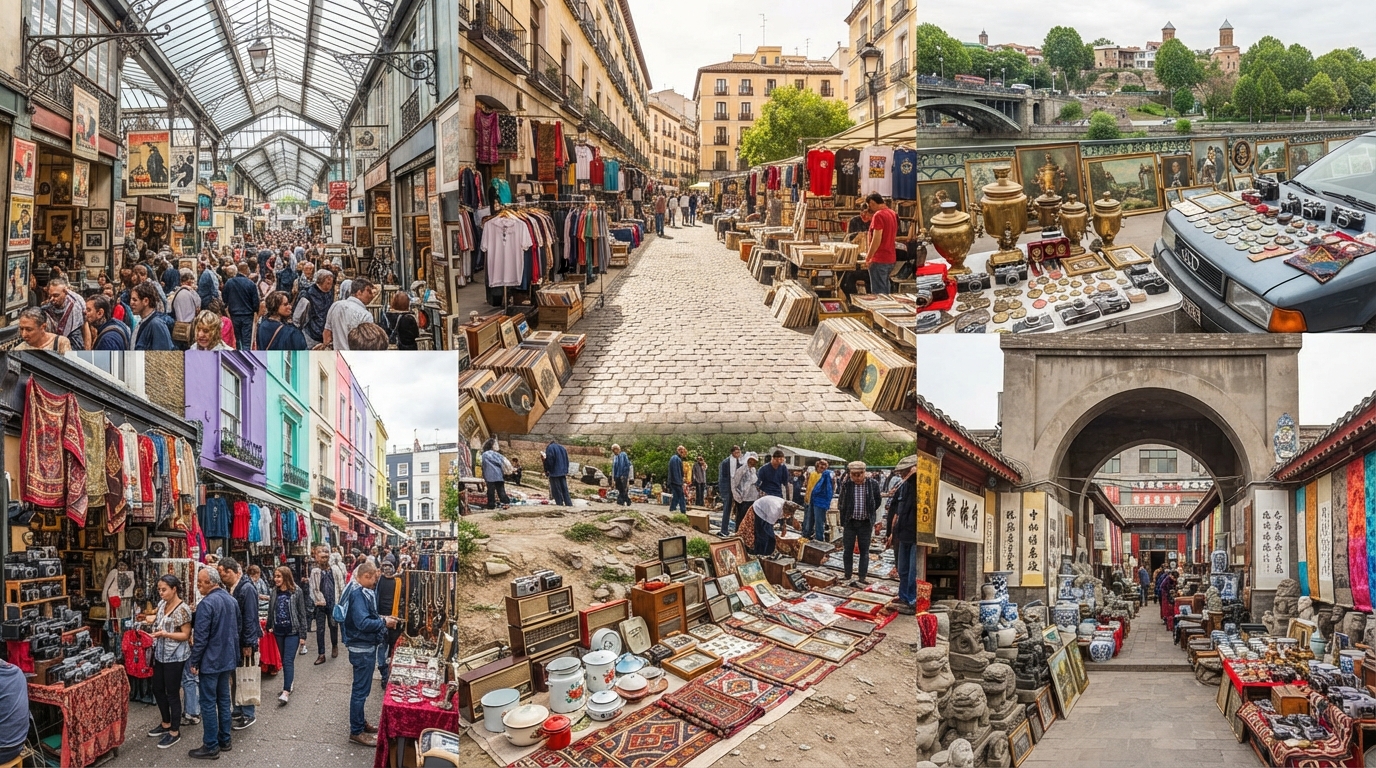
Gazeta reviewed the world's most famous flea markets, examining their structure and the reasons for their preservation.
Tashkent Markets and Their Future
According to a decree of the President of Uzbekistan dated July 27, 2026, aimed at the socioeconomic development of the capital in 2026–2027, Tashkent's markets and their branches will be put up for auction with private investors. Among the 35 sites slated for redevelopment is Yangiabad, a spontaneous market considered the direct successor to the legendary Tezikovka, described by Alexander Solzhenitsyn and Dina Rubina. This market attracts excursions, collectors, and foreign tourists seeking Soviet antiques.
Against this backdrop, the market's possible demolition is actively discussed on social media. The experience of other cities shows that the fate of flea markets can be quite varied: some operate for decades, attracting collectors and tourists from around the world, while others even receive the status of landmarks or protected sites. "Gazeta" presented a story about six famous flea markets and their evolution.
**Paris's Saint-Ouen: The Cradle of Flea Markets**
Paris's Saint-Ouen, known as the world's largest antiques market, is also associated with the origin of the term "flea market." Its history began in the 1880s, when Parisian junk dealers collected and resold found items on the streets. After Prefect Eugène Poubelle ordered city residents to place their trash in closed iron bins, access to discarded items became more difficult for dealers, and they were forced out of the city limits.
The official birthdate of the market is considered to be 1885, when the commune of Saint-Ouen first required vendors displaying their wares on the sidewalks to pay for a space. The name "marché aux puces" ("flea market") itself took hold in the early 20th century due to the condition of the worn-out goods sold. A few years later, the Parisian press was writing about the market, and with the arrival of the metro, it became a popular Sunday strolling spot for the bourgeoisie and artistic bohemians. Gradually, the first covered markets began to appear around the spontaneous stalls: Vernisson (1920) was the first, followed by Biron (1925), Jules-Vallès (1938), Rosiers (1946), and others—each with its own specialization and character. By the 1920s, the market officially received its status and began to be written with a capital "P"—les Puces ("Fleas").
Today, Saint-Ouen encompasses 11 covered markets, five shopping streets, and numerous stalls spread over approximately seven hectares. It is visited annually by over five million people, with up to 150,000 on certain weekends. In terms of visitor numbers, Saint-Ouen ranks among the most popular tourist destinations in France, alongside Disneyland, Notre-Dame, the Louvre, and the Eiffel Tower. Around 1,100 antique dealers, second-hand dealers, and gallery owners work here. The diversity of its wares has earned the market the nickname "the attic of the world."
In 2001, the Parisian flea market became one of the first areas in France to receive ZPPAUP (Zone of Preservation of Architectural, Urban, and Natural Heritage) status for its atmosphere and spirit. A map of all Saint-Ouen's markets and streets, a directory of vendors, and a detailed history of the place can be found on the official website.
London's Portobello: From Working-Class Neighborhood to Tourist Attraction
Portobello Market in London is over 150 years old. Its emergence was fueled by urbanization in the mid-19th century. As neighboring areas developed, shops and groceries opened on Portobello Road to accommodate the growing population. Over time, traders from various countries arrived, which influenced the market's offerings.
Since 1936, after the outbreak of the Spanish Civil War, Spanish refugees settled here, bringing southern gastronomy to the market. After World War II, the Caledonian Market in Islington, where for years stolen goods were sold mixed with antiques, closed. Some of its traders moved to Portobello, cementing the antiques specialty that would later become the hallmark of the place.
In the 1950s and 1960s, a Caribbean community was added to the mix, arriving in Britain at the invitation of the authorities to work. Cheap rent, in turn, attracted aspiring artists and fashion designers. Vivienne Westwood sold handmade jewelry here, while John Lennon and Mick Jagger frequented the shops selling vintage military uniforms. The Clash bassist Paul Simonon worked part-time at one of the stalls as a child and later said it was there that he developed his style. "It felt like the whole world was wandering up and down that street. So I grew up with a broad outlook. It was exciting, educational, and left a deep mark on me," he shared in an interview.
By the late 1980s, Portobello had transformed from a working-class neighborhood into one of the most expensive and fashionable in London. Many long-established independent traders have been displaced by chain stores, cafes, and upscale restaurants catering more to tourists than locals.
In 2015, the Westway Trust, a charity that had managed the market for over 40 years, unveiled a plan to rebrand and redevelop the site under the name "Portobello Village," declaring the market was in decline. The plan called for demolishing the marquee, constructing a three-story "market building," and renovating the surrounding public space. Local residents and shoppers launched a petition, declaring that such projects "suck London of its essence and personality," do not reflect the "true Portobello," and are being implemented without regard for community input. A separate protest group, Westway23, organized a demonstration on the market site. Ultimately, the major redevelopment was abandoned. By 2024, the marquee and flooring were to be updated, and a sign emphasizing the market's focus on vintage fashion was installed.
The dispute with the Westway Trust isn't the last chapter in this story. In early 2026, the borough council approved a large-scale £4.4 million street improvement plan after three years of consultation with residents and businesses. For example, they decided to replace the granite paving stones, which were inconvenient for carts and stalls, with asphalt, saving £1.6 million. The plan also included flood protection (following the devastating floods of 2021), new lighting, and wheelchair accessibility. The temporary anti-terrorism barriers, which residents sued the council over in 2025, will be replaced with permanent retractable bollards. Funding is coming from a developer levy, not from the city budget. As borough council spokesperson Kim Taylor-Smith put it, the goal of the investment is to "protect Portobello Road for future generations while respecting its history."
**Madrid's El Rastro: A Bloody Trail of History**
The Spanish capital is home to another major European flea market, El Rastro (from Spanish rastro meaning "trace"). Its name is associated with a 15th-century slaughterhouse in Plaza Cascorro – from here, animal carcasses were dragged along the street to the tanneries, leaving a bloody trail. A second-hand trade gradually developed around this route.
For a long time, the trade remained entirely informal, with vendors laying out their wares on the streets. In 1811, the city began to regulate the informal market, introducing licenses for stallholders. At the same time, genuine antique dealers emerged, selling higher-quality items. Over two centuries, the market expanded to occupy several blocks in the La Latina district, as well as numerous adjacent alleys and squares, attracting over 100,000 visitors every Sunday.
In 2020, El Rastro closed due to the COVID-19 pandemic and remained closed for eight months. City officials proposed opening only 135 rotating stalls per week (approximately 12% of normal capacity), while traders insisted on 50% occupancy, calling the situation "a disaster for the historic Rastro stalls." They also demanded guarantees that families would retain their traditional spaces, some of which had been in place for generations. While negotiations were ongoing, over 500 people marched in Madrid in support of the market, demanding that the mayor's office reconsider the reopening plan and agree to the traders' terms. Ultimately, the market opened in late November at 50% capacity: half of the 1,000 stalls operated on a rotating basis, with a maximum of 2,700 people allowed on the premises at any one time.
Today, El Rastro is divided by type of merchandise: some aisles sell second-hand clothing, while others offer antique books, furniture, and paintings. A separate section of the market specializes in vinyl records, old magazines, and toys. Indoor antique galleries operate in converted buildings along the Ribera de Curtidores. They sell coins, stamps, and old photographs. There's little food at the market, but there are many bars nearby where visitors stop after browsing the stalls.
Tbilisi's Dry Bridge: A Legacy of the Collapse of the USSR
Flea markets also exist in former Soviet countries. One of the most famous is located in Tbilisi on the Dry Bridge, which got its name after the branch of the Kura River that was drained and replaced by a road.
The flea market on Tbilisi's Dry Bridge emerged in the early 1990s, after the collapse of the USSR. Amid the transition to a market economy, the closure of state-owned enterprises, hyperinflation, and civil conflict, many residents were left without jobs and income. They began selling personal belongings, family heirlooms, and household items on the bridge.
Today, the spontaneous market occupies not only the bridge but also the adjacent park, partially extending onto the Kura River embankment. Here, they sell samovars, tea sets, vinyl records, old cameras, orders and medals, surgical instruments, jewelry, paintings, and silverware. The merchandise is laid out on folding tables, car hoods, and on the ground. Vendors explain the history of the items and are happy to chat with customers.
**Seoul Hwanghak-dong: Dokkaebi Market**
Seoul's Hwanghak-dong Flea Market, or "Dokkaebi Market" as locals call it, developed gradually. In the 1950s, after the Korean War, it sold items from American military bases: uniforms, watches, cigarettes, and canned goods. They also sold household appliances, tools, and furniture left behind by people who lost their homes during the war. According to one version, the market was named "Dokkaebi" after a goblin who, according to folklore, could transform old and unwanted items into valuable ones.
In the late 1960s, the Cheonggyecheon Stream was covered with a concrete pavement and an elevated road was built over it. Residents of the slums demolished during construction were relocated, but many returned to the area after reconstruction. In 1970, the Samil residential complex opened nearby, bringing renewed vigor to street trading. The market was nicknamed "Golden Alley." It is also known as "Ant Market" and "Everything Market."
In the early 2000s, city authorities began restoring Cheonggyecheon: the elevated road was dismantled and the stream was reopened. Hwanghak-dong merchants were forcibly relocated—first to the former Dongdaemun Stadium site, then to a former school building in the Sinseol-dong neighborhood. The market was officially renamed the "Seoul Folk Flea Market."
Today, it sells second-hand clothing and other items, antiques, traditional Korean souvenirs and handicrafts, and prepared foods. A stylized photo zone operates on the second floor: locals come to take photos in interiors reminiscent of the past, while tourists come to experience traditional Korean culture.
**Beijing Panjiayuan: "Ghost Market"**
Beijing Panjiayuan is known as Asia's largest antique market. The nickname "ghost market" arose in the late 19th and early 20th centuries, during the decline of the Qing Dynasty. Bankrupt officials and members of noble families secretly sold heirlooms and antiques. Selling inheritances was considered shameful, so transactions were conducted at night, by lantern light, and trading ceased at dawn. The modern market on this site appeared almost a century later, in the early 1980s. A small group of Beijing residents began selling works of art and items from family collections in courtyards. Since antique trading was prohibited at the time, the market operated illegally, but quickly became popular among Beijing collectors. Over time, the traders were forced to expand, and in 1992, Panjiayuan was officially recognized.
The market was rebuilt for the 2008 Olympic Games. However, antiques trading continued after the reconstruction.
Today, Panjiayuan is the world's largest antique and second-hand market. Estimates vary, with between 3,000 and 4,000 stalls spread across 4-5 hectares. They are divided into six thematic zones, selling antiques, furniture, stonework, calligraphy, painting, and porcelain. Separate sections are dedicated to the products of the peoples of China, including the Hui, Mongols, Miao, Koreans, and Manchus.