

How AI Is Transforming the Future of Mobile Networks
The mobile industry is evolving from voice and data services to AI-powered intelligent networks, with digital twins and autonomous infrastructure shaping the future.
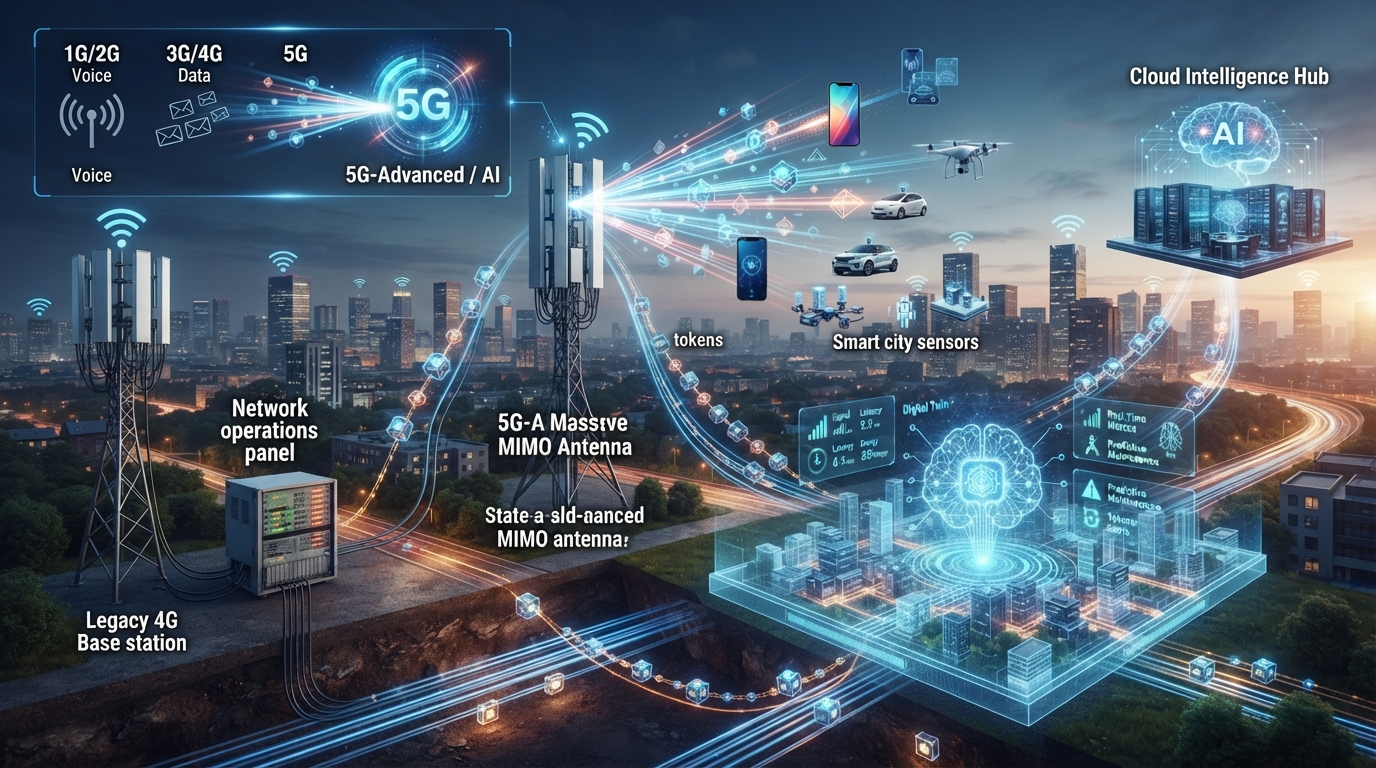
How AI Is Shaping the Future of Mobile Networks
Tashkent, Uzbekistan (UzDaily.uz) — Over the last 40 years, the mobile communications sector has progressed from basic voice calls to sophisticated networks that can analyze data, adapt to varying traffic loads, and manage their own operations. Currently, the industry is entering a new phase of growth where artificial intelligence (AI) is pivotal.
The initial generations of mobile communications were solely focused on voice transmission, functioning as electronic switching systems that connected users. With the advent of 3G and 4G technologies, the industry transitioned to packet-based data transmission. The rise of smartphones and cloud-based over-the-top (OTT) services marked the beginning of the Mobile Broadband (MBB) era, significantly altering how digital services are accessed.
The sector is now on the brink of another technological shift — the age of AI agents. As AI-enabled devices become more prevalent, mobile networks are confronted with entirely new demands.
Previously designed mainly for information transmission, networks are now increasingly required to facilitate the intelligent data exchange necessary for AI models. Central to this concept are tokens — units of information utilized by contemporary generative AI systems.
In this context, the network is transforming from a mere data transport channel into an intelligent platform that combines connectivity, computing resources, and user experience management. Concurrently, the number of connected devices is anticipated to surge, while the demands for latency, bandwidth, and network reliability will become even more critical.
To explore how the global ICT industry is gearing up for these changes, a journalist from UzDaily attended the GSMA Mobile World Congress (MWC Shanghai) in June, held in Shanghai. Prominent mobile operators, technology firms, and industry experts shared their visions for the future of mobile networks.
The three-day event featured a large exhibition alongside forums and industry conferences, attracting over 37,300 participants from 143 countries, including representatives from Uzbekistan's telecommunications sector.
Huawei, which has been active in Uzbekistan for over 26 years, was one of the most engaged participants at the event. The company collaborated with mobile operators, industry partners, and experts to discuss advancements in next-generation communications technologies, computing platforms, 5G-Advanced (5G-A) networks, high-speed uplink technologies, and the integration of AI into telecommunications infrastructure.
Dmitry Konarev, Huawei's Lead ICT Solutions Architect, showcased practical examples of the intelligent transformation of telecom networks. His presentation highlighted the shift from traditional internet systems to an ecosystem of AI agents and the rise of a new token economy, where networks function not just as data transmission channels but as intelligent infrastructures that support AI interactions.
As part of the media program, attendees also toured Huawei's research and development center at Lianqiu Lake in Shanghai. The center showcased technologies capable of achieving data transmission speeds of up to 10 Gbit/s by utilizing millimetre-wave and C-band spectrum, along with intelligent streaming services and personalized user experience technologies.
Another session focused on the impact of artificial intelligence on mobile infrastructure, led by Eric Zhao, Vice President and Chief Marketing Officer of Huawei's Wireless Solutions division.
Zhao stated that the industry is moving towards an end-to-end intelligent architecture where the cloud becomes the hub for intelligence generation, devices act as application platforms, and the network serves as an intelligent intermediary. In this framework, networks will be responsible for transmitting not only data but also tokens — essential elements for AI models to function and make decisions.
This transformation necessitates substantial modifications to mobile network architecture. Key priorities include reducing latency, enhancing uplink capacity, and incorporating AI into infrastructure management. Machine learning algorithms are already being employed to optimize radio resource allocation, boosting network efficiency, expanding capacity, and enhancing service quality.
AI is also emerging as a crucial tool for improving energy efficiency. Intelligent management allows base stations to lower power consumption without compromising performance, making network operations more cost-effective.
Industry experts emphasized the increasing significance of digital twin technology. Rather than addressing issues post-factum, operators are shifting towards predictive maintenance, enabling them to anticipate equipment conditions and avert potential failures.
AI models can generate digital twins of networks, offering real-time insights into coverage, signal strength, frequency usage, data transmission speeds, and service quality across the network. This provides operators with a comprehensive understanding of infrastructure performance and enables quicker responses to changing conditions.
The next phase of development may involve integrating digital twins of equipment, networks, and the surrounding environment into a unified intelligent system. Modern antenna systems are progressively evolving from passive hardware into intelligent network components. They can autonomously report their position, vibration levels, and weather conditions, while automatically adjusting beamforming parameters to ensure more stable coverage.
According to industry specialists, further digitalization of infrastructure will lay the groundwork for the complete integration of artificial intelligence into mobile network management. Unlike traditional algorithms, AI can make decisions based on the analysis of vast data sets, paving the way for fully autonomous networks.
In the future, mobile networks could independently identify declining service quality, redistribute resources, predict failures, and carry out most operational tasks without human intervention. In the absence of critical hardware failures