

How a small island in Canada appeared, vanished, and was found again
Officials in British Columbia say the floating island drifted towards the shoreline of a local lake. But its origins remain a mystery.
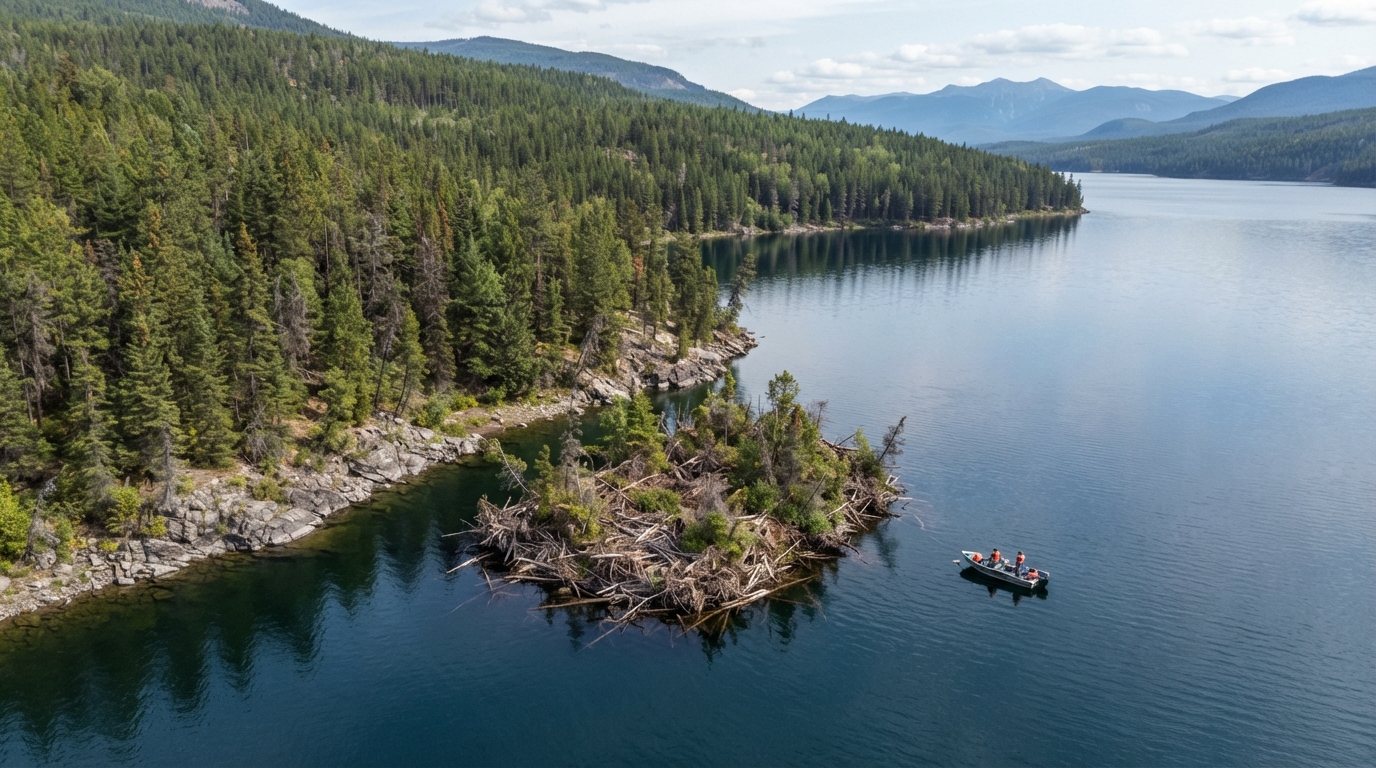
A small, mobile island in British Columbia, Canada, initially sighted by boaters in mid-August, has reappeared after briefly eluding satellite tracking.
The forested landmass was first observed in early August by boaters in the middle of Williston Reservoir, British Columbia's largest freshwater lake. Their video footage of the discovery quickly gained widespread attention online.
Satellite imagery from late July corroborated the island's existence, revealing it to be approximately the size of one and a half American football fields. However, within a few weeks, it had vanished from its original location.
Officials in British Columbia have now successfully re-located the island near the shore, though its precise origin remains a mystery.
Bob Gammer, a spokesperson for BC Hydro, the government-owned utility responsible for the reservoir and a nearby dam, became aware of the island after seeing the boaters' video circulating on Canadian social media. The video depicted a wooded section of land seemingly bobbing on the water.
Gammer initially suspected the clip might be AI-generated. "I thought, well, this could be anywhere," he told the BBC. "Maybe it's not real."
However, a satellite image retrieved by his team from July 21 confirmed its authenticity and its presence in the middle of the reservoir in a secluded northern region of the province.
Despite this confirmation, a satellite image taken just weeks later, on August 5, showed no trace of the island. Its disappearance garnered international news coverage, sparking global curiosity.
"We just don't know where it went," Gammer stated at the time. "Did it sink? Did it find its way into another corner of the reservoir?"
Gammer now reports that these questions have been answered. The island, he explained, appears to have simply drifted towards the shore, settling approximately 30 km (18.6 miles) from its initial sighting point. This was verified by a new satellite image and accounts from pilots flying overhead.
BC Hydro estimates the island's size to be 9,800 square meters, or one hectare, which is roughly equivalent to one Canadian football field or 1.5 American football fields.
Regarding its formation, Gammer said BC Hydro is not entirely certain, but a prominent theory suggests it developed over many years from accumulated driftwood that provided a foundation for plants and trees to take root. He believes it detached from the reservoir's shoreline this summer as water levels reached a high not observed since 2012.
Floating islands have been documented in other locations. For instance, Wisconsin's Lake Chippewa is home to the "Forty Acre Bog," believed to have formed from peat bogs detaching from the lakebed and rising to the surface. In some years, local boaters actively push this floating bog to prevent it from obstructing a local bridge.
According to the Lake Chippewa Flowage Resort Association, this bog supports diverse wildlife, including frogs and salamanders, and, like the rest of the lake and its shoreline, is legally protected by state laws. Local resident Cheryl Treland described the bog to Wisconsin Public Radio in 2024 as "like an iceberg." She emphasized, "This isn't like a leaf floating on the top of the water."
Gammer cautioned that the island in British Columbia is not a stable formation and advised against attempting to step onto it. "It is remote, and most people will never come near it," he said. For those with the means and inclination to seek it out, he issued a warning: "Stay off the island. It could break apart."