

How a Chinese-made toy gets to a US retailer
With Christmas on the horizon, we trace children's toys from factories in China to US shelves.
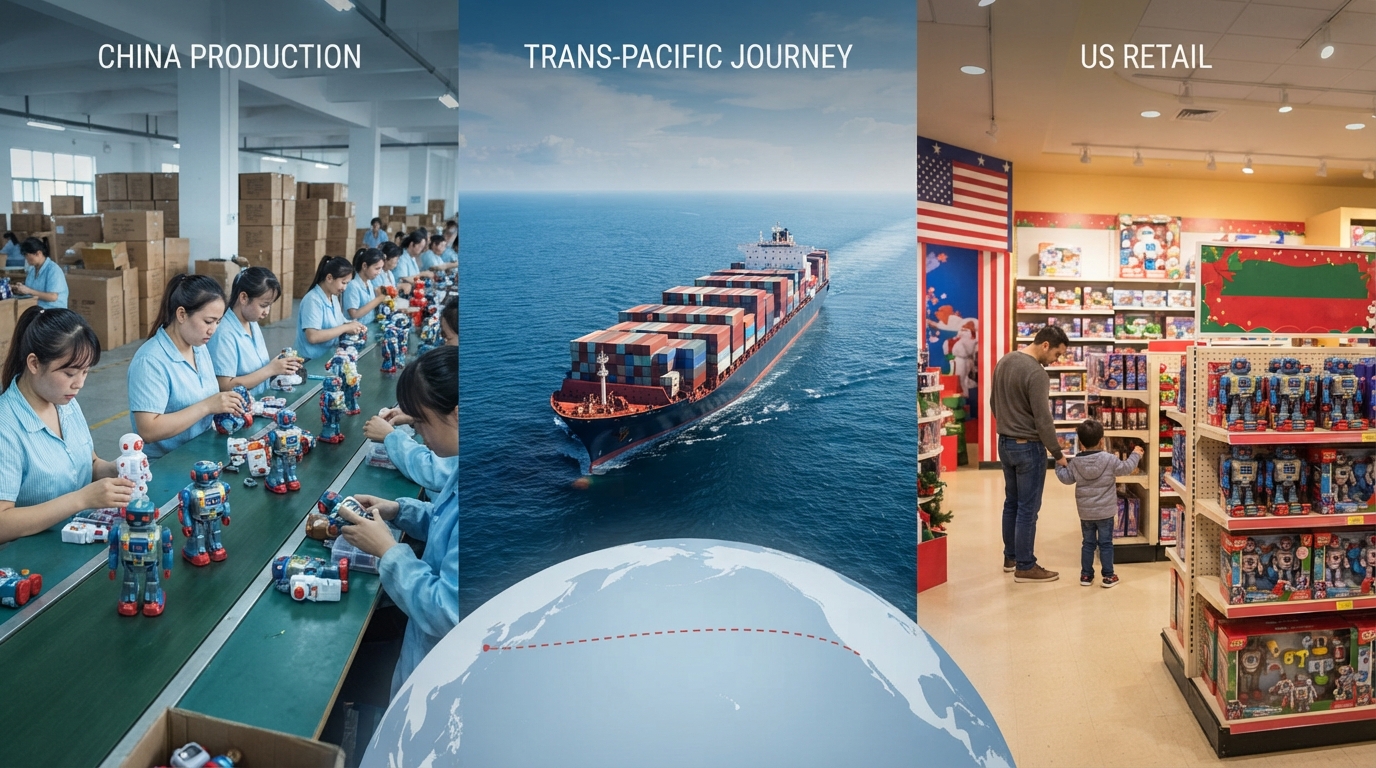
How a Chinese-made toy reaches a US retailer
China is the world’s biggest toy producer, making most of the toys sold in the US.
On the bottom of most children’s toys sold in the US, you will see the same three words: “Made in China”.
According to US government figures, nearly eight in 10 toys imported into the country in 2024 — 78.3% — came from China.
Trade figures show that toys brought in from China last year were worth $9.8bn (£7.4bn).
With Christmas approaching, the toy industry in the US and elsewhere is heading into by far its busiest period of the year.
As retailers build up stock for the festive rush, whether they are online giants or “mom-and-pop” brick-and-mortar shops, the BBC World Service’s Follow the Money series follows the journey of a toy from a factory in China to the US. And where the money ends up.
Guangdong province, which borders Hong Kong in southern China, is the centre of the country’s toy manufacturing sector.
In Dongguan, workers on the floor of the Mihox factory pop plastic toys out of steel moulds and stack them into crates for painting.
The company says it has more than 800 employees and produces about 55 million toys a year for the American market, which accounts for half of its business.
Every toy begins with a design from a customer, such as an American toy company. The factory then creates a prototype and makes moulds from which plastic parts and other components are produced.
Melanie Wang of the Mihox sales team says it takes one to two years to go from the first idea to a finished toy. Much of that time is spent with the customer going back to the drawing board. “They modified the design again, again, and again to improve it.”
Once the design is approved, the process speeds up. Making a mould takes about a month, and the production run lasts around three months.
The Mihox factory in Dongguan employs more than 800 people.
So how much of the US retail price does the factory receive? “About 20%,” Wang says.
For a $30 toy, that equals $6, which must cover the cost of plastic and other materials, production expenses including wages, and the factory’s profit.
According to Jay Foreman, chief executive of US toy company Basic Fun, Chinese factories usually make a profit of between 3% and 10%. So for a $30 toy, that works out to between 60 and 18 cents of the $6 the factory charges to make it.
Samson Ko, president of the Toys Manufacturers’ Association of Hong Kong, says many of his members moved their factories across the border into mainland China in the 1980s because land and labour were cheaper.
He says toy production has changed very little since then. “Automation now takes place mostly in the moulding and the packaging process. But for soft toys, or even some of the electronics nowadays, it’s still very labour intensive.”
And, he adds, Chinese labour is no longer cheap after recent increases.
Melanie Wang says Mihox receives 20% of a toy’s retail price.
One report, external at the start of this year said average pay in Vietnam is about half that in China.
Even so, fewer than 10% of Ko’s members have shifted any production outside China, and in those cases mostly only because customers requested it.
Ko says Chinese factories stay busy because a single toy can go through more than one manufacturing stage, from moulding the parts to adding electronics, sewing materials and final assembly. That often means it has to move between different factories.
He adds that in Guangdong these separate facilities are close to one another and are used to “working in harmony”. He says this helps the whole manufacturing process run more smoothly than in other countries.
From the factory, the toy is trucked to a port such as Shenzhen, the largest in Guangdong.
Ivy Tse, co-founder of FreightAmigo, a Hong Kong logistics company that operates an online platform for exporters in both Hong Kong and mainland China, says businesses can book a cargo container, arrange sea transport to an overseas destination, organise insurance cover and secure finance.
Tse says it takes about 15 days for a cargo ship to travel from Shenzhen to the US west coast, and 25 to 30 days to reach the east coast. This year’s Christmas toys left China in August and September.
Freight from the factory to the US usually adds about 10% to a toy’s manufacturing cost, Tse says. So if we use a toy that sells for $30 in the US and therefore costs $6 to make in China, shipping it to the US costs 60 cents.
Once the toy arrives in the US, there is currently a tariff on Chinese toys that must be paid to US Customs and Border Protection (CBP).
After talks between President Trump and Chinese leader Xi Jinping last month, the two governments have recommended lower tariffs for toys. But no new rate or start date has been set, and the US must first hold a public consultation. For now, the basic rate is 12.5%, and some toys pay more.
The tariff is charged on the toy’s manufacturing price, not its retail price. So for a $30 toy, the basic rate is 12.5% of $6, which comes to 75 cents.
The American company that imported the toys pays this tariff. One such company is Learning Resources, a family business near Chicago that sells educational toys. Half of its toys are imported from China.
“We pay 100% of the tariffs, let there be no doubt about that,” says chief executive Rick Woldenberg.
Jay Foreman says most of the money spent on a toy in the US does not leave the country.
The cost of making the $30 toy, shipping it to the US and paying the import tariff comes to $7.35. That leaves $22.65, or 75.5% of the total.
Foreman of Basic Fun explains that this money never leaves the US. His Florida-based company makes Tonka trucks and Care Bears cuddly toys.
“It’s kept by my company, the [US] transportation company, the retailer,” he says.
If $2.65 is allowed for the US delivery company, the toy company and the retailer would usually split the remaining revenue 50-50. That would give them $10 each.
Although profit margins are commercially sensitive and therefore not usually disclosed, industry studies show that the toy company and retailer would typically make a profit of up to 25%, or $2.50.
Getting a toy onto US shelves takes a great deal of work and a long journey.