

How a 97-year-old escaped deadly Indian floods on a banana raft
A 97-year-old's dramatic rescue captures how Assam's floods are reaching places once thought safe.
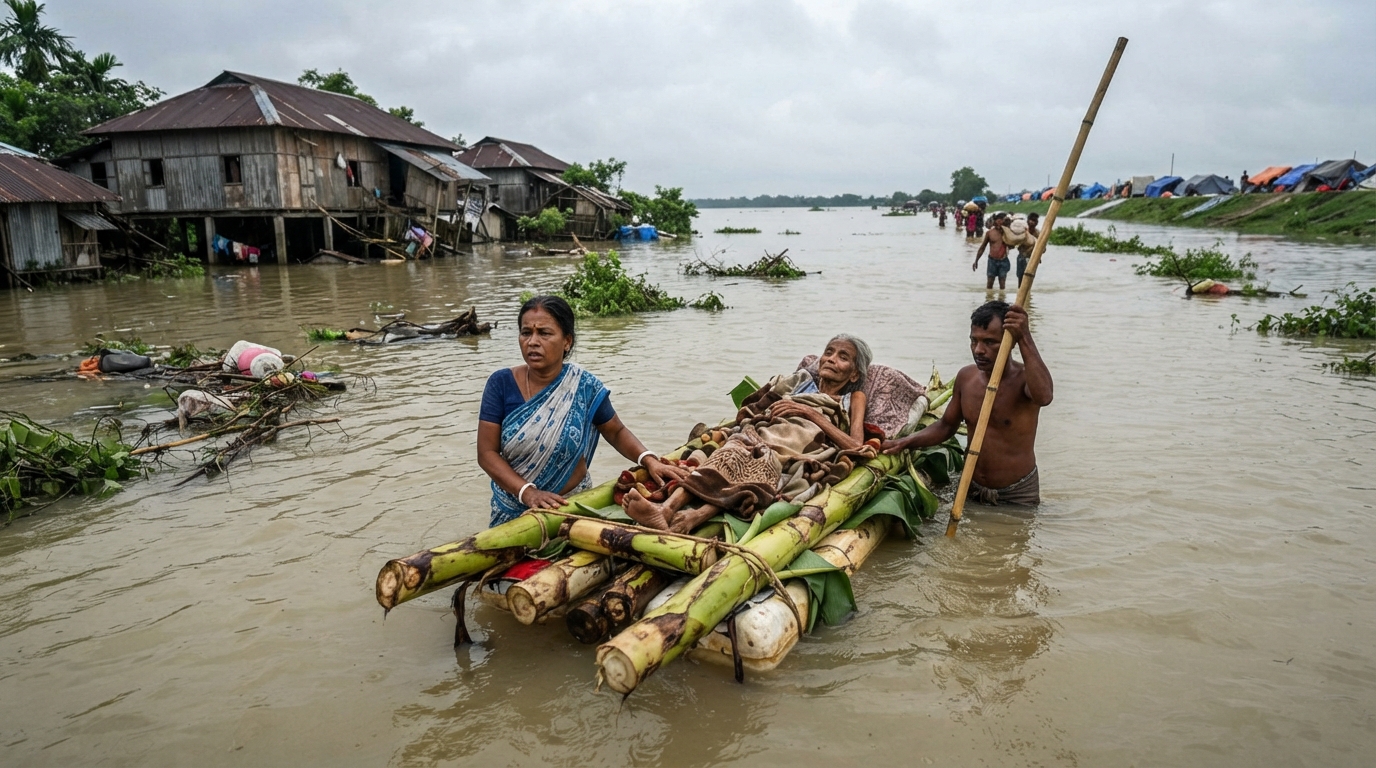
**97-Year-Old Rescued on Banana Raft Amidst Deadly Indian Floods**
In the early hours of July 19, as floodwaters inundated Charing village in India's northeastern state of Assam, Bornali Baruah and her husband undertook a desperate mission to save his 97-year-old mother, Lokada Duarah. Almost entirely bedridden, Duarah was unable to walk, and with no boats, rescue teams, or neighbors available, they improvised. They carefully transferred her onto a makeshift raft constructed from banana trunks and navigated the swift currents to safety.
"Everyone was trying to save themselves," Baruah recounted. An hour later, the trio reached a shelter camp situated on a national highway, a considerable distance from their home in Sivasagar district, one of the areas most severely impacted by the floods. The water, three to four feet deep, had a powerful current, forcing them to move slowly, hand-in-hand, using sticks for stability. By this time, Baruah's house was submerging, with water eventually reaching approximately five feet inside.
The situation in Charing mirrored a larger catastrophe unfolding across Assam. Recent figures indicate a flood-related death toll of 100, with 10 districts and 456 villages affected, impacting around 140,000 people. Fifty-two relief camps have been established. Overall, the floods have impacted nearly 1.2 million individuals across 25 districts, damaged over 19,000 homes, and displaced more than 75,000 people into 252 relief camps.
The floods have been particularly severe in parts of Upper Assam, where villages like Charing, typically spared from inundation, have been submerged. For 40-year-old Baruah, the shock is profound. "This is the first flood we have experienced in this area in our lifetime," she stated. Baruah, a lifelong resident of Charing whose ancestors also lived there, recalled hearing about a major flood in 1950, long before her birth, but nothing comparable had occurred during her lifetime.
Her single-story, eight-room home is situated in a river-laced landscape, approximately 25km (15 miles) from Sivasagar town. The Brahmaputra is roughly 20km away, the Dikhow 12km, the Jhanji 10km, and the Mitong just 5km. She had never anticipated water reaching her doorstep. When it did, the flood not only threatened her home but also the livelihood she had meticulously built over years.
Baruah, a former full-time journalist, transitioned to animal husbandry in 2016. Three years later, she was recognized as Assam's 'Best Livestock Farmer.' Her farm had grown to include around 300 goats, 500 ducks, and 1,000 chickens, in addition to fish. The flood devastated much of her enterprise. She reported losing most of her goats, 300 ducks, 300 chickens, a significant quantity of fish, and her animal feed production machine. Furniture, laptops, vehicles, and the family's book collection were also destroyed. None of her livestock was insured. "There is no insurance system here for livestock, especially goats," she explained.
The initial warning came on July 17 with the rising Jhanji river. Two days later, the Dikhow and Mitong overflowed into surrounding areas as the Brahmaputra and its tributaries rapidly swelled. Several rivers breached their embankments, Baruah noted, unleashing powerful currents through towns and villages. Approximately a day after the water began rising, she and her family evacuated their home, by which point the water inside was four feet deep. They spent the subsequent 10 days in a relief camp.
For five days in the camp, there was no electricity or mobile connectivity, preventing Baruah from even charging her phone. The government provided the family with a relief kit containing rice, lentils, and cooking oil. Strangers at the camp also offered assistance. A young woman Baruah had never met helped with food, cleaning, and caring for her 60 surviving goats. Another individual took responsibility for treating and feeding sick animals.
The question remains: why did the water reach an area Baruah claims had never flooded before? Dhrubajyoti Sahariah, a professor of geography and director of the Centre for Brahmaputra Studies at Gauhati University, explained that while flooding is a natural phenomenon in the lowland Brahmaputra Valley of Assam, what has changed is the "frequency, intensity and severity of floods well beyond historical norms."
The Brahmaputra, one of the world's largest multi-channel rivers, ranks among the top five globally for both water discharge and sediment load, much of which originates from Tibet. As it enters Assam's vast floodplains, home to approximately 28 million people and bordered by hills, it slows and deposits sediment, contributing to erosion and floods. While annual flooding is a feature of life in Assam, some years are far worse; the 2004 floods, for instance, affected 12 million people and claimed 251 lives.
In the recent floods, Sahariah attributed the severe flooding and extensive silt deposition in Sivasagar, Charaideo, and Jorhat to continuous heavy rainfall in Upper Assam and neighboring Nagaland's Mon district. Sahariah further noted that floods are now reaching previously unaffected areas due to increased settlement on active floodplains, deforestation, heightened mining and hill-cutting leading to more river sediment, and the construction of roads, bridges, and other infrastructure without adequate consideration for the region's hydrology.
However, Assam cannot manage the Brahmaputra independently. Many of its tributaries originate in surrounding hill states, and flood-control measures are largely planned within Assam. "What is needed is basin-scale planning," Sahariah emphasized, along with enhanced inter-state coordination and a better understanding of the rivers' evolving geography.
For Baruah, the scientific explanations have become a painful personal reality. She has returned to the vicinity of her flood-damaged home. For now, she and her family are staying at a neighbor's house nearby, hoping to move back into their own home within a week. Baruah has no intention of leaving Charing, stating that moving away requires economic and social circumstances her family simply does not possess.
Consequently, she is beginning to contemplate how to live with a threat that was, until now, largely absent from her life. She believes that if heavy rain returns, she would need to elevate her house, perhaps by reinforcing its foundation. She is not yet certain how she would manage or finance this. The family would also require a raised platform for retreat to safety and would pre-stock food and drinking water.
Baruah is learning to live with the possibility of more floods and to prepare for them. When asked if she felt like a climate refugee, she responded, "No. If we regain our economic and mental strength, life will return to the way it was before." She concluded, "We will have to learn to coexist with the floods."