

Houthi missile strike on Yemen camp kills 50 security recruits, local authorities say
Three missiles hit a camp in government-controlled Shabwa province that officials say was being used as a training centre for new recruits.
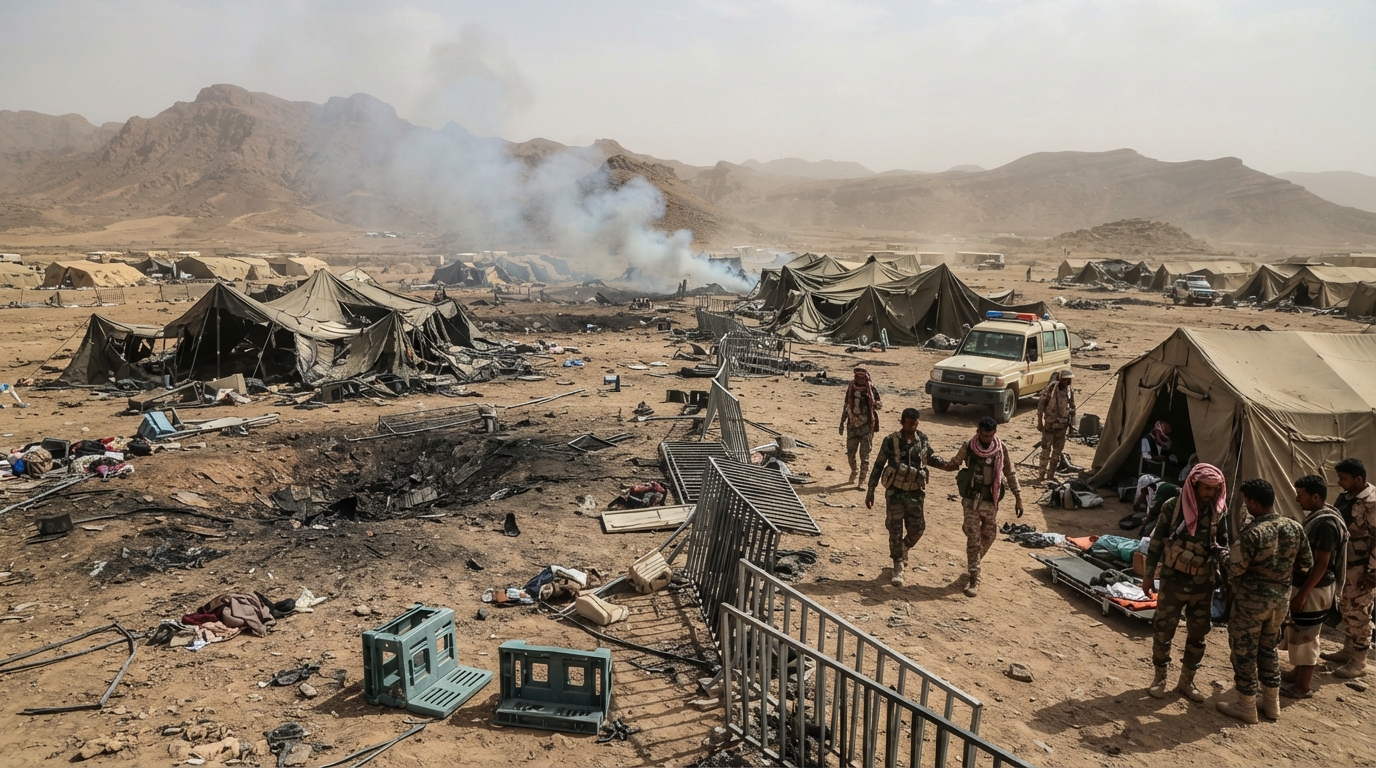
Houthi missile strike on Yemen camp kills 50 security recruits, local authorities say
Yemen's government said the missile strike killed recruits to its internal security forces (file photo)
More than 50 security personnel have been killed and 200 injured in a Houthi missile strike on a camp in Yemen's central province of Shabwa, local authorities say.
A spokesman for the Saudi-backed Yemeni armed forces said the Iran-backed group fired three ballistic missiles at al-Alam camp near Ataq city, which was being used as a training centre for recruits to the security forces and police.
Rashad al-Alimi, the head of Yemen's Presidential Leadership Council, denounced what he described as a "criminal attack" and vowed a "firm response".
The Houthis' military spokesman said they had struck "Saudi enemy concentrations".
Yemen's devastating civil war has intensified in recent months.
At the beginning of October, pro-government forces launched a major offensive aimed at recapturing territory in western Yemen held by the Houthis.
Backed by air power from a Saudi-led coalition of Arab states, they succeeded in retaking land on the Red Sea coast overlooking the strategically important Bab al-Mandab Strait, which the Houthis seized in a surprise assault in September.
Even so, heavy fighting continues there, along with clashes around the besieged government-held city of Taiz, and farther north in Marib and al-Jawf provinces.
The Houthis have also answered Saudi air strikes with missile and drone attacks on airports, energy sites and military bases in neighbouring Saudi Arabia.
Monday's strike in Shabwa is among the deadliest reported since the escalation began.
Shabwa province's media office said in a statement that ballistic missiles hit the Martyr Ahmed al-Sulaimani Training Centre, where recruits from several provinces were being trained to join the internal security forces. It said a preliminary assessment put the death toll at 53, with more than 200 injured.
A video shared on social media appeared to show several bodies lying scattered on the ground.
Shabwa's deputy governor, Fahad al-Khalifi, told AFP news agency that hospitals in the province were overwhelmed and had been compelled to move the most seriously wounded to neighbouring Hadramout and Aden, where the government is based. He said some of them were in a critical condition.
Information Minister Moammar al-Eryani said the attack amounted to a war crime because the internal security forces training centre was not a military target.
He also accused the Houthis of "attempting to fabricate a false media victory, boost the morale of its collapsing elements, and cover up the defeats and setbacks it is suffering across various combat axes".
The Houthis' military spokesman, Yahya Sarea, said in a statement that the missiles targeted a gathering of "Saudi enemy" forces at al-Alam camp, which he said was run by Saudi officers.
Saudi authorities did not immediately comment.
In a separate development, Houthi-run media reported that a Saudi air strike on a house in the Sahar district of the Houthi-controlled northern province of Saada on Sunday killed at least 10 people and wounded 23 others, many of them women and children.
According to the Houthi-run health ministry in north-western Yemen, a total of 141 people had been killed in Saudi strikes over the past seven weeks.
Meanwhile, the government's health ministry said last week that at least 1,282 people had been killed in the conflict across Yemen since 6 August.
In Saudi Arabia, at least 19 people have been killed in Houthi attacks targeting the kingdom's airports since the start of October.
Yemen has been ravaged by a civil war that began in 2014, when the Houthis drove the government out of the capital, Sanaa. The conflict escalated in 2015 after the Saudi-led coalition intervened in an effort to restore the government's rule.
A four-year informal ceasefire began to fall apart in July, when the Houthis announced a "maritime embargo" against Saudi Arabia and started missile and drone attacks on Saudi airports, oil facilities and tankers in the Red Sea.
The Houthis said they were responding to what they call a Saudi blockade of their territory, as well as an air strike on Sanaa airport that they blamed on the kingdom.