

Housing renovations will begin in three districts of Tashkent. The mayor has determined the implementation procedure.
Integrated development and renovation projects will begin in the Yashnabad, Mirabad, and Sergeli districts of Tashkent. Property owners will be notified and offered comparable housing nearby, or another form of compensation will be agreed upon. The transactions will be notarized.
On August 25, Tashkent Mayor Shavkat Umurzakov approved measures to implement integrated development and renovation projects in the capital. This decision was made in accordance with the presidential decree of February 24 regarding the implementation of integrated development mechanisms for multi-apartment residential complexes.
From March 1, 2026, to March 1, 2028, a special legal regime, known as a "regulatory sandbox," will be in effect in certain areas as part of an experiment.
Toshkent Invest has been appointed responsible for implementing these projects in Tashkent. The Fund for Reconstruction and Development is required to provide investment companies operating in integrated development areas with $20 million each for five years at 5% per annum, with a two-year grace period.
Within 10 days, Toshkent Invest, in conjunction with the city's Cadastral Chamber, is required to collect information on all properties and their owners within the integrated development areas.
The projects will be implemented in the Yashnabad, Mirabad, and Sergeli districts.
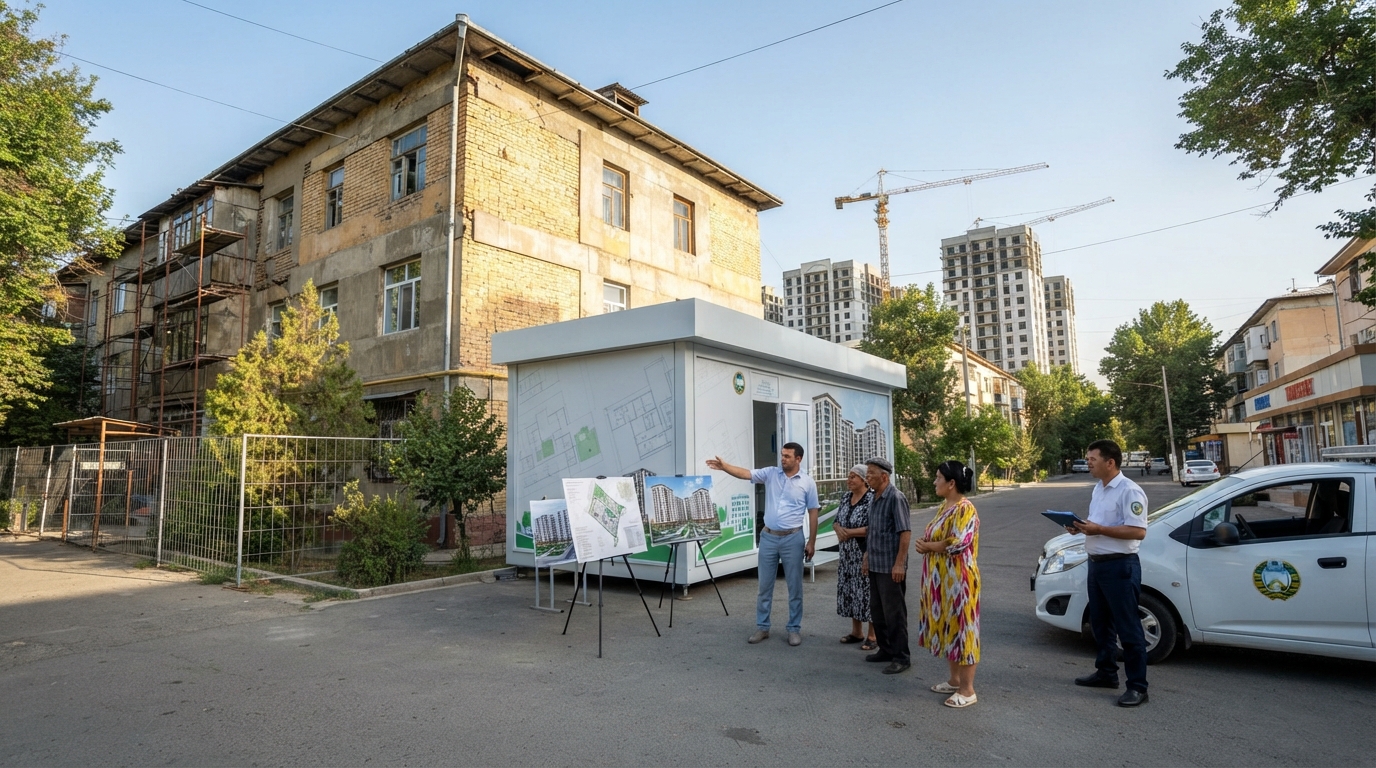
Headquarters with representatives of Toshkent Invest, district khokimiyats, justice authorities, the Cadastral Chamber, the Department of Construction and Housing and Utilities, and other agencies have been instructed to be established in mahalla buildings in these areas. Their task is to explain the project's content and renovation-related issues to residents.
The khokims of the three districts and the deputy khokim of the capital must notify property owners within two days that their properties are subject to renovation and encourage them to contact the headquarters established in the mahallas for compensation.
Toshkent Invest has been instructed to negotiate with developers building residential complexes near the renovation zones to formulate proposals for providing owners with housing "in exchange for equivalent housing" (o'ringa o'rin).
The company must also hold separate negotiations with property owners, agree on compensation plans, and enter into notarized agreements. Design organizations for developing master plans and development projects must be selected based on the best proposals.
The Department of Justice has been instructed to assign notaries near complex development sites to execute agreements with owners. Drafts of these agreements must also be reviewed by the prosecutor's office and the territorial office of the Anti-Corruption Agency.
Citizens permanently registered in housing subject to renovation must be automatically registered in the new housing transferred to the owner in exchange for the old one.
If a lien has been placed on a property as part of enforcement proceedings, it must be promptly lifted once the obligations have been fulfilled. If the obligations have not yet been fulfilled, the lien may be temporarily lifted to execute the agreement, after which it will be transferred to the new housing provided to the owner.
Arrears or overpayments for electricity, water, heating, gas, and waste removal for the demolished property must also be transferred to the personal accounts of the new housing.
Furthermore, city authorities have been instructed to take action against unauthorized apartment buildings that do not meet urban development requirements or have been deemed unsuitable following an instrumental and technical inspection.
Separately, the khokimiyat must prepare proposals within two months to expand green spaces and create one eco-park in each district of Tashkent.
In June, Tashkent authorities announced the start of renovation projects in the Yashnabad, Mirabad, and Sergeli districts. Tashkent Mayor Shavkat Umurzakov visited the Jarkurgan, Abdurauf Fitrat, and Khanabadtepa mahallas. He stated that the priority should be to provide residents with equivalent housing in completed new buildings so they can relocate as quickly as possible—if possible, to the same district or familiar urban environment.
On June 10, President Shavkat Mirziyoyev signed a law on urban renovation, which will come into force in December. It establishes requirements for public discussions, stipulates the need for consent from at least 80% of owners, the procedure for compensation payments and provision of temporary housing, investor participation, and judicial dispute resolution.
The law also prohibits pressure on owners who disagree with the project. Earlier, at a meeting with the president, it was reported that renovation projects across the country could potentially affect approximately 17,000 old two- and three-story buildings built before 1991.
In 2026, at least 30,000 apartments are planned to be built in renovation zones in Uzbekistan. By comparison, the target for 20,000 apartments was set for 2025.
In Tashkent, areas for renovation projects began to be identified earlier. In August 2024, the mayor of the capital established the boundaries of such zones in six districts. In the summer of 2025, Gazeta also reported on a pilot project in the Navnikhol mahalla of the Mirzo-Ulugbek district, where nine two-story buildings were planned to be demolished.