

Honduran dumpling maker, Ukrainian waiter, Russian manager - how does a teahouse in Maryland work?
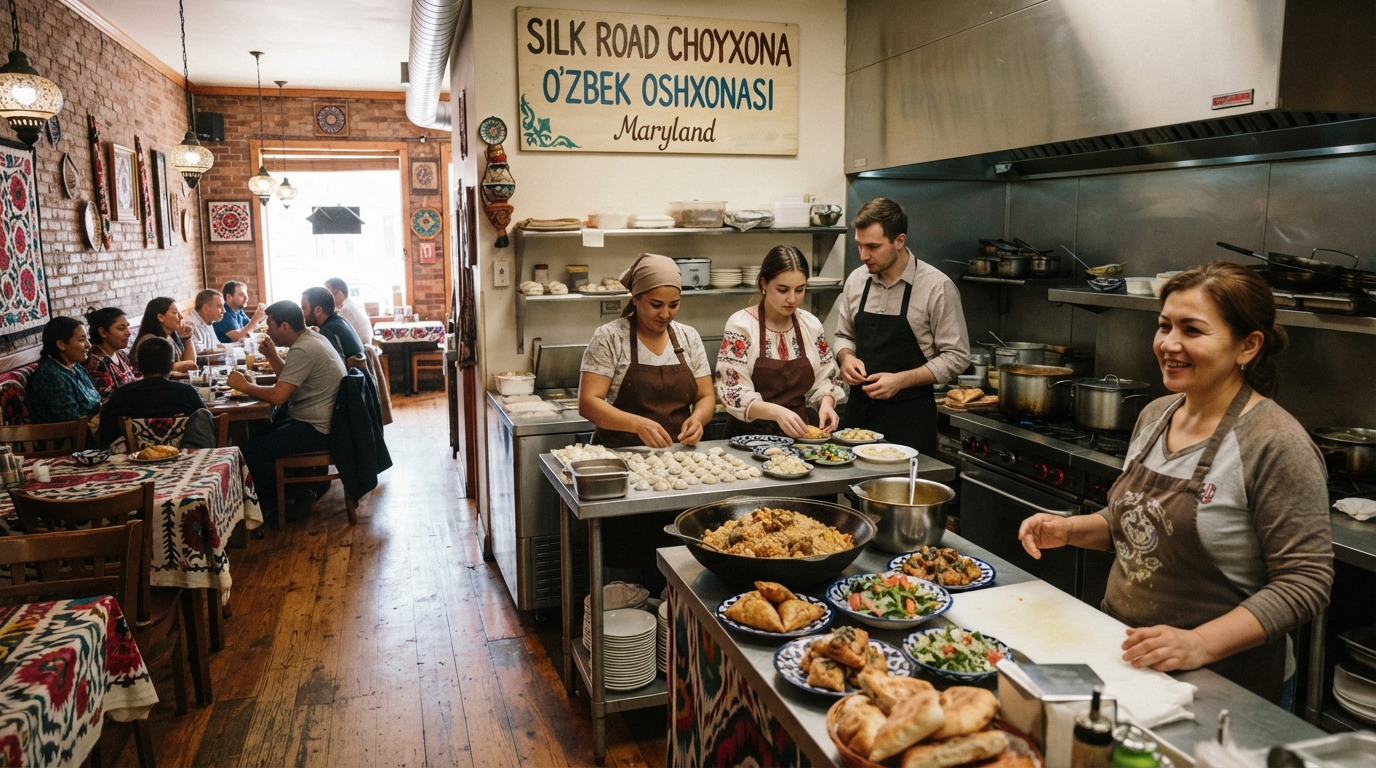
Aziza, from Samarkand, couldn't cook a single meal when she arrived in the United States 18 years ago. Today, she owns an Uzbek restaurant in Gaithersburg, Maryland. Customers from neighboring states come to Aziza's pilaf, salads, and desserts. So, what's so special about the teahouse? Kun.uz was in Maryland and spoke with an Uzbek entrepreneur at the teahouse.
Honduran dumplings maker, Ukrainian waiter, Russian manager – how does a teahouse in Maryland work?
Aziza from Samarkand couldn’t cook a single meal when she arrived in the US 18 years ago. Today, she owns an Uzbek restaurant in Gaithersburg, Maryland. Diners from neighboring states come to eat Aziza’s pilaf, salads, and desserts. So, what’s so special about the teahouse? Kun.uz was in Maryland and talked to an Uzbek entrepreneur at the teahouse.
Maryland is a state adjacent to Washington, D.C. The population is mostly Latin American and partly from the CIS. Aziza Amirkulova from Samarkand came to the US to study 18 years ago and has never been back home in the past few years. She is married and has children. However, her husband Azim died of a serious illness in 2019, leaving Aziza with the burden of the family. She continues to run the teahouse she opened with her husband as best she can. It has become my life, I am both a man and a woman, says our interviewee, referring to the kitchen chores.
The restaurant is named “Silk Road Teahouse”. We wanted to modestly call it a teahouse, not a restaurant or a cafe. Because the Great Silk Road is historically rich and covers a large area, and is familiar to many, says the Uzbek entrepreneur.
Aziza Amirkulova claims that she employs about 10 people. Among them are a Honduran woman who makes dumplings, Ukrainian and Russian waiters, an Uzbek chef and other workers. The owner says that to run this teahouse, at least 30-40 thousand US dollars are needed per month.
“Our dishwasher earns $100 a day, the woman who makes dumplings and samsa earns at least $720 a week, and our cook earns even more. I work at the market for $3,000-4,000 a week, my monthly rent is $6,500, and my utility bills are $2,500,” Amirkulova adds.
Aziza says that the success of her teahouse is in its halal and cleanness, and the taste of the food. Our food is like home, people remember their youth or their mothers and grandmothers. It is for this taste and feeling that people come from faraway states to eat, she says.
“For example, we cook samsa in the oven, we don’t have a tandoor. But those people also cooked and ate it in the oven at home, right? They remember their homes, their grandmothers, and their mothers. Even people who work at the World Bank in Washington order palovim,” the entrepreneur says.
Amirkulova notes that the teahouse hosts celebrations, banquets, and even weddings.
“Our Uzbek girl married a young man from Dushanbe. They came to us, all of them are young and have not much money. I prepared soup, shashlik, various salads and desserts for the wedding guests. They all enjoyed it, it was a very special experience for me,” says Aziza.
According to the entrepreneur, she would not trade the quality, taste, and honesty of her teahouse for anything. This will become her kitchen’s calling card.
Watch the full interview on Kun.uz’s YouTube page.